Why Hoh Rain Forest matters.
Hoh Rain Forest is an extraordinary temperate rainforest where Olympic Peninsula meets ancient glacial landscapes, towering conifer forests and one of North America's most extensive surviving ecosystems shaped by Pacific Ocean rainfall.
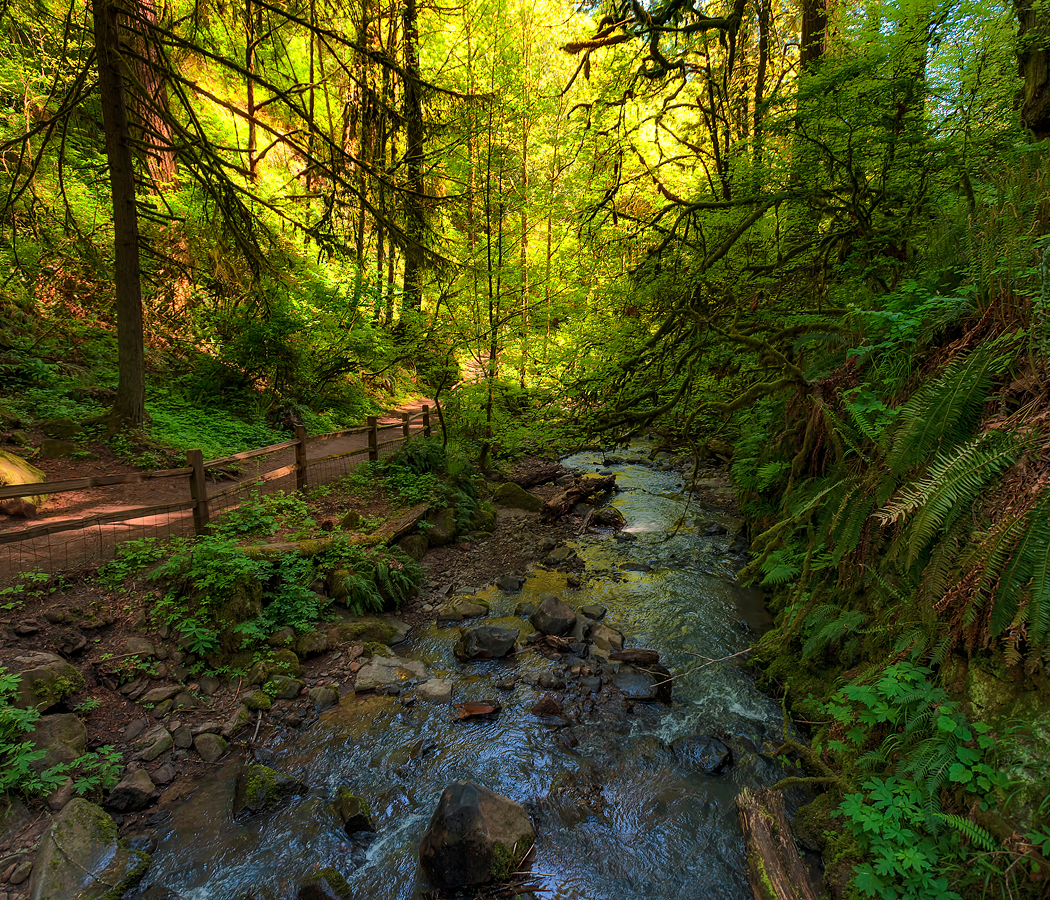
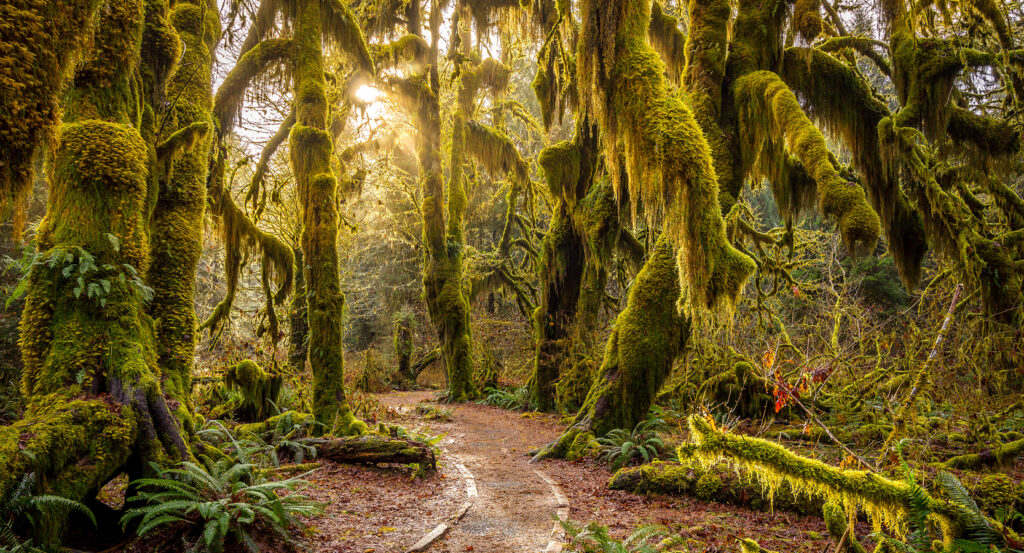
Set along the Upper Hoh Road near the Hoh River Trailhead and just steps from the Hoh Rain Forest Visitor Center, the forest occupies a broad glacial valley on the western slopes of the Olympic Mountains, deep within Olympic National Park and east of the Pacific coastline. Towering Sitka spruce and western hemlock form a dense canopy above immense fallen trunks, moss-covered branches and a luxuriant understory of ferns. The forest floor contains thick accumulations of decaying wood, nurse logs and vegetation thriving in the cool, moisture-rich environment. The Hoh River winds through the valley beneath steep mountain slopes, carrying sediment and glacial meltwater toward the Pacific Ocean. The result is an exceptionally preserved temperate rainforest whose immense trees, saturated vegetation and dramatic mountain geography establish one of the Pacific Northwest's most consequential natural landscapes.
What defines Hoh Rain Forest.
Hoh Rain Forest is best known for preserving one of the finest remaining examples of old-growth temperate rainforest in the United States, sustained by exceptional precipitation and the ecological conditions of the western Olympic Peninsula. The forest receives 140 inches of precipitation annually, with additional moisture supplied through coastal fog and atmospheric humidity. Moist air moving inland from the Pacific Ocean rises against the Olympic Mountains, cooling and releasing substantial rainfall through the process of orographic precipitation. This sustained moisture supports the development of enormous coniferous trees and unusually extensive communities of mosses, lichens and ferns. Sitka spruce and western hemlock define much of the forest, with Douglas fir, western red cedar and bigleaf maple contributing to its structural diversity. Individual spruce trees reach heights exceeding 250 feet, supported by the region's productive soils and long growing seasons. The forest's ecological development followed the retreat of glaciers that occupied the Olympic Peninsula during the last ice age. Glacial erosion shaped the valley's broad profile, and subsequent river processes deposited sediment across its floodplain. The Hoh River originates in glaciers on Mount Olympus, carrying cold water through a watershed extending toward the Pacific coast. Indigenous communities have maintained relationships with the river and surrounding forests for thousands of years, including the Hoh Tribe, whose ancestral territory encompasses the lower watershed. Federal protection expanded during the early twentieth century through the creation of Mount Olympus National Monument in 1909, initially established to protect Roosevelt elk and their habitat. Olympic National Park was established in 1938, bringing the rainforest and surrounding mountain ecosystems into a unified conservation landscape. UNESCO designated the park an International Biosphere Reserve in 1976 and a World Heritage Site in 1981, recognizing its ecological importance and extraordinary biological diversity. The forest's continued preservation protects a complex old-growth ecosystem whose structure developed across centuries of natural disturbance, regeneration and ecological succession.
The Hall of Mosses Trail provides one of the forest's most concentrated introductions to its distinctive ecological structure through a loop extending 0.8 miles. Its route passes beneath massive bigleaf maples whose branches support dense curtains of club moss and other epiphytic vegetation. These organisms absorb moisture and nutrients from the surrounding environment, establishing extensive plant communities above the forest floor. The trail's immense nurse logs demonstrate the regenerative importance of fallen trees, whose decaying wood provides elevated germination sites for young conifers. Seedlings developing along these trunks eventually form linear arrangements of mature trees, preserving the physical outline of the original fallen wood. The Spruce Nature Trail extends 1.2 miles through contrasting forest environments, including stands of mature conifers and sections of the river floodplain. Its route reveals differences between older forest communities and younger vegetation established following changes in river channels and sediment deposition. The Hoh River Trail introduces a substantially longer wilderness corridor, extending 17 miles toward Glacier Meadows beneath the slopes of Mount Olympus. Its early sections follow relatively gentle terrain through dense rainforest before the route advances into increasingly rugged mountain environments. The valley supports Roosevelt elk, whose substantial herds graze and browse within forest clearings and riparian habitats. Black bears, river otters, banana slugs and numerous bird species contribute to the ecosystem's biological diversity. Northern spotted owls inhabit mature forest environments containing large trees and complex canopy structures. The rainforest's soundscape includes flowing water, bird calls and the muted acoustics created by extensive vegetation. Seasonal changes alter the forest's appearance through shifting river levels, flowering understory plants and changing light beneath the canopy. Its ecological significance emerges through the interaction of abundant moisture, ancient trees, glacial geography and natural processes sustaining a remarkably productive forest environment.
How Hoh Rain Forest fits.
Hoh Rain Forest works as the natural anchor for an Olympic Peninsula outing connecting the Pacific coast's dramatic marine landscape, the cultural heritage of the region's Indigenous communities and the alpine ecosystems of the Olympic Mountains.
Begin at Ruby Beach, the dramatic stretch of Pacific coastline distinguished by towering sea stacks, driftwood-covered shores and extensive intertidal habitats. Located along the western boundary of Olympic National Park, the beach occupies a rugged section of shoreline shaped by powerful ocean waves and continuous coastal erosion. Offshore rock formations rise above the surf, providing nesting habitat for seabirds and contributing to the distinctive geological character of the coast. Large driftwood logs accumulate along the upper beach, transported by rivers and ocean currents before being deposited during storms. At low tide, exposed rocky areas reveal tide pools containing sea anemones, mussels, barnacles and other organisms adapted to changing marine conditions. Continue to Lake Quinault, the substantial glacial lake occupying a forested valley near the southwestern boundary of Olympic National Park. Its waters drain through the Quinault River system, connecting the surrounding mountain watershed with the Pacific Ocean. The Quinault Indian Nation maintains deep cultural and historical relationships with the lake and its surrounding territory. The historic Lake Quinault Lodge opened in 1926, introducing a major destination for travelers exploring the Olympic Peninsula. Architect Robert Reamer designed the lodge in a rustic style associated with early national park hospitality, incorporating timber construction and substantial communal spaces overlooking the water. Nearby forest trails provide access to enormous conifers and distinctive rainforest vegetation, including some of the region's most celebrated champion trees. Conclude at Hurricane Ridge, the elevated mountain destination overlooking the northern Olympic Range. Its principal viewpoint stands 5,242 feet above sea level, providing expansive views across glaciated peaks, alpine meadows and distant waterways. The surrounding landscape supports seasonal wildflower displays, subalpine vegetation and wildlife adapted to high-elevation conditions. Black-tailed deer graze within open meadows, and Olympic marmots occupy rocky slopes across the mountain environment. Winter snowfall transforms the ridge into a substantial snow-covered landscape, illustrating the dramatic climatic differences between the peninsula's coastal forests and alpine elevations. The progression moves from Ruby Beach's rugged marine environment through Lake Quinault's glacial watershed and cultural heritage and culminates at Hurricane Ridge's expansive alpine landscape, connecting three distinct ecosystems within the Olympic Peninsula.
Where your story begins.
Foresyte Travel reveals places that feel extraordinary long before you arrive.
Enjoy editorial crafted for luxury travelers.
Foresyte may earn a commission when you book.