
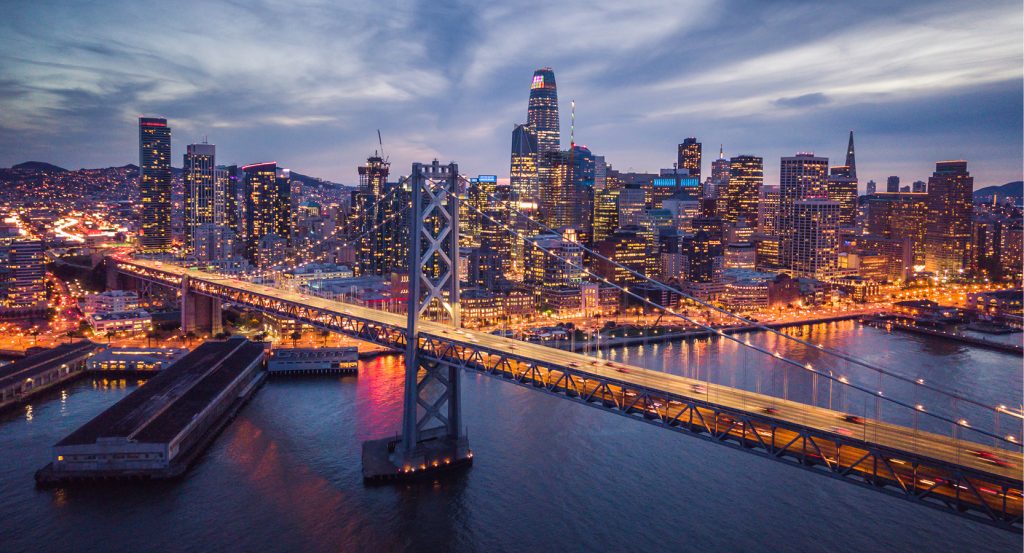
Why Holiday Inn San Francisco Golden Gateway matters.
Holiday Inn San Francisco Golden Gateway is a commanding hotel where Polk Gulch's commercial character meets 1970s high-rise architecture, expansive city views and a longstanding Holiday Inn presence along San Francisco's Van Ness Avenue corridor.
Set along Van Ness Avenue near Pine Street and just steps from the California Street cable car tracks, the hotel occupies a prominent corner between Polk Gulch's dense commercial blocks, the eastern edge of Japantown and the steep terrain rising toward Nob Hill. The 26-story tower rises from a broad podium with a narrow rectangular profile, repetitive window grid and emphatic vertical scale characteristic of large urban hotels developed during the early 1970s. Upper floors look across an unusually broad field of San Francisco, with sightlines extending over downtown towers, the northern waterfront, residential hills and the Bay from a position above most surrounding buildings. Renovation has progressively updated the interiors inside the original high-rise envelope, preserving the tower's fundamental relationship with the skyline more than five decades after construction. The result is a hotel whose height, 1970s form and position where several Central San Francisco districts converge give the property a distinctive physical role along the Van Ness corridor.
What defines Holiday Inn San Francisco Golden Gateway.
Holiday Inn San Francisco Golden Gateway is best known for occupying a 1972 high-rise whose scale translated Holiday Inn's postwar expansion model into one of San Francisco's most prominent central-city hotel towers. The building emerged during a period when Van Ness Avenue was accommodating increasingly large commercial structures alongside its older automobile businesses, apartment houses and institutional buildings. Its 26 stories established an unusually tall lodging presence on the corridor, giving the hotel a vertical profile distinct from the lower structures extending through Polk Gulch. Holiday Inn had entered the 1970s as one of the most recognizable products of the American motel revolution begun by Kemmons Wilson two decades earlier, and the Golden Gateway brought that standardized national lodging culture into a dense urban setting. The San Francisco property belonged to a broader evolution in which a brand born around highway travel increasingly occupied substantial downtown buildings. The tower's concrete-and-glass construction placed its architectural emphasis on height, repetitive geometry and panoramic exposure across the city. A 2013 renovation introduced another significant physical chapter more than four decades after construction, updating the property inside the established tower. Subsequent interior work continued that pattern of reinvestment as the building passed its half-century mark. The 1500 Van Ness Avenue address has preserved the same fundamental hotel use since 1972, giving the property unusual continuity within a corridor repeatedly altered by redevelopment and changing transportation patterns.
How Holiday Inn San Francisco Golden Gateway fits.
Holiday Inn San Francisco Golden Gateway works as the anchor for an outing connecting experimental spatial composition, a post-earthquake entertainment hall repeatedly reinvented across the twentieth century and a major civic collection that transformed San Francisco's former central library into an institution for Asian art.
Begin at Audium, whose origins reach to Stan Shaff and Doug McEachern's late-1950s experiments treating the movement of sound through physical space as a compositional element. Their collaborations progressed through performances with Anna Halprin's Dancers' Workshop, San Francisco State College and the San Francisco Museum of Art before the first dedicated Audium theater opened in 1967 with 44 speakers. Shaff and McEachern subsequently designed the permanent Bush Street theater around a custom electronic system, opening it publicly in 1975 with 136 speakers distributed through an environment conceived specifically for spatial composition; later technical development increased that system to 176 speakers. Continue to Great American Music Hall, opened in 1907 as Blanco's during San Francisco's reconstruction after the earthquake and fire, with an ornate interior of balconies, columns, mirrors and ceiling decoration establishing an elaborate setting for dining and entertainment. Sally Rand acquired the property in 1936 and renamed it the Music Box before another incarnation brought jazz back to the building after World War II. Tom Bradshaw rescued the deteriorating hall in 1972, restored the interior and established the Great American Music Hall identity, which subsequently brought performers including Sarah Vaughan, Dizzy Gillespie, Bill Evans and Jerry Garcia into the revived room. Conclude at Asian Art Museum, whose institutional history began after Avery Brundage offered San Francisco a collection that eventually numbered 8,000 works and led to the museum's 1966 debut in Golden Gate Park. A later Civic Center campaign moved the collection into George Kelham's 1917 Beaux-Arts former Main Library, with Chong-Moon Lee contributing $15 million toward the project and Gae Aulenti directing the architectural conversion. The museum reopened there in 2003 after seismic work adapted the historic structure for the collection, and a later $90 million expansion added the Akiko Yamazaki and Jerry Yang Pavilion through a design by wHY. The progression moves from a purpose-built laboratory for spatial sound through an entertainment hall repeatedly transformed by San Francisco performance culture and culminates in a former civic library whose architectural reinvention created a major institutional home for Asian art.
Where your story begins.
Foresyte Travel reveals places that feel extraordinary long before you arrive.
Enjoy editorial crafted for luxury travelers.








































































































