Why Hotel Abri matters.
Hotel Abri is a resilient hotel where Union Square's downtown intensity meets a post-earthquake building reinvented through seismic engineering, contemporary design and the cultural legacy of the Monticello Inn that preceded it.
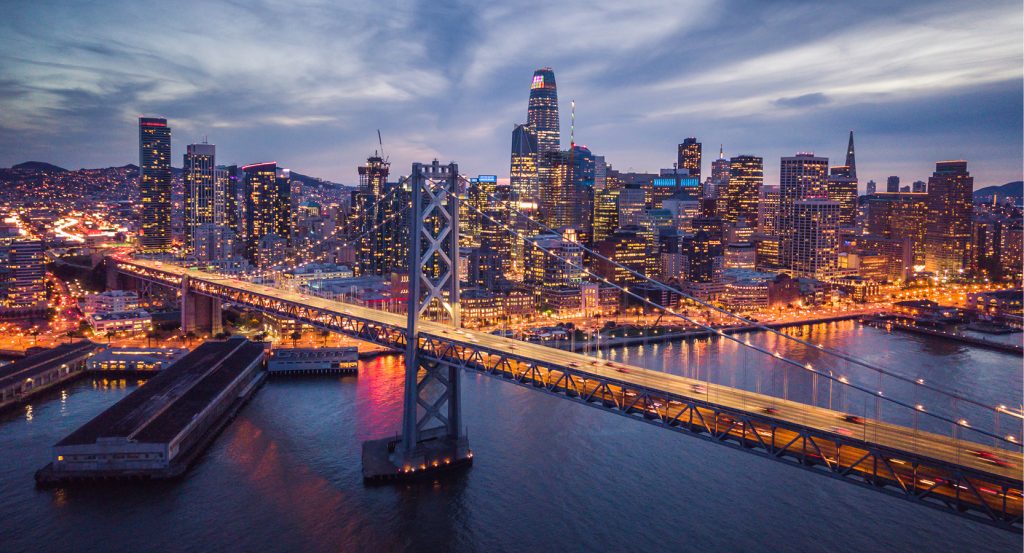
Set along Ellis Street near Cyril Magnin Street and just steps from the Powell Street cable-car turnaround, the hotel occupies Union Square's southern threshold between Market Street's transit spine, the theater blocks extending northwest along Geary Street and SoMa's commercial buildings beginning immediately south. The five-story structure maintains the compact scale and repetitive window pattern characteristic of downtown buildings erected during San Francisco's reconstruction era. Earth-toned interiors, contemporary furnishings and a fireplace-centered lobby create a warmer composition behind the restrained street facade. The narrow footprint extends deep into the block, producing an intimate interior arrangement amid one of Downtown's densest pedestrian and transit environments. The result is a hotel whose compact historic shell and contemporary interior preserve a direct architectural connection between post-1906 reconstruction and the modern Union Square district.
What defines Hotel Abri.
Hotel Abri is best known for Larkspur Hospitality's comprehensive transformation of the former Monticello Inn, pairing a demanding structural retrofit with an $11.4 million reinvention that repositioned a century-old downtown building as a contemporary independent hotel. The underlying structure dates to the reconstruction period immediately following the 1906 earthquake and fire and had survived the 1989 Loma Prieta earthquake before Larkspur acquired the Monticello in December 2006. Larkspur identified structural reinforcement as an immediate priority and commissioned GGLO Architects with Nibbi Brothers General Contractors for the project. Nibbi inserted shotcrete, shear walls, perimeter angle-iron ties, soil anchors and large concrete footings into the existing structure. Conflicts between the original building and the new structural system required electrical infrastructure to pass through a concrete beam to preserve interior headroom. Crews performed portions of that electrical work overnight to protect the operations of businesses occupying the lower level. The five-month construction campaign kept the building and its existing commercial tenants operating and reached completion two months ahead of the structural schedule. Nibbi's construction contract totaled $3.6 million, forming the engineering core of Larkspur's broader $11.4 million redevelopment. The interior campaign reconfigured the hotel, rebuilt the lobby and changed building systems across public and private areas. Hotel Abri emerged from the project in 2008 with a name derived from the French word for shelter, marking a deliberate departure from the Monticello identity. MetWest Terra Hospitality acquired the property through an affiliate in January 2012 and assumed management, making Abri its first Downtown address. The transaction placed the independently branded property within a Bay Area portfolio that also included Casa Madrona Hotel and Spa, Lodge at Tiburon and Toll House Hotel.
Thomas Jefferson supplied the organizing reference for the Monticello Inn chapter that preceded Abri, giving the same building an unusually literary and historically themed character before its contemporary conversion. Monticello, Jefferson's Virginia residence, inspired the earlier interior concept through Colonial references associated with the third president's domestic world. A dedicated library translated Jefferson's devotion to books into one of the hotel's principal communal rooms. Classic literary works filled the collection, and a fireplace made the library a gathering place within the small property. Art exhibitions and literary salons subsequently became associated with the Monticello, extending the Jefferson reference into recurring cultural activity. Wild Writing Women used the property for literary salon gatherings during the final years of the Monticello chapter. The former library survived conceptually through its conversion into Hotel Abri's City Room, preserving the location of that earlier communal setting after the surrounding decorative scheme disappeared. Oversized frosted sliding-glass doors, a corner lounge and wet bar define the later room within the redesigned ground floor. Puccini & Pinetti supplied another long-running connection with the building through a restaurant founded by Kimpton in 1995 and named for executives Bob Puccini and Steve Pinetti. Michael Bauer traced the restaurant's origin to Kimpton's replacement of John Sedlar's Abiquiu, itself the successor to Corona Bar and Grill at the same Ellis Street corner. Puccini & Pinetti continued through the Monticello-to-Abri transition, carrying a restaurant character created more than a decade before the hotel's 2008 reinvention into its subsequent chapter. The sequence of Jefferson-inspired library, literary salons and longstanding restaurant history gives the building a cultural record substantially deeper than the minimalist contemporary character visible after Larkspur's redevelopment.
How Hotel Abri fits.
Hotel Abri works as an anchor for an outing connecting a surviving theater from the city's post-earthquake reconstruction with an international art institution on Market Street and North America's only museum devoted specifically to bookbinding.
Begin at Toni Rembe Theater, which debuted as the Columbia Theatre on January 10, 1910 under proprietors Jake Gottlob and Melville Marx. Walter D. Bliss and William B. Faville designed the building after members of their firm studied European theater architecture, producing a Classical Revival composition enriched with polychrome terra cotta by Gladding, McBean & Co. American Conservatory Theater established its principal San Francisco home there during the late 1960s. National Register listing followed in 1975 and San Francisco designation in 1976, preserving a major theater from the reconstruction period that followed the 1906 disaster. Continue to International Art Museum of America, established in 2010 as an institution dedicated to international art appreciation and education. Its permanent galleries and exhibition halls extend across more than 25,000 square feet on Market Street. Several hundred works span artists from 12 countries across Europe, America and Asia, with dates extending from the sixteenth century into contemporary practice. An indoor garden grotto and waterfall create a distinctive architectural environment among the galleries and provide a spatial counterpoint to the museum's international collection. Conclude at American Bookbinders Museum, founded in 2009 by Bay Area bookbinder Tim James and relocated to the South of Market district in 2015. The institution is the only museum of its kind in North America and concentrates on the history, tools and labor of bookbinding. Hand tools from the seventeenth century trace production before mechanization, and nineteenth-century machines demonstrate the industrial changes that transformed book manufacture. Equipment, finished books and trade ephemera connect technical innovation with the binders whose specialized work turned printed sheets into durable objects. The progression moves from Toni Rembe Theater's preservation of post-earthquake performance architecture through International Art Museum of America's international visual-art collection and culminates in American Bookbinders Museum's preservation of the tools and machinery that transformed the physical production of books.
Where your story begins.
Foresyte Travel reveals places that feel extraordinary long before you arrive.
Enjoy editorial crafted for luxury travelers.
Foresyte may earn a commission when you book.