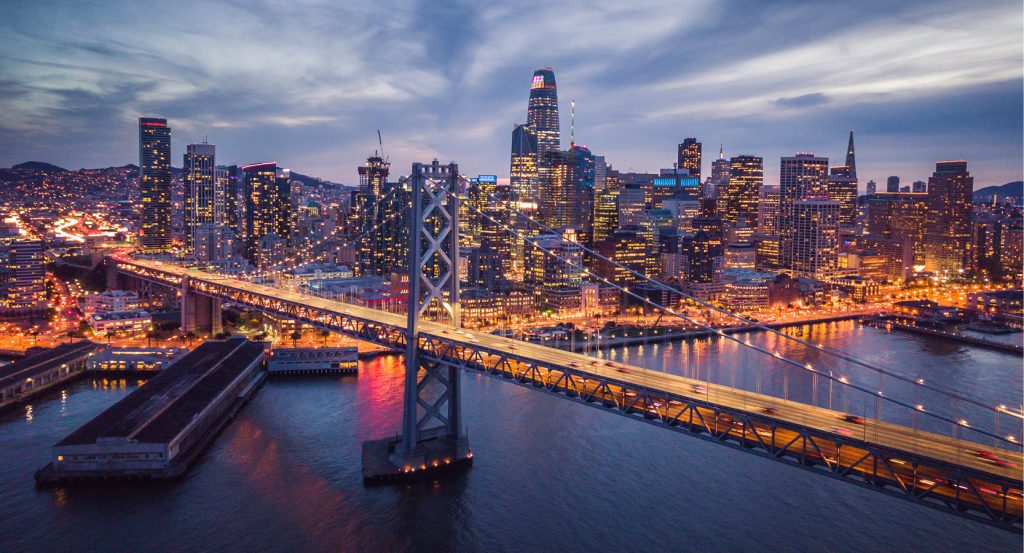
Why you should experience Hotel Adagio in San Francisco, California.
Hotel Adagio is a self-possessed heritage hotel where Union Square's theatrical energy, Jazz Age ambition, Spanish Colonial Revival character and tradition of independent hospitality converge within a tower conceived at the close of the 1920s.
Set along Geary Street near Jones Street and just steps from American Conservatory Theater, the property began in 1929 as El Cortez, commissioned by hotelier Mortimer A. Samuel and designed by architect Douglas D. Stone as a 15-story expression of Spanish Colonial Revival architecture. Samuel conceived the hotel as an elevated urban residence and maintained his own apartment within the building, where surviving 1920s woodwork, 14-foot ceilings and a grand fireplace preserve an unusually personal connection between proprietor and property. The upper floors retain spaces named The William Street, Cottage Place, Maggie Alley and The Samuel Suite within Samuel's former residential domain, while Stone's architectural style continues through the building's Moorish-inflected windows and period detailing. Mortimer A. Samuel and Douglas D. Stone gave Hotel Adagio a foundational character rooted in private authorship, architectural conviction and the metropolitan confidence of San Francisco immediately before the Great Depression.
What you should know about Hotel Adagio.
Hotel Adagio is best known for undergoing a major ownership and creative repositioning between 2011 and 2012, beginning when Chesapeake Lodging Trust acquired the 171-room property for $42.25 million and subsequently carried out a multimillion-dollar reconstruction before placing the hotel within Marriott International's Autograph Collection. The project transformed all 171 guestrooms, penthouse suites and public spaces, expanded the meeting and event program and introduced a newly conceived restaurant and lobby bar, while Precision Hotel Interiors participated in the guestroom, corridor and lobby reconstruction. Parker-Torres developed the redesigned bar environment by opening the former enclosed entry area, exposing 16-foot Moorish windows and creating a geometric LED-lit backbar within a 40-seat room organized around a 12-seat bar. The resulting Mortimer debuted in August 2012 as part of the larger repositioning, while the Autograph Collection affiliation connected the independently conceived property with Marriott's collection of individually branded hotels. Chesapeake Lodging Trust's acquisition, the $42.25 million transaction, 171-room reconstruction, Precision Hotel Interiors work, Parker-Torres design, 16-foot windows, 40-seat composition, 12-seat bar and Autograph Collection conversion collectively marked the most consequential modern reinvention of Hotel Adagio.
An earlier creative chapter began in June 2003 when San Francisco-based Joie de Vivre Hospitality converted the former Shannon Court Hotel into Hotel Adagio, establishing the name and boutique character that survived the subsequent Chesapeake and Marriott eras. Designer Colum McCarten developed Joie de Vivre's new interiors, while baker and restaurateur Pascal Rigo created Cortez as the property's destination restaurant and gave the reborn Hotel Adagio a culinary character connected to one of San Francisco's prominent hospitality entrepreneurs. Cortez later yielded to Bar Adagio before the 2012 reconstruction divided the former restaurant territory between Mortimer and a separate dining concept called The Green Room, preserving food and drink as a recurring vehicle for successive reinventions of the property. Joie de Vivre Hospitality, Colum McCarten, Pascal Rigo, Cortez and Shannon Court consequently form an interconnected prehistory to the Chesapeake-era reconstruction, revealing Hotel Adagio's present character as the product of multiple deliberately authored hospitality chapters.
How to fold Hotel Adagio into your trip.
Hotel Adagio works as the anchor for an afternoon tracing theatrical architecture, immigrant cultural expression and literary rebellion through the neighborhoods surrounding Union Square.
Begin at Curran Theatre, where producer Homer Curran commissioned architect Alfred Henry Jacobs to create the Geary Street theater that opened in 1922, establishing a performance house whose history later encompassed major touring productions, pre-Broadway engagements and generations of San Francisco theatergoing. Continue to Contemporary Jewish Museum, where the institution founded in 1984 eventually occupied the former Jessie Street Pacific Gas & Electric substation, with architect Daniel Libeskind inserting a faceted contemporary structure into the surviving 1907 Willis Polk building when the museum opened there in 2008. Conclude at City Lights Booksellers & Publishers, founded in 1953 by Lawrence Ferlinghetti and Peter D. Martin before Ferlinghetti published Allen Ginsberg's Howl and Other Poems in 1956, precipitating the obscenity prosecution that became a defining American confrontation over literary freedom. The progression moves from Curran and Jacobs's theatrical San Francisco through Libeskind and Polk's architectural discussion into Ferlinghetti and Ginsberg's publishing rebellion, framing Hotel Adagio within a city whose creative institutions repeatedly turned individual authorship into cultural identity.
Where your story begins.
Foresyte Travel reveals places that feel extraordinary long before you arrive.
Experience premium editorial crafted for luxury travelers.