
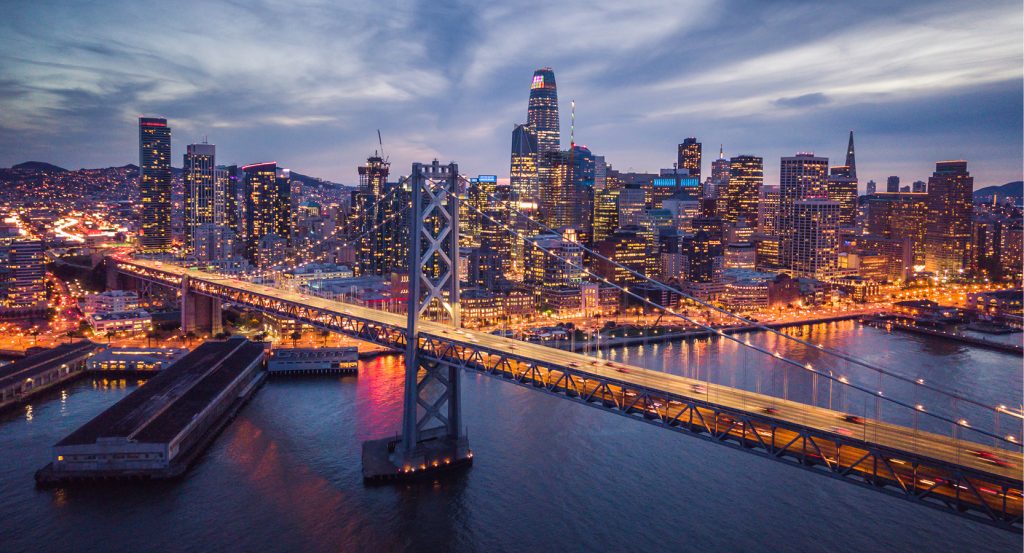
Why Hotel Nikko San Francisco matters.
Hotel Nikko San Francisco is a distinctive hotel where Union Square's cosmopolitan character meets Japanese hospitality heritage, late twentieth-century international development and a cultural character sustained through nearly four decades in San Francisco.
Set along Mason Street near O'Farrell Street and just steps from the Powell Street transit corridor, the hotel occupies Union Square's southwestern edge where historic commercial buildings give way to the denser architecture of the Theater District and Market Street. The high-rise structure rises from a broad podium through a vertically articulated tower whose setbacks and gridded façade distinguish its silhouette from the lower masonry buildings surrounding Mason Street. Marble, glass and carefully controlled interior sightlines carry the building's Japanese design lineage through spaces extensively reconstructed during its thirtieth-anniversary transformation. A luminous ceiling installation derived from the geometry of a kimono became a defining element of the renewed lobby, joined by paintings from Japanese American artist Reiko Muranaga. The result is a hotel whose tower, Japanese architectural lineage and later artistic interventions give an internationally developed property a recognizable character within Central San Francisco.
What defines Hotel Nikko San Francisco.
Hotel Nikko San Francisco is best known for becoming Takenaka Corporation's first American development project, translating the Japanese company's integrated approach to development, architecture and construction into a major Union Square hotel. Takenaka acquired the Mason Street site and carried the project from planning through design and construction, creating a 570,164-square-foot tower as the company established a development presence in the United States. Japan Airlines Development Company joined Takenaka in the enterprise, connecting the San Francisco project with Nikko Hotels International and the global hospitality expansion developed by Japan Airlines. Approximately $220 million went into the hotel before its 1987 debut, making the project an unusually substantial Japanese investment in San Francisco during the decade. The October opening placed Nikko Hotels within one of the city's principal hotel districts and established a property that preserved its original brand through subsequent changes surrounding its Japanese operator. Japan Airlines retained the Nikko hotel business through JAL Hotels until 2010, when Hotel Okura acquired 79.6 percent of JAL Hotels and brought the Nikko Hotels International brand under one of Japan's other major hospitality companies. Hotel Nikko San Francisco entered the Okura organization without surrendering the Nikko character established on Mason Street in 1987. JAL Hotels and Hotel Okura consolidated their hotel-management operations in 2015 as Okura Nikko Hotel Management, placing the San Francisco property inside a combined system encompassing Okura Hotels & Resorts, Nikko Hotels International and Hotel JAL City. The building entered its largest physical reinvestment two years later through a $60 million transformation directed by Hirsch Bedner Associates. Hotel Nikko closed for three months as the 2017 project reconstructed major interior areas, strengthened the building seismically and modernized technology and infrastructure across the property. The reopening during the hotel's thirtieth-anniversary year connected Takenaka's original American development with a new architectural chapter conceived around the property's Japanese heritage.
Michael Feinstein gave Hotel Nikko a distinct cultural chapter in 2013 when the singer, pianist and American Songbook preservationist attached his name to the intimate performance room inside the Mason Street property. The venue had previously operated as the Rrazz Room, created after Robert Kotonly and Rory Paull converted a hotel meeting room into a dedicated nightclub at a cost approaching $1 million. Feinstein's at the Nikko formally arrived in April 2013, linking the hotel with an artist whose six-year apprenticeship cataloging Ira Gershwin's music had become foundational to his career as an interpreter and preservationist of American popular song. Sutton Foster inaugurated the public performance schedule in May with a sold-out engagement, bringing a two-time Tony Award winner into the new 140-seat room during its opening week. Feinstein's partnership widened the stage beyond his own repertoire through appearances by Broadway performers, jazz musicians, comedians and other touring artists. The club simultaneously preserved the intimate dimensions inherited from the Rrazz Room, keeping performers physically close to an audience measured in hundreds. Hotel Nikko thereby acquired a cultural function unusual among Union Square hotels, supporting a permanent performance room within the property rather than relying solely on temporary ballroom programming. Feinstein's at the Nikko has carried that relationship across more than a decade, embedding live performance and the American Songbook within a hotel otherwise defined by Japanese ownership, design and hospitality traditions.
How Hotel Nikko San Francisco fits.
Hotel Nikko San Francisco works as the anchor for an outing connecting a 1920s theater shaped by San Francisco's Broadway history, a Methodist institution transformed into a nationally consequential center of social activism and a major Asian art collection housed inside a reconstructed Beaux-Arts civic building.
Begin at Curran Theatre, the $800,000 house producer Homer Curran commissioned from architect Alfred Henry Jacobs after operating an earlier theater bearing his name. The 1,667-seat venue opened on September 10, 1922 under Shubert booking and developed into one of San Francisco's enduring stages for touring theatrical productions. Lenny Bruce recorded a full-length performance there in 1960, adding a landmark of American stand-up to its theatrical history. Carole Shorenstein Hays later directed an extensive restoration that preserved the 1922 proscenium carvings, wall sconces and decorative work, with Phoenix Day spending 2,500 hours restoring a 1,300-pound Australian-crystal chandelier containing 224 lights. Continue to Glide Memorial Church, established through Methodist philanthropist Lizzie Glide's evangelistic project and housed in a complex designed by Berkeley architect James W. Plachek. Cecil Williams joined Glide during the 1960s and redirected the declining congregation toward racial justice, poverty relief and inclusion of San Francisco's LGBTQ community. The church became headquarters for the Council on Religion and the Homosexual in 1965 and supported Vanguard, among the country's earliest gay liberation organizations. Williams and poet Janice Mirikitani subsequently expanded Glide's social activism across hunger, addiction, racial justice and political organizing. National Register recognition in 2022 preserved the building's association with Black, Asian American and LGBTQ history. Conclude at Asian Art Museum, founded after collector Avery Brundage pledged thousands of works to San Francisco and voters approved $2.75 million for a dedicated wing at the de Young Museum. That first home opened in 1966, and Brundage's subsequent gifts ultimately placed more than 7,700 objects into the city's collection. Expansion carried the institution to the former Main Library in Civic Center, a 1917 Beaux-Arts building by George Kelham. Italian architect Gae Aulenti directed its conversion, pairing preservation with seismic intervention before the museum reopened there in 2003 as the Chong-Moon Lee Center for Asian Art & Culture, named for the entrepreneur whose $15 million gift advanced the relocation. The progression moves from a surviving theater shaped by twentieth-century performance through an institution that recast religious space around civil rights and concludes with a civic building transformed to house one of San Francisco's major cultural collections.
Where your story begins.
Foresyte Travel reveals places that feel extraordinary long before you arrive.
Enjoy editorial crafted for luxury travelers.
Foresyte may earn a commission when you book.








































































































