Why Hotel VIA matters.
Hotel VIA is a progressive hotel where South Beach's waterfront reinvention meets independent San Francisco hospitality through David O'Keeffe's ground-up development, technology-centered operations and a rooftop conceived around the neighborhood's extraordinary relationship with the bay and downtown skyline.
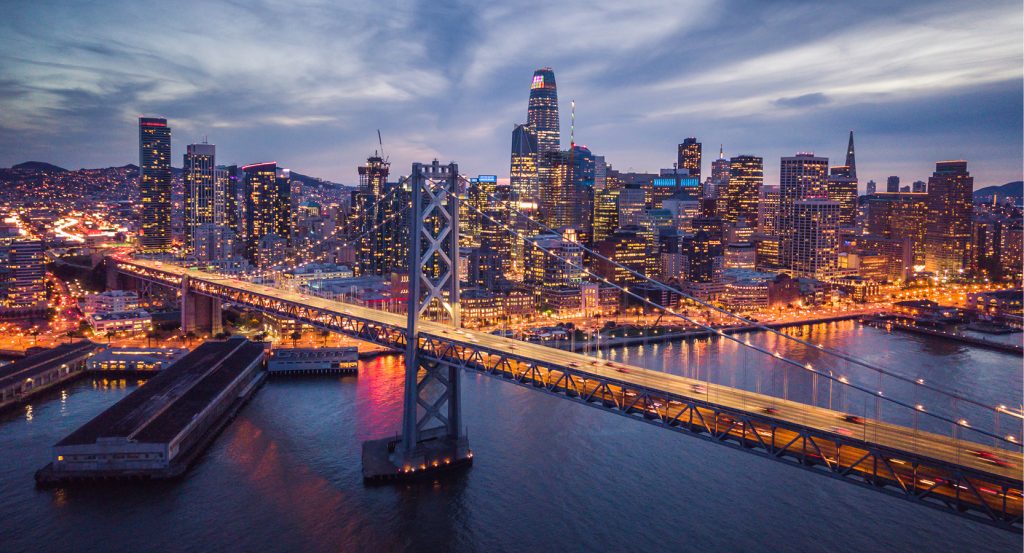
Set along King Street near 3rd Street and just steps from Oracle Park, the hotel occupies Central South Beach between China Basin's waterfront, the Embarcadero corridor extending north toward the Ferry Building and the former warehouse blocks reaching west toward South Park and the Caltrain terminal. The 12-story building uses glass, brick-toned surfaces and clean vertical lines to establish a contemporary counterpart to the masonry warehouses that shaped the surrounding district. Minimalist interiors draw from South Beach loft architecture through custom furniture, restrained finishes and large windows oriented toward the neighborhood's urban geometry. The rooftop extends the building vertically into an indoor-outdoor social setting with broad perspectives across the Bay Bridge, East Bay, downtown skyline and South Beach Harbor. The result is a hotel whose contemporary architecture, technological infrastructure and elevated public spaces translate South Beach's redevelopment into an independent hospitality concept closely tied to its waterfront setting.
What defines Hotel VIA.
Hotel VIA is best known for David O'Keeffe's decision to build the first ground-up San Francisco hotel since 2008, using an independently owned property to interpret the transformation of South Beach from a warehouse and maritime district into a center of sports, technology and waterfront development. O'Keeffe Development advanced the King Street project on a parcel directly opposite the San Francisco Giants' ballpark, giving the developer an unusually visible position within a neighborhood where he had already pursued real-estate projects. O'Keeffe was the developer during construction and took on the project as a 12-story boutique hotel with a roof garden and bar. Hotel VIA became the first newly built hotel in South Beach since 2005, ending a twelve-year interval in neighborhood hotel construction. The property entered operation in June 2017 as San Francisco emerged from a nine-year citywide drought in new full-service hotel construction. Its name derives from the Latin-rooted word “via,” meaning a way or route to a destination, connecting the brand directly with the property's position among Caltrain, Muni, the Embarcadero and regional transportation links. Independent ownership allowed the development team to build technology into the hotel from inception instead of adapting systems inherited from an established chain. Comcast Business installed high-capacity Ethernet, internet, Wi-Fi and advanced voice infrastructure supporting a mobile concierge application, smartphone room access and personal seven-inch tablets. The mobile concierge gave the property a digital service layer tied to local planning and hotel requests, extending the technological concept beyond basic connectivity. Personal tablets placed another control point inside private interiors for hotel services, promotions and entertainment. Environmental measures developed alongside that technology through rainwater capture, low-flow plumbing and an extensive recycling program. David and Gerard O'Keeffe subsequently pursued an entertainment permit for COGAC Group LLC covering occasional performances inside Bar VIA and rooftop events including weddings, corporate functions and DJ programs. Hotel VIA emerged as an independently developed South Beach property whose significance lies in combining ground-up hotel construction, local ownership, digital infrastructure and a neighborhood-specific social program during a pivotal period of waterfront redevelopment.
How Hotel VIA fits.
Hotel VIA works as an anchor for an outing connecting South Beach's nineteenth-century residential experiment, Dogpatch's contemporary craft institution and the industrial shipyard that made San Francisco's southeastern waterfront a nationally consequential center of manufacturing.
Begin at South Park, the oldest public park in San Francisco and the center of an ambitious residential development assembled by British-born entrepreneur George Gordon during the 1850s. Gordon modeled the oval enclave on London squares, surrounding a private green with houses reached by some of San Francisco's earliest paved streets and sidewalks. The district later shifted dramatically as warehouses and industry replaced much of its original residential character, and Japanese American businesses developed around South Park during the late nineteenth and early twentieth centuries. San Francisco eventually assumed control of the green as a public park, preserving the oval plan through successive neighborhood changes. Fletcher Studio Landscape Architecture directed a major renewal completed in 2017, reorganizing paths, planting and gathering areas around the historic form. Continue to Museum of Craft and Design, founded in 2004 as the San Francisco Museum of Craft+Design and dedicated specifically to contemporary craft and design. The institution initially operated on Sutter Street before developing a series of temporary locations after 2010. A move to Dogpatch brought the museum into the American Industrial Center in 2013 and created its first dedicated public-programming area. Its non-collecting model centers rotating collaborations with artists, designers, universities and other cultural institutions, placing creative process above a permanent collection. More than half a million people had entered its exhibitions and programs by its fifteenth anniversary in 2019. Conclude at Pier 70, where the Union Iron Works established shipbuilding operations at Potrero Point in 1884 and developed one of the West Coast's most consequential industrial complexes. Bethlehem Steel acquired Union Iron Works in 1905 and expanded the shipyard across successive national war efforts. The yard built 66 destroyers and 18 submarines between 1917 and 1924, then constructed 72 vessels and repaired more than 2,500 during the World War II period. Industrial work at the site also contributed to the Golden Gate Bridge and later produced sections of the BART Transbay Tube. The Union Iron Works Historic District entered the National Register of Historic Places in 2014, recognizing 44 contributing resources and an industrial landscape extending across the former shipyard. The progression moves from South Park's transformation from private London-inspired enclave into public urban space through Museum of Craft and Design's contemporary focus on making and culminates in Pier 70's extraordinary record of shipbuilding, engineering and industrial production along San Francisco Bay.
Where your story begins.
Foresyte Travel reveals places that feel extraordinary long before you arrive.
Enjoy editorial crafted for luxury travelers.