Why Hyatt Regency San Francisco Downtown SOMA matters.
Hyatt Regency San Francisco Downtown SOMA is an art-driven hotel where SoMa's museum district meets a four-decade hospitality lineage through a 1983 Yerba Buena redevelopment tower reimagined by BHDM Design around locally commissioned art and contemporary San Francisco design.
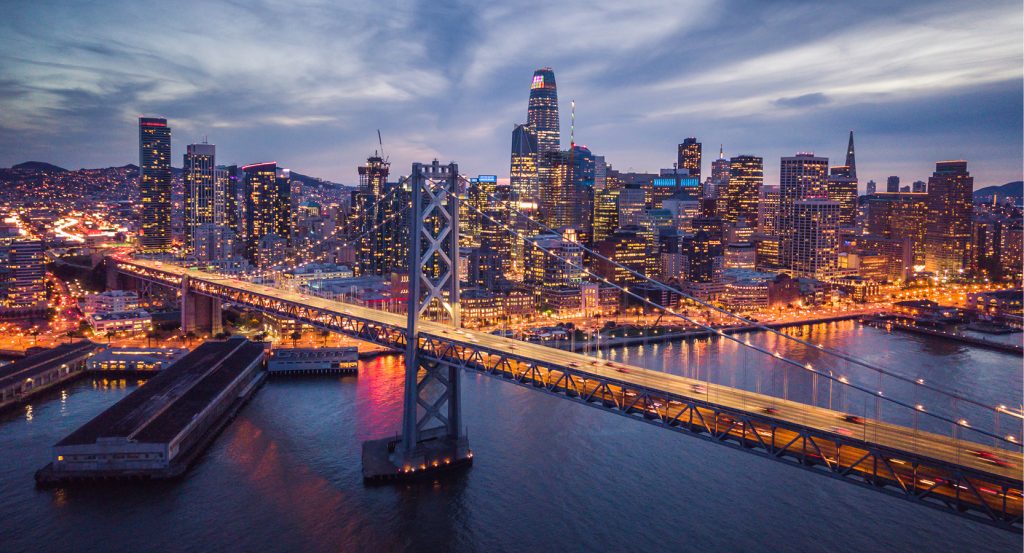
Set along 3rd Street near Market Street and just steps from Yerba Buena Gardens, the hotel occupies northern SoMa between the museum corridor extending south toward Howard Street, the Moscone Center convention precinct and the downtown blocks reaching north toward Union Square and Montgomery Street. The 36-story tower rises as a slender vertical slab above a broader street-level base, preserving the scale and massing of the original early-1980s development. Floor-to-ceiling glazing across upper levels opens long perspectives toward downtown, the bay and the surrounding museum district. BHDM Design reshaped the lower interiors through fluted wood, stone, woven surfaces and commissioned artwork, giving the large tower a more tactile relationship with its arts-focused surroundings. The result is a hotel whose high-rise form and art-centered public interiors connect an early chapter of Yerba Buena redevelopment with the cultural institutions that subsequently transformed SoMa.
What defines Hyatt Regency San Francisco Downtown SOMA.
Hyatt Regency San Francisco Downtown SOMA is best known for carrying one of Yerba Buena's formative hotel towers through successive international brands and ownership eras before Highgate and Hyatt undertook a $70 million reinvention centered on art, sustainability and the surrounding SoMa cultural district. Arcon/Pacific developed the tower with Hornberger + Worstell as architect during the San Francisco Redevelopment Agency's effort to transform Yerba Buena into a new downtown district. The property began as Hotel Meridien San Francisco under the Air France-affiliated Meridien organization, becoming the first private project completed within the agency's Yerba Buena development program. ANA Hotels acquired the property for $100 million in 1988 and renamed it ANA Hotel San Francisco, bringing the tower into the Japanese airline company's international hospitality network. Lowe Enterprises acquired the San Francisco property together with ANA's Washington hotel for $270 million in 1998, with Destination Hotels assuming management and introducing the Argent Hotel name. Highgate Holdings and Whitehall Street Global Real Estate Partnership acquired the building in 2005 and followed with a $28.3 million renovation that produced The Westin San Francisco Market Street in 2007. LaSalle Hotel Properties paid $350 million for the property in January 2015, removed the Westin affiliation and established Park Central San Francisco under Highgate management. Highgate later reacquired the building for $315.2 million following Pebblebrook Hotel Trust's acquisition of LaSalle Hotel Properties in 2018. A Hyatt affiliate entered a franchise agreement with 50 Third Street Owner LP in December 2020, beginning the building's conversion from Park Central into Hyatt Regency San Francisco Downtown SoMa. BHDM Design and Houston/Tyner led the design work across a two-year redevelopment overseen by LUCID, with Rider Levett Bucknall contributing design, construction and cost management. The completed $70 million project received an Interior Design Best of Year 2022 domestic chain-hotel honor for BHDM Design and Houston/Tyner. Hyatt Regency San Francisco Downtown SOMA concentrates four decades of San Francisco hotel investment into one building, progressing through Meridien, ANA, Argent, Westin, Park Central and Hyatt as Yerba Buena itself developed from redevelopment territory into the city's principal museum and convention district.
Academy of Art University supplied the defining creative program for the reinvention through a collaboration that placed work by students and alumni throughout the public interiors and executive accommodations. BHDM Design organized a portfolio review spanning fashion, illustration, architecture, photography and additional disciplines before selecting creators for individual commissions. Sculpture, digital motion graphics, mixed media, painting, drawing and landscape architecture entered the building through that process, giving the redesigned interior a direct institutional relationship with San Francisco art education. A 100-foot woven terrazzo installation extends through the lobby as one of the redevelopment's largest site-specific works. Another installation uses more than a mile of rope in a composition referencing the Golden Gate Bridge, translating an emblem of San Francisco infrastructure into textile form. Dark oak wall pieces frame the concierge area, adding carved and assembled surfaces to the broader range of commissioned media. Custom carpets use gridded patterns derived from architectural plans, carrying the arts program beyond standalone objects and into the interior finishes. Furniture draws on the restrained modernism associated with Eileen Gray and John Pawson, creating a quieter counterpoint to the larger installations. Highgate also worked with MindClick across the redevelopment, using its sustainability assessment program to evaluate furniture, fixtures, equipment and architectural products for factors including carbon emissions, recycled content and chemical composition. Nearly twenty MindClick-rated vendors participated across categories encompassing case goods, fabrics, flooring, tables, upholstered seating, wall coverings, window treatments, art and mirrors. Hyatt designated the project as its first hotel designed and furnished in alignment with the company's World of Care environmental program. The Academy of Art University commissions and MindClick program gave the reinvention two tightly connected dimensions, making local creative production and product-level environmental assessment fundamental components of the hotel's new identity.
How Hyatt Regency San Francisco Downtown SOMA fits.
Hyatt Regency San Francisco Downtown SOMA works as an anchor for an outing connecting San Francisco's institutional rise in modern art, the global cultural history of the African diaspora and the civic redevelopment that created Yerba Buena Gardens from decades of political negotiation.
Begin at San Francisco Museum of Modern Art, founded in 1935 before moving into Mario Botta's purpose-built 3rd Street museum in 1995. Snøhetta subsequently designed a 235,000-square-foot expansion integrated with Botta's building, reopening the enlarged institution in 2016 after a three-year closure. More than 700 individually shaped fiberglass-reinforced polymer panels form the rippled eastern facade, with Monterey County silicate crystals embedded in their surfaces to interact with changing daylight. The expansion also established the Pritzker Center for Photography and a century-long partnership surrounding the Doris and Donald Fisher Collection. Continue to Museum of the African Diaspora, which emerged from a San Francisco initiative to establish an African American cultural presence within the final undeveloped parcel of Yerba Buena Gardens. A steering committee appointed by Mayor Willie L. Brown helped define the institution before its mission broadened toward the global African diaspora. The museum entered operation in 2005 inside a facility designed by The Freelon Group. Contemporary art became central to its institutional direction, with exhibitions and programs placing artists of the African diaspora within an international cultural context. Conclude at Yerba Buena Gardens, whose creation required four decades of redevelopment planning, community advocacy and negotiation over the future of the surrounding district. Mayor George Moscone embraced a 1976 civic plan linking a new convention center with public gardens accessible to San Francisco residents. The Esplanade and Yerba Buena Center for the Arts entered operation in 1993, followed by the children's block later in the decade. Houston Conwill, Estella Conwill Majoza and Joseph De Pace created the Martin Luther King Jr. Memorial beneath a waterfall, combining etched glass passages, poetry and imagery connected with the civil-rights movement. The progression moves from San Francisco Museum of Modern Art's architectural and collecting expansion through Museum of the African Diaspora's institutional commitment to Black contemporary art and culminates in Yerba Buena Gardens' transformation of contested redevelopment territory into a civic landscape, revealing the cultural institutions that reshaped SoMa around the hotel.
Where your story begins.
Foresyte Travel reveals places that feel extraordinary long before you arrive.
Enjoy editorial crafted for luxury travelers.
Foresyte may earn a commission when you book.