Why you should experience Hyatt Regency Seattle in Seattle, Washington.
Hyatt Regency Seattle is where scale meets clarity, where modern design supports momentum rather than distraction, and where staying feels like choosing a command center that keeps you connected, efficient, and grounded in the heart of the city.
Occupying a prominent footprint in Downtown near the Washington State Convention Center, Hyatt Regency Seattle immediately communicates confidence through its sheer presence. As one of the largest hotels on the West Coast, the building doesn't attempt intimacy or nostalgia; instead, it offers something rarer in urban hospitality: spaciousness, order, and predictability at scale. Arrival unfolds with precision, moving guests through wide, light-filled public areas that feel engineered for flow. The lobby is expansive and composed, defined by clean architectural lines, modern materials, and a sense of calm despite the constant movement of travelers passing through. There is no congestion here, no forced drama, just an environment designed to absorb volume. Guest rooms continue this philosophy with layouts that prioritize usability, proportion, and light. Interiors are contemporary and restrained, using neutral palettes, refined textures, and subtle design accents that support focus and rest. Large windows frame views of the city skyline, Lake Union, or distant mountains, reinforcing a sense of openness that counterbalances the hotel's central location. Beds are generously sized and engineered for dependable rest, making long days of meetings, conferences, or city exploration feel recoverable. Workspaces are functional and intelligently placed, offering enough separation to maintain productivity. Seating areas feel practical and uncluttered, supporting short breaks or quiet reflection. Bathrooms echo the hotel's modern sensibility with clean-lined fixtures, walk-in showers, ample counter space, and lighting calibrated for clarity at any hour of the day. Everything about the room experience feels intentional and consistent, reducing friction and cognitive load for guests who value efficiency. Suites elevate this further by introducing additional living space and enhanced privacy, making extended stays or high-demand itineraries feel manageable. Dining at Hyatt Regency Seattle reflects the hotel's role as a hub. On-site dining options offer variety and accessibility, designed to serve guests with diverse schedules and preferences. Whether grabbing a quick breakfast before a meeting, settling into a working lunch, or enjoying a composed dinner without leaving the building, the experience prioritizes reliability and quality over novelty. Bars and lounges function as transitional spaces, suitable for informal meetings, decompression, or casual social interaction. Wellness amenities support balance at scale, offering fitness facilities that accommodate volume without feeling crowded, reinforcing the hotel's commitment to functionality rather than exclusivity. Service throughout Hyatt Regency Seattle is professional, efficient, and well-calibrated to the hotel's size. Staff interactions are purposeful and responsive, focused on keeping guests moving smoothly through their day. The location places you within walking distance of downtown offices, cultural venues, shopping, and transit connections, making the hotel a natural base for both business and urban exploration.
What you should know about Hyatt Regency Seattle.
Hyatt Regency Seattle was conceived as a response to the city's growing role as a global business, technology, and convention destination, designed to deliver hospitality at a scale that matches Seattle's expanding influence.
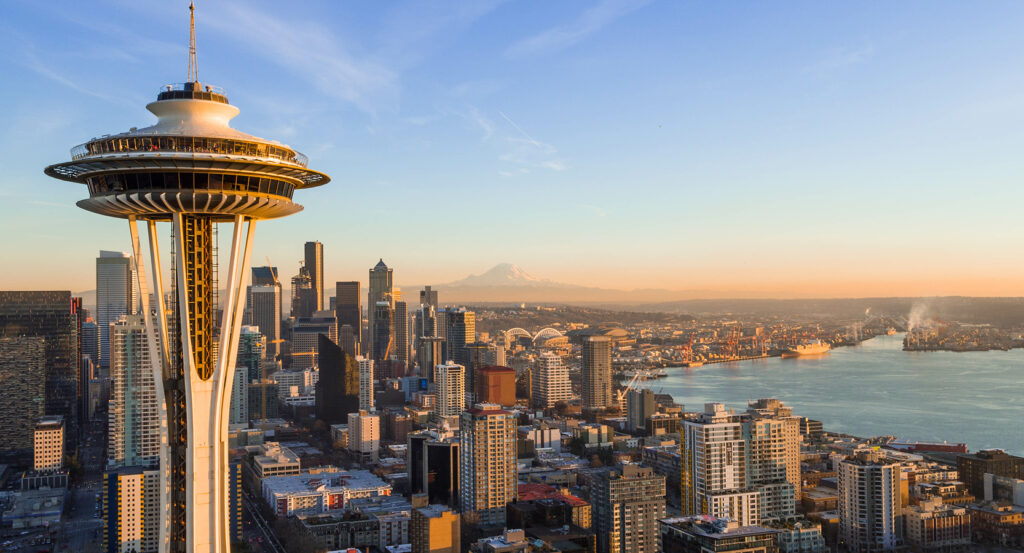
Opened in 2018, the hotel was built to address a long-standing gap in Seattle's infrastructure: the need for a large, modern convention-oriented hotel capable of supporting international events, corporate gatherings, and high-volume travel. Its development was closely tied to the expansion of the Washington State Convention Center, positioning the hotel as a cornerstone of downtown's evolving business ecosystem. Architecturally, the building emphasizes verticality and openness, using glass, steel, and clean geometry to reflect Seattle's contemporary skyline. This forward-looking design signals a shift in the city's hospitality landscape, moving away from boutique-scale storytelling toward global functionality. The hotel's interior spaces were intentionally designed to manage density, with wide corridors, large elevators, and expansive common areas that prevent the bottlenecks often associated with large properties. This operational foresight allows the hotel to maintain a composed atmosphere even during peak occupancy. Hyatt Regency Seattle also represents Hyatt's broader strategy of anchoring major urban markets with flagship properties that emphasize consistency, scalability, and integration with surrounding infrastructure. The hotel incorporates advanced building systems and sustainability measures, aligning with Seattle's environmental priorities and modern expectations for responsible development. Energy efficiency, waste reduction, and operational sustainability were integrated into the hotel's design and ongoing management, reinforcing its role as a long-term civic asset. Culturally, the hotel reflects Seattle's character as a city shaped by innovation, logistics, and global connectivity. Rather than drawing from heritage or counterculture, Hyatt Regency Seattle aligns itself with the city's professional and technological backbone, serving travelers whose visits are tied to work, collaboration, and large-scale events. The hotel's size and layout also allow it to host a wide range of functions, from international conferences to local gatherings, embedding it into the rhythm of the city's economic and social life. Staff training emphasizes operational fluency and adaptability, ensuring that service remains consistent across high volumes and varied guest needs. This focus on systems rather than personalities creates an environment where reliability becomes the defining feature of the experience. Over time, Hyatt Regency Seattle has established itself not as a destination in its own right, but as an essential piece of the city's infrastructure, a place that enables Seattle to function at a global level. Its significance lies in what it supports rather than what it showcases, making it a quiet but powerful contributor to the city's ongoing growth.
How to fold Hyatt Regency Seattle into your trip.
Hyatt Regency Seattle integrates seamlessly into an itinerary built around efficiency, accessibility, and sustained engagement with the city.
Start the morning with breakfast on-site or nearby, then step directly into Downtown with minimal transition, whether your day involves meetings, conferences, or exploration. Walk to the Washington State Convention Center, nearby offices, or cultural venues without relying on transportation, allowing the city to unfold at a controlled pace. Midmorning, take advantage of the hotel's proximity to transit connections to reach neighborhoods like South Lake Union, Capitol Hill, or the waterfront with ease. Return to the hotel around midday for a reset, a quiet moment in your room, a workout, or a working lunch that keeps your schedule intact. In the afternoon, explore downtown landmarks, museums, or shopping districts, knowing that the hotel remains a stable anchor amid the city's activity. As evening approaches, choose between dining on-site for convenience or stepping out to nearby restaurants. End the night back at Hyatt Regency Seattle, where the scale and order of the environment help the day conclude cleanly. Hyatt Regency Seattle works as a functional anchor, supporting trips defined by momentum, clarity, and sustained performance, and allowing Seattle to be experienced efficiently, confidently, and without unnecessary friction.
Where your story begins.
Foresyte Travel reveals places that feel extraordinary long before you arrive.
Experience premium editorial crafted for luxury travelers.