Why InterContinental Mark Hopkins San Francisco by IHG matters.
InterContinental Mark Hopkins San Francisco is a storied hotel where Nob Hill's railroad-era grandeur meets nearly a century of civic and social history through Weeks & Day architecture, celebrated California murals and the panoramic Top of the Mark.
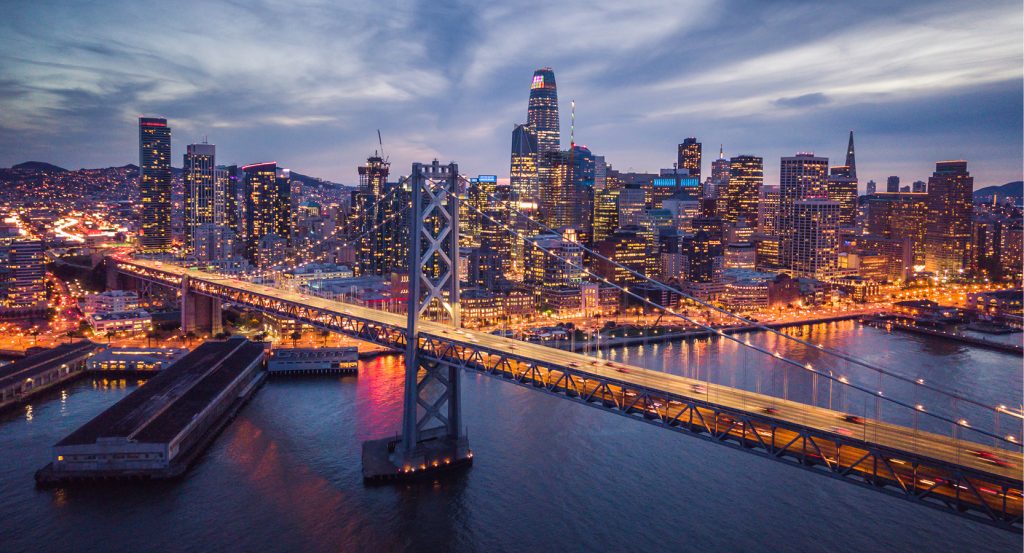
Set along California Street near Mason Street and just steps from Huntington Park, the hotel occupies Nob Hill's summit between Grace Cathedral, the historic hotel enclave surrounding Powell Street and the steep eastern slope descending through Chinatown toward the Financial District and San Francisco Bay. The 19-story tower rises through a symmetrical composition of masonry walls, projecting bays and progressively stepped upper floors shaped by French and Spanish architectural references. Ornamental stonework and formal interior spaces preserve the expansive character associated with San Francisco's post-1906 rebuilding era. Upper floors command broad perspectives across downtown, the Golden Gate, Marin Headlands and the bay from one of the highest points in Central San Francisco. The result is a hotel whose commanding hilltop architecture and preserved public interiors embody Nob Hill's transformation from private railroad estates into San Francisco's most enduring grand-hotel district.
What defines InterContinental Mark Hopkins San Francisco.
InterContinental Mark Hopkins San Francisco is best known for transforming the former estate of railroad magnate Mark Hopkins into an expansive hotel whose architecture, art and social history became inseparable from Nob Hill's reinvention after the 1906 earthquake and fire. Hopkins belonged to the Central Pacific Railroad's Big Four alongside Leland Stanford, Collis P. Huntington and Charles Crocker, and his mansion occupied one of the hill's most prestigious sites. The mansion later became the Mark Hopkins Institute of Art under the San Francisco Art Association before the post-earthquake fire destroyed the building in 1906. Mining engineer George D. Smith acquired the site in 1925 after having envisioned a hotel there years earlier. Smith retained Weeks & Day, the prominent San Francisco architectural partnership of Charles Peter Weeks and William Peyton Day, to develop a 19-story structure combining French château references with Spanish architectural elements. The completed building established a new expansive presence on the former mansion site and rapidly became one of the principal social institutions on Nob Hill. Maynard Dixon and Frank Van Sloun created nine large painted panels for the Room of the Dons, embedding California history and mythology directly within the hotel's decorative program. One panel depicts Calafia, the fictional queen associated with the literary origin of California's name, against a gold-leaf sky. Peacock Court developed into another major social room and hosted performers including Benny Goodman, Tommy Dorsey, Xavier Cugat and Yma Sumac during the hotel's early decades. George D. Smith controlled the property through much of its formative period before a succession of operators and owners followed during the 1960s and early 1970s. InterContinental assumed management in 1973 and subsequently directed extensive restoration campaigns across the facade, public rooms and private interiors. Historic Hotels of America inducted the property in 2011, formally recognizing the building's place within American hotel history. IHG sold the asset for $120 million in 2014 to a joint venture between Woodridge Capital Partners and funds managed by Oaktree Capital Management while retaining long-term management. Leadwell Global Properties acquired the hotel several years later for more than $205 million. InterContinental Mark Hopkins preserves a rare continuum between the railroad fortunes that created Nob Hill, San Francisco's post-earthquake architectural rebuilding, California art and the international hotel era that followed.
Where your story begins.
Foresyte Travel reveals places that feel extraordinary long before you arrive.
Enjoy editorial crafted for luxury travelers.