
Why Little Armenia matters.
Little Armenia is a storied enclave where Central Los Angeles's immigrant character meets Armenian commerce, multilingual streets and a compact urban district shaped by successive migrations from the Middle East and former Soviet Union.
Positioned between Los Feliz, Thai Town, and Hollywood, the neighborhood occupies a dense section of East Hollywood extending through Hollywood Boulevard, Sunset Boulevard and Santa Monica Boulevard between the Hollywood Freeway and Vermont Avenue. Apartment buildings, bungalow courts and early commercial blocks create a predominantly low- and mid-rise fabric, with storefronts concentrated along the principal east-west corridors and smaller residential streets filling the blocks between them. Movement through Little Armenia follows a tight rectilinear grid crossed by Alexandria, Kenmore and Normandie avenues, creating short transitions between busy commercial frontage and heavily settled residential interiors. Older freestanding houses survive among successive generations of apartments, leaving the neighborhood with a visibly incremental pattern created through more than a century of urban construction. The result is a neighborhood whose compact grid, dense housing, layered commercial streets and proximity to the Hollywood foothills give a geographically concentrated setting to one of Los Angeles's most consequential immigrant districts.
What defines Little Armenia.
Little Armenia is best known for becoming a major center of Armenian life in Los Angeles as immigration from several distinct parts of the Armenian diaspora converged in East Hollywood during the late twentieth century. Armenians had maintained a presence around Hollywood decades earlier, but the concentration grew sharply after changes to American immigration policy in 1965 reopened migration from regions that had supplied few arrivals under previous restrictions. Lebanese Armenians entered Southern California in substantial numbers after civil war began in Lebanon in 1975, followed by Armenians leaving Iran amid the 1979 revolution and the Iran-Iraq War. Many arrived with experience living in established Armenian communities outside Armenia, carrying religious, commercial and cultural institutions into their new city. East Hollywood became one of their principal settlement areas, joining older Armenian centers elsewhere in Southern California with a population drawn heavily from Beirut, Tehran and other Middle Eastern cities. Another migration stream gathered momentum during the 1980s as Armenians from the Soviet Union entered Los Angeles, then expanded after Armenia became independent in 1991 and severe economic disruption followed the Soviet collapse. By 1988, Armenian leaders placed the Hollywood concentration at 50,000 to 60,000 people, and Armenian-owned businesses in East Hollywood had tripled during the preceding decade to more than 250. Grocers, bakeries, restaurants, jewelers, repair shops and other family enterprises turned ordinary commercial blocks into a district where Armenian language, foodways and social networks became embedded in the daily economy.
Religious and educational institutions gave that immigrant concentration a durable cultural center during the same period. St. Garabed Armenian Apostolic Church began its Hollywood presence in 1977, with worship initially conducted in classrooms across Alexandria Avenue before construction of the church building advanced. Groundbreaking occurred on March 6, 1977, construction reached completion by Christmas 1978 and Karekin II of the Great House of Cilicia consecrated the church on November 2, 1980. Rose and Alex Pilibos Armenian School developed across the street into an educational institution centered on Armenian language, history, literature, music and religious tradition, creating an unusually close physical relationship between parish and school. The pairing helped Alexandria Avenue function as a focal point for families whose connections to Armenia crossed several countries and generations. Los Angeles formally designated Little Armenia on October 6, 2000 after Councilmember Jackie Goldberg introduced the proposal and neighborhood organizers canvassed residents, merchants and property owners. The designated district extended from Hollywood Boulevard south to Santa Monica Boulevard and from the Hollywood Freeway east to Vermont Avenue, giving municipal recognition to a community whose cultural presence had already developed over several decades. A 2001 expansion of Pilibos reinforced the institutional concentration shortly after the designation, at a time when East Hollywood remained a powerful sentimental center for Armenian Angelenos despite the growth of larger Armenian populations elsewhere in the metropolitan region.
How Little Armenia fits.
Little Armenia works as the anchor for a daytime outing connecting Frank Lloyd Wright's first Los Angeles commission, a cemetery inseparable from the rise of the film industry and a public observatory created to bring astronomy to the wider city.
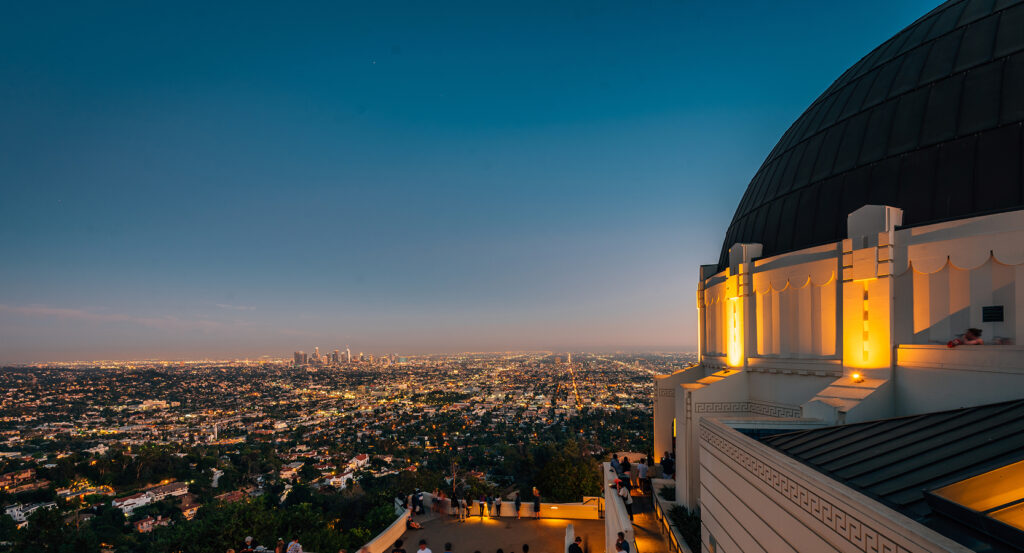
Begin at Hollyhock House, commissioned by oil heiress and theater producer Aline Barnsdall after she purchased the 36-acre Olive Hill property for $300,000 in 1919. Barnsdall had first approached Frank Lloyd Wright in 1915 about designing a theater, and the eventual scheme expanded to encompass a cinema, artist residences, shops, guest houses and her own residence. Wright completed the principal house between 1919 and 1921, abstracting Barnsdall's favorite flower through cast stone, art glass, furniture and textiles as he moved beyond the Prairie architecture associated with his Midwestern career. Only the main residence and two guest houses emerged from the larger arts complex before delays and escalating costs ended the commission. Barnsdall gave the house, eleven surrounding acres and Residence A to Los Angeles in 1927 for a public art park honoring her father. Hollyhock House joined seven other Wright works on the UNESCO World Heritage List in 2019, making the property Los Angeles's only World Heritage Site. Continue to Hollywood Forever, founded in 1899 during the early growth of Hollywood and eventually surrounded by an entertainment district that scarcely existed when its first burials occurred. Paramount Studios developed along the undeveloped southern portion of the original property, creating an unusually direct physical connection between a major film studio and the burial ground chosen by generations of performers and filmmakers. Cecil B. DeMille, Rudolph Valentino, Douglas Fairbanks, Judy Garland and Mickey Rooney are among the film figures buried there, placing multiple periods of Hollywood history within the same grounds. The cemetery entered the National Register in 1999, a century after its founding. A different chapter began in 2000 when Hollywood Forever partnered with Cinespia on outdoor film screenings across the Fairbanks Lawn, extending the property's relationship with cinema from burial place to exhibition site. Conclude at Griffith Observatory, built on the south slope of Mount Hollywood from funds left by Griffith J. Griffith for a public astronomical institution. Griffith had given 3,015 acres to Los Angeles for Griffith Park in 1896 and later pursued an observatory after viewing the heavens through the telescope at Mount Wilson. Architects John C. Austin and Frederick M. Ashley developed the building with astronomical guidance incorporated into its design, and the Observatory opened on May 14, 1935. Its Zeiss refractor placed direct astronomical observation within reach of the general public, fulfilling Griffith's central ambition for the institution. The building later underwent a major expansion between 2002 and 2006, adding substantial exhibition space beneath the original structure without sacrificing its commanding position above the basin. The progression moves from Barnsdall and Wright's architectural experiment through a burial ground intertwined with the film industry and culminates at an institution conceived to place the universe within public reach above Los Angeles.
Where your story begins.
Foresyte Travel reveals places that feel extraordinary long before you arrive.
Enjoy editorial crafted for luxury travelers.
Foresyte may earn a commission when you book.





































































































