
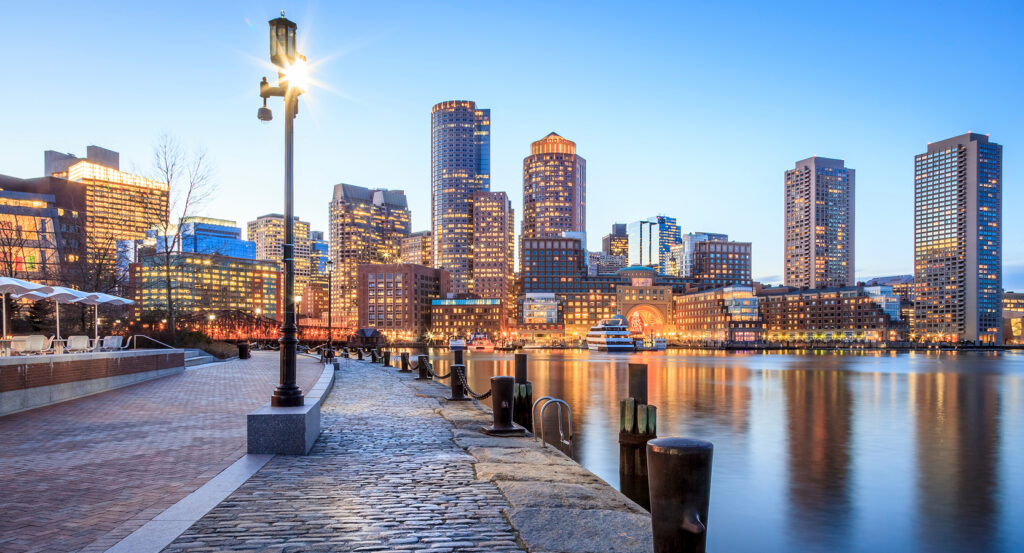
Why Long Wharf matters.
Long Wharf is Boston's historic waterfront district where the Financial District's colonial maritime heritage, commercial innovation, harbor access, and architectural legacy preserve one of America's most consequential urban landscapes.
Running along Atlantic Avenue between State Street and Boston Harbor and just steps from the New England Aquarium, this historic waterfront corridor combines centuries-old granite wharves, harbor promenades, ferry terminals, public plazas, maritime landmarks, and panoramic views across Boston Harbor that reveal the birthplace of the city's enduring relationship with the sea. Historic warehouses, active passenger vessels, and carefully preserved waterfront infrastructure create an atmosphere where nearly four centuries of commercial and maritime history remain vividly present. The result is a destination defined by historical significance, waterfront vitality, and exceptional urban preservation.
What defines Long Wharf.
Long Wharf is best known for serving as colonial America's preeminent commercial pier, extending nearly one-half mile into Boston Harbor after construction began in 1710 under merchant Oliver Noyes and concluded in 1715, creating the largest man-made wharf in North America and establishing Boston as one of the British Empire's most important Atlantic trading ports. Built almost entirely by hand using timber cribbing filled with stone and earth, the structure projected 1,586 feet (483 meters) into Boston Harbor, far beyond the natural shoreline of the early eighteenth century, allowing deep-draft merchant vessels to dock directly alongside warehouses regardless of the tides. Throughout the colonial era, Long Wharf became the principal gateway for commodities including molasses, rum, tea, sugar, textiles, fish, timber, and manufactured goods while simultaneously serving as the arrival point for governors, military officials, merchants, immigrants, and distinguished visitors. During the American Revolution, British troops landed here in 1768, and the wharf remained strategically significant throughout the Siege of Boston before continuing as New England's dominant commercial waterfront well into the nineteenth century. Successive landfill campaigns during the nineteenth century dramatically shortened the visible length of the wharf as Boston's shoreline expanded eastward, yet its surviving granite headhouse, seawalls, and harbor alignment continue preserving the original colonial engineering. Today Long Wharf functions as one of Boston's busiest transportation hubs, accommodating MBTA ferries, Boston Harbor City Cruises, whale watch excursions, Harbor Islands National and State Park ferries, and water taxis while linking visitors directly to the harbor that shaped the city's economic rise. Extensive waterfront revitalization, coordinated through the Boston Harborwalk, has transformed the historic pier into a thriving public space where maritime transportation, recreation, preservation, and tourism coexist within one of America's oldest continuously active commercial waterfronts.
The architectural experience unfolds through massive granite seawalls, surviving eighteenth- and nineteenth-century waterfront construction, carefully restored pedestrian promenades, resilient harbor infrastructure, and uninterrupted views toward the Boston Harbor Islands that reinforce the wharf's historic relationship with the sea. Layers of colonial engineering, nineteenth-century maritime commerce, twentieth-century preservation, and contemporary waterfront planning remain legible throughout the landscape, demonstrating how successive generations adapted one of America's earliest commercial ports. Every section of Long Wharf demonstrates the evolution of Boston from a colonial trading settlement into a global maritime city while preserving one of the nation's most influential waterfront environments.
How Long Wharf fits.
Long Wharf works as part of an exploration through Boston's celebrated waterfront.
Begin at the New England Aquarium, where marine exhibits introduce Boston's enduring relationship with the ocean before strolling along Long Wharf. Continue to the Boston Harborwalk, whose scenic waterfront paths reveal centuries of maritime history and harbor views. Conclude at the Boston Harbor Islands National and State Park, where ferry access from Long Wharf provides a memorable finale exploring one of the nation's most remarkable urban island systems. The progression moves naturally from marine discovery to colonial maritime history before concluding amid Boston Harbor's extraordinary natural landscapes, revealing why Long Wharf remains the historic gateway to the city.
Where your story begins.
Foresyte Travel reveals places that feel extraordinary long before you arrive.
Enjoy editorial crafted for luxury travelers.
Foresyte may earn a commission when you book.







































































































