
Why Lyceum Theatre matters.
Lyceum Theatre is a rare surviving Broadway playhouse where the Theater District's performance culture meets Beaux-Arts architecture, Daniel Frohman's theatrical enterprise and more than 120 years of continuous legitimate stage use.
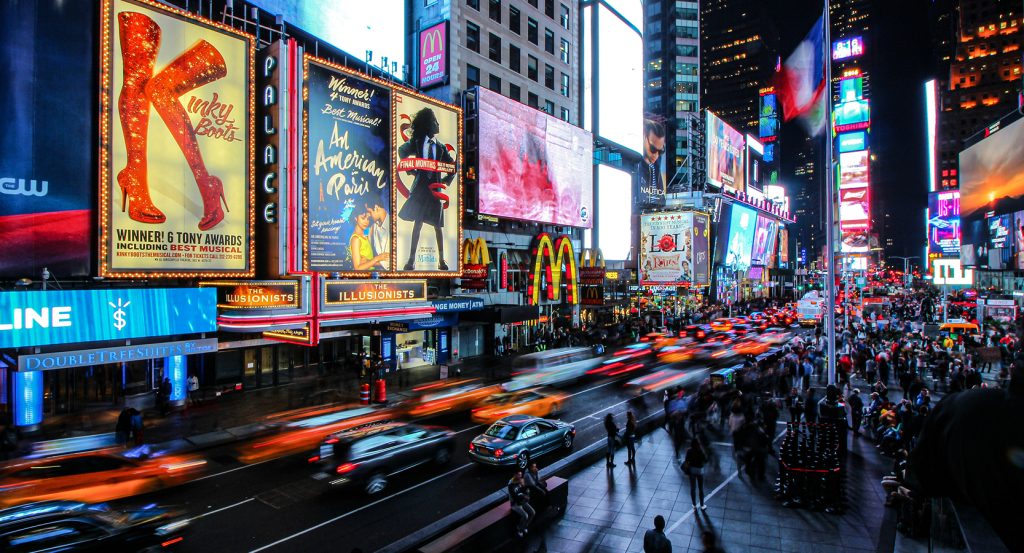
Set along West 45th Street near 6th Avenue and just steps from the Museum of Broadway, the theater occupies a comparatively intimate site within the dense concentration of playhouses east of Times Square. Herts & Tallant composed the gray limestone facade around six Corinthian columns, three large arched windows and sculptural ornament, giving the narrow frontage a formal vertical hierarchy distinct from the illuminated marquees surrounding it. Inside, twin staircases rise through a marble-finished foyer toward a three-level auditorium seating 922 people, with decorated boxes and an ornate proscenium framing the stage. The original building incorporated unusually extensive production facilities, including backstage work areas and an upper rehearsal room, allowing Frohman to place performance, preparation and management within one theatrical complex. The result is an unusually intact Broadway house whose limestone frontage, compact auditorium and integrated production spaces preserve the physical organization of an early twentieth-century producer-managed theater.
What defines Lyceum Theatre.
Lyceum Theatre is best known for being New York's oldest surviving theater in continuous legitimate use, built in 1903 for producer-manager Daniel Frohman as the successor to his earlier Lyceum on 4th Avenue. Frohman commissioned Henry Beaumont Herts and Hugh Tallant, theater specialists whose partnership subsequently produced several important Broadway houses, for a purpose-built base supporting his company and managerial operations. The new Lyceum opened on November 2, 1903 with The Proud Prince, starring E. H. Sothern, beginning a performance history that later included Billie Burke, Ethel Barrymore, William Gillette and other major actors of the early Broadway era. Frohman equipped the building with a sophisticated ventilation system that passed air over ice chambers during warm weather and steam coils during cold weather, an advanced comfort system for a theater of its period. Above the auditorium he maintained private quarters containing a small opening overlooking the stage, traditionally associated with his supervision of rehearsals and performances involving his wife, actress Margaret Illington. Economic pressure during the Great Depression eventually ended Frohman's ownership, and a theatrical group including playwrights George S. Kaufman and Moss Hart acquired the property 1940, protecting the playhouse during a precarious period for older Broadway buildings. The Shubert Organization took control 1950 and has operated the Lyceum ever since, carrying Frohman's house into another long institutional era. New York City protected the exterior in 1974, recognizing both Herts & Tallant's architecture and the building's theatrical importance, and extended protection to the principal interior spaces in 1987.
The Lyceum's later performance history developed through repertory companies, major American plays and productions that repeatedly exploited the intimacy of its auditorium. Michael V. Gazzo's A Hatful of Rain opened there in 1955 under Frank Corsaro's direction with Ben Gazzara, Shelley Winters and Anthony Franciosa, remaining at the Lyceum until September 1956 during a 398-performance Broadway engagement. The APA-Phoenix Repertory Company occupied the house during the 1960s, mounting work including You Can't Take It With You, The School for Scandal and a 1968 Cherry Orchard directed and translated by Eva Le Gallienne, with Uta Hagen as Ranevskaya and Donald Moffat as Lopakhin. Athol Fugard's Master Harold…and the Boys arrived in 1982 with Danny Glover, and Whoopi Goldberg brought her solo Broadway production to the house in 1984. Tony Randall's National Actors Theatre later used the Lyceum for more than a dozen productions, followed by Lincoln Center Theater engagements including The Invention of Love and Mornings at Seven. Doug Wright's I Am My Own Wife, starring Jefferson Mays, played there in 2003 and 2004, winning both the Pulitzer Prize for Drama and Tony Award for Best Play, with Mays receiving the Tony for leading actor. Mischief Theatre's The Play That Goes Wrong completed 737 Broadway performances there between 2017 and 2019, with Nigel Hook winning the Tony for scenic design. Cole Escola's Oh, Mary! opened at the Lyceum in July 2024 and brought Tony Awards to Escola and director Sam Pinkleton in 2025, extending the theater's association with formally adventurous comedy deep into its second century.
How Lyceum Theatre fits.
Lyceum Theatre works as the anchor for a Theater District outing connecting Broadway's professional literature, theatrical memory and the preservation of live performance across generations.
Begin at Drama Book Shop, founded by the Drama League in 1917 and independent since 1923, when New York's expanding theater industry created sustained demand for scripts and specialist theatrical literature. Arthur Seelen acquired the business in 1958, and its later West 40th Street location contained the 60-seat Arthur Seelen Theatre, where Thomas Kail, Anthony Veneziale, John Buffalo Mailer and Neil Stewart established Back House Productions. Lin-Manuel Miranda and Kail worked there on In the Heights beginning in 2002, years before the musical won four Tony Awards. Thomas Kail, Miranda, Jeffrey Seller and James L. Nederlander subsequently joined to purchase the business, and David Korins designed its current West 39th Street home; the Drama Book Shop itself received a Tony Honor for Excellence in the Theatre in 2011. Continue at Museum of Broadway, created by producer Julie Boardman and Diane Nicoletti and opened in November 2022 after the founders assembled artists, designers and theater historians around a permanent institution devoted to Broadway. The museum divides its 45th Street interior into a Map Room charting the geographic migration of New York theater, a chronological sequence devoted to pivotal productions and a section examining the work behind a Broadway production. Jennifer Ashley Tepper curated the historical-building component, Ben West developed the timeline, John Kenrick handled major theatrical turning points, and David Rockwell joined the designers contributing to the production-focused section. Conclude at New York Public Library for the Performing Arts, formed through a partnership between The New York Public Library and Lincoln Center and opened in 1965 in a building designed by Gordon Bunshaft of Skidmore, Owings & Merrill. Its theatrical holdings grew from the Theatre Collection founded after David Belasco's papers entered NYPL in 1931, later becoming the Billy Rose Theatre Division, whose holdings now exceed ten million items. Betty L. Corwin created the Theatre on Film and Tape Archive there in 1970 after negotiating with theatrical unions and guilds to preserve live productions on video; the collection now contains more than 5,000 staged works and thousands of related interviews and programs. The progression moves from a century-old specialist bookstore that helped incubate In the Heights through a museum devoted to Broadway's creative history and culminates in an institution preserving scripts, photographs, designs and filmed performances for future theatrical scholarship.
Where your story begins.
Foresyte Travel reveals places that feel extraordinary long before you arrive.
Enjoy editorial crafted for luxury travelers.
Foresyte may earn a commission when you book.







































































































