
Why Times Square matters.
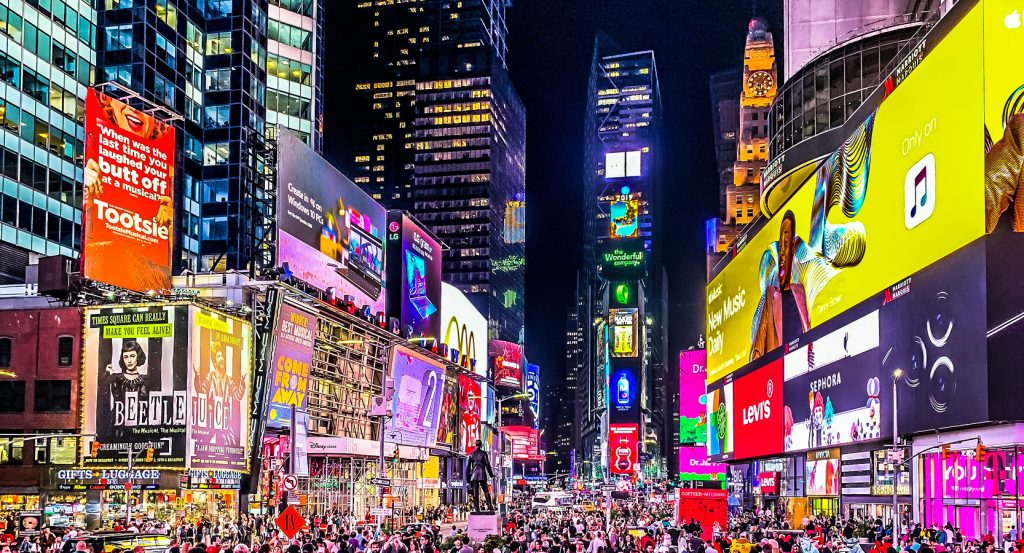
Times Square is an electrifying urban crossroads where Midtown's theatrical concentration meets towering digital displays, Broadway marquees and an immense field of public performance.
Set along Broadway near West 45th Street and just steps from the Father Duffy Statue, the district occupies the diagonal collision of Broadway and 7th Avenue amid closely packed theaters, hotels and commercial towers. Wedge-shaped blocks produce long north-south sightlines, with illuminated façades rising through multiple architectural layers above the street. Walking establishes the primary encounter as shifting angles continually rearrange the relationship among signs, marquees, building fronts and crowds across the intersecting avenues. Elevated viewpoints, recessed building entrances and broad areas of open pavement introduce a second spatial mechanism by alternating concentrated movement with places for sustained observation. The result is an urban environment whose unusual geometry and vertical intensity make architecture, advertising and human activity simultaneously visible across an exceptionally compressed section of Midtown.
What defines Times Square.
Times Square is best known for developing from nineteenth-century Longacre Square into New York's principal theater and entertainment district after transportation, publishing and speculative construction converged around Broadway and 42nd Street. William H. Vanderbilt's American Horse Exchange established an important commercial presence when the area still carried a name borrowed from London's carriage district, but the arrival of electric street lighting and theatrical advertising began changing its character during the late nineteenth century. Oscar Hammerstein opened his Olympia entertainment complex on Broadway between 44th and 45th Streets in 1895, initiating a theatrical migration that subsequently produced 43 additional theaters between 1901 and 1920. Adolph S. Ochs accelerated the district's transformation after acquiring The New York Times in 1896 and selecting the triangular Broadway and 7th Avenue site for a new newspaper headquarters designed by Cyrus L. W. Eidlitz with Andrew C. McKenzie. Mayor George B. McClellan signed the 1904 resolution renaming Longacre Square for the newspaper as construction advanced on the Times Tower, then among Manhattan's tallest buildings. The Interborough Rapid Transit subway opened the same year with a major station at 42nd Street, connecting the developing entertainment district to New York's new rapid-transit network; the station handled almost five million passengers during its first full year of operation. Legitimate theaters increasingly concentrated around the district by World War I, and subway lines, elevated trains and bus routes had made West 42nd Street a major transportation hub by the late 1920s. The convergence of Ochs's publishing headquarters, Hammerstein's theatrical expansion and mass transit shifted a carriage-trade district into a nationally recognized center of entertainment and commercial display.
Illuminated advertising developed into a separate mechanism through which municipal regulation actively preserved the district's unusual visual character. By the 1920s, marquees, signboards and advertisements across the area contained an estimated one million light bulbs, establishing the intense nighttime illumination associated with the Great White Way. New York later incorporated that commercial brightness into the Special Midtown District, requiring illuminated signs on qualifying developments and enlargements along Broadway and 7th Avenue between 43rd and 50th Streets. A different public-space intervention began in February 2009 when the Department of Transportation replaced vehicular traffic with experimental pedestrian areas along Broadway between West 42nd and West 47th Streets. Snøhetta subsequently developed the permanent reconstruction with the Department of Design and Construction, creating five pedestrian plazas through widened sidewalks, curbless surfaces and sculpted granite benches. The $55 million project incorporated extensive subsurface work before completion in December 2016, including new sewers and water mains alongside $25 million in utility upgrades undertaken by companies including Con Edison and Verizon. Snøhetta's finished scheme produced 2.5 acres of pedestrian-only ground and nearly doubled the amount of pedestrian space in the district, completing a physical transformation in which New York preserved Times Square's illuminated commercial character and simultaneously reconfigured the streets beneath it for public occupation.
How Times Square fits.
Times Square works as the anchor for a daytime sequence through three nearby sites that connect women's suffrage and public debate, the architectural development of Broadway theater and the reinvention of a nineteenth-century civic landscape.
Begin at The Town Hall, created by the League for Political Education, an organization founded in 1894 by six women seeking to advance women's rights and political education after a suffrage measure failed in the New York State Legislature. McKim, Mead & White designed the permanent hall, which opened in January 1921 after the Nineteenth Amendment had been ratified, eliminating box seats and obstructed views in keeping with the founders' elegant principles. Margaret Sanger was arrested on its stage during a 1921 meeting on birth control, Marian Anderson made her New York recital debut in the hall, and George V. Denny created America's Town Meeting of the Air there in 1935 as a nationally broadcast forum for political, social and economic questions. The institution joined architectural design, performance and public debate inside a hall conceived directly from the political activism of its founders. Continue to New Amsterdam Theatre, where producers A. L. Erlanger and Marcus Klaw commissioned Herts & Tallant to create an elaborate Art Nouveau playhouse that opened on October 26, 1903 with A Midsummer Night's Dream. Henry Herts and Hugh Tallant employed cantilever construction for balconies without supporting columns blocking lower-level sightlines, then surrounded the auditorium and public rooms with theatrical sculpture, murals, faience, carved ornament and imagery drawn from Shakespeare, Wagner and classical mythology. Florenz Ziegfeld brought the Ziegfeld Follies to the house in 1913, beginning an association lasting through 1927 before the theater became a movie house in 1937. New York State acquired the deteriorated building in 1992, and the Walt Disney Company restored it before live performance returned in 1997, making its recovery a major episode in the redevelopment of West 42nd Street. Conclude at Bryant Park, where land used as a potter's field during the 1820s became the setting for the 1853 Exhibition of the Industry of All Nations after construction of the neighboring Croton Distributing Reservoir. Georg Carstensen and Charles Gildemeister designed the glass-and-iron Crystal Palace for an exhibition containing 4,000 exhibitors, and Waring Latting's adjoining 315-foot observatory briefly became New York's tallest structure. Reservoir Square received the Bryant Park name in 1884, honoring poet and New York Evening Post editor William Cullen Bryant, before architect Lusby Simpson won a 1933 competition for a formal redesign executed under Parks Commissioner Robert Moses with Aymar Embury II and Gilmore D. Clarke. Daniel Biederman, Andrew Heiskell and the Rockefeller Brothers Fund established the Bryant Park Restoration Corporation in 1980, leading to a four-year physical renovation that concluded with the park's 1992 reopening and introduced 2,000 movable chairs into the redesigned public ground. The progression moves from a suffrage organization's purpose-built forum through Herts and Tallant's technologically advanced Broadway theater into a civic landscape successively occupied by a world exhibition, formal garden design and twentieth-century restoration, revealing how public assembly, performance and urban reinvention shaped the blocks surrounding Times Square.
Where your story begins.
Foresyte Travel reveals places that feel extraordinary long before you arrive.
Enjoy editorial crafted for luxury travelers.
Foresyte may earn a commission when you book.







































































































