
Why New Amsterdam Theatre matters.
New Amsterdam Theatre is an ornate Broadway playhouse where Times Square's theatrical heritage meets Art Nouveau interiors, elaborate decorative arts and more than a century of major stage productions.
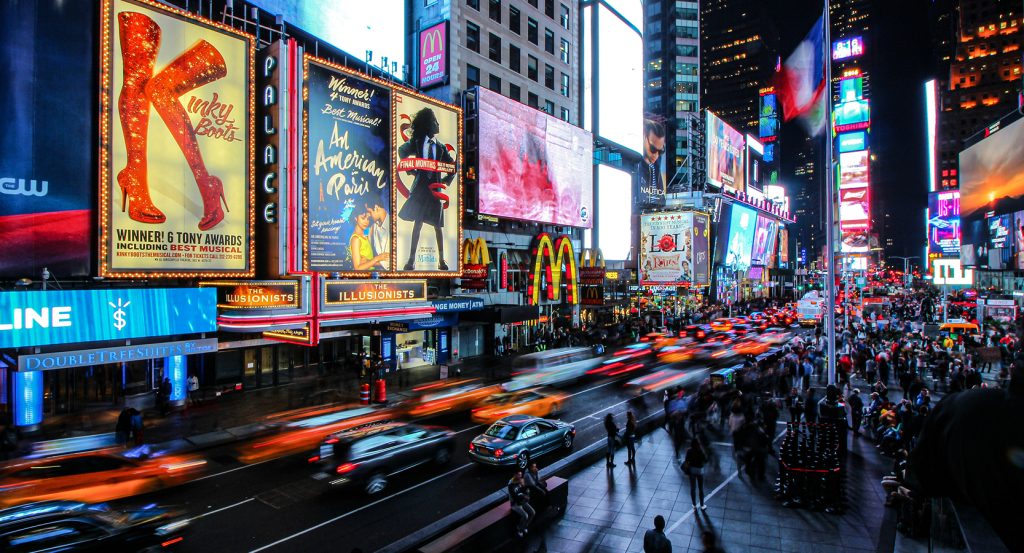
Set along West 42nd Street near 7th Avenue and just steps from Madame Tussauds New York, the theater occupies a narrow midblock parcel whose 42nd Street frontage leads through an elongated entrance sequence toward the auditorium deeper inside the block. Herts & Tallant gave the street elevation a Beaux-Arts composition, then developed the interior through sweeping curves, floral ornament and theatrical imagery that made the building an early major New York example of Art Nouveau design. Terra-cotta panels carry theatrical subjects through the lobby, foyers, staircases and auditorium, accompanied by murals from George Peixotto, Robert Blum and other artists and art tiles designed by Henry Chapman Mercer. Oak carving, faience balustrades, stonework and sculptural decoration extend that artistic program across rooms conceived as interconnected components of a single theatrical environment. The result is a richly integrated playhouse whose narrow entrance, curving interior, murals, ceramics, carving and ornamental surfaces preserve an unusually complete decorative achievement from Broadway's early twentieth-century expansion.
What defines New Amsterdam Theatre.
New Amsterdam Theatre is best known for its central role in the rise of Broadway around Times Square and its long association with Florenz Ziegfeld, whose productions turned the building into one of the formative stages of American musical entertainment. Producers A. L. Erlanger and Marcus Klaw commissioned Herts & Tallant to create the theater in 1902, and the building opened on October 26, 1903 with Shakespeare's A Midsummer Night's Dream. The architects designed the interior specifically around that inaugural production, embedding Shakespearean subjects alongside imagery drawn from Wagner, Hans Christian Andersen, Aesop and classical mythology. Ziegfeld moved his Follies to the New Amsterdam in 1913 and maintained the association through 1927, bringing performers including Fanny Brice, Eddie Cantor, W. C. Fields, Will Rogers and Bert Williams onto its stage. Marilyn Miller starred in Sally beginning in 1920, a production that ran 570 performances, then returned in Sunny in 1925 for another extended engagement. Basil Rathbone appeared as Cassius in Julius Caesar in 1927, demonstrating a dramatic repertory continuing alongside the musical revues. Economic pressures eventually closed the theater during the 1930s, and the auditorium entered a radically different period as a movie house beginning in 1937. The building remained associated with cinema for decades before closing in 1985, ending the first long cycle of public entertainment inside a theater whose stage had helped define the Broadway revue.
A second performance world once existed above the principal auditorium, beginning with the Aerial Gardens built by Herts & Tallant in 1904 as a rooftop theater with 680 seats. The upper venue contained its own proscenium stage, orchestra floor, suspended boxes and an adjoining garden terrace where trees, plants and tables extended theatrical activity outdoors. Florenz Ziegfeld commissioned Austrian-born designer Joseph Urban to remake the roof in 1915, producing a movable stage, glass runway, dance floor, advanced theatrical lighting and tables equipped with telephones for the Midnight Frolic. Will Rogers and Eddie Cantor appeared upstairs before achieving greater prominence in the Follies below, allowing Ziegfeld to use the roof as a testing ground for performers and production numbers. The upper theater later passed through names including Ziegfeld Roof, Dresden Theatre and Frolic Theatre before becoming a radio studio in 1930 and subsequently entering television use. Structural problems eventually ended theatrical use of the rooftop auditorium, yet the surviving main theater gained New York City protection for both its exterior and interior in 1979. Disney entered the building's modern chapter during the 1990s, joining city and state authorities in financing a major rehabilitation directed by Hardy Holzman Pfeiffer Associates. The restored New Amsterdam formally reopened in April 1997, and King David became its first live stage production since 1937 the following month. Disney's return of live theater to the building became a pivotal event in the redevelopment of West 42nd Street, reconnecting a deteriorated former movie house with the Broadway function for which Klaw, Erlanger, Herts and Tallant had created it nine decades earlier.
How New Amsterdam Theatre fits.
New Amsterdam Theatre works as the anchor for a Midtown outing connecting intimate theatrical architecture, the institutional culture surrounding American playwriting and the nineteenth-century civic history beneath Bryant Park.
Begin at Belasco Theatre, where producer, director and playwright David Belasco opened the Stuyvesant Theatre in 1907 before renaming it for himself in 1910. Architect George Keister shaped its shallow auditorium around Belasco's belief that proximity between actors and audience strengthened drama, and Ashcan School painter Everett Shinn contributed 18 murals to an interior conceived with residential intimacy. A sophisticated lighting board expanded Belasco's control over stage effects, and a freight elevator connected basement workshops directly with the stage, joining close audience geometry with advanced theatrical technology. The Shubert Organization acquired the building in 1948, and architect Francesca Russo directed a major restoration completed in 2010. Continue to Drama Book Shop, founded by the Drama League in 1917 and independent since 1923, building a century-long role as a specialist source for plays and theatrical literature. The institution received a Tony Honor for Excellence in the Theatre in 2011, but another consequential chapter developed below its former West 40th Street home, where Thomas Kail and fellow Wesleyan University alumni established Back House Productions in the 60-seat Arthur Seelen Theatre. Lin-Manuel Miranda and Kail worked there on In the Heights, which later won four Tony Awards in 2008. Kail, Miranda, Jeffrey Seller and James L. Nederlander subsequently purchased the threatened bookstore, and scenic designer David Korins designed its West 39th Street home. Conclude at Bryant Park, whose ground passed from an early nineteenth-century potter's field into the setting for one of New York's first great experiments in public engineering and international exhibition culture. The adjacent Croton Distributing Reservoir opened in 1842 behind 50-foot granite walls, carrying fresh water into the expanding city through the Croton Aqueduct system. Reservoir Square then hosted the 1853 Exhibition of the Industry of All Nations, where Georg Carstensen and Charles Gildemeister's glass-and-iron Crystal Palace housed 4,000 exhibitors beside Waring Latting and William Naugle's 315-foot Latting Observatory. The exhibition drew more than one million people before the Crystal Palace burned in 1858, and Reservoir Square received the Bryant Park name in 1884 in honor of editor and civic reformer William Cullen Bryant. The progression moves from Belasco's technologically ambitious intimate theater through the Drama Book Shop's century of theatrical culture and culminates in Bryant Park's earlier history of water engineering and international exhibition, revealing successive forms of performance, creative exchange and public performance around the 42nd Street corridor.
Where your story begins.
Foresyte Travel reveals places that feel extraordinary long before you arrive.
Enjoy editorial crafted for luxury travelers.
Foresyte may earn a commission when you book.







































































































