
Why Metropolitan Opera House matters.
Metropolitan Opera House is a commanding performance hall where Lincoln Square's concentration of performing arts meets Wallace K. Harrison's five-arched facade, an immense repertory stage and the Metropolitan Opera's international artistic tradition.
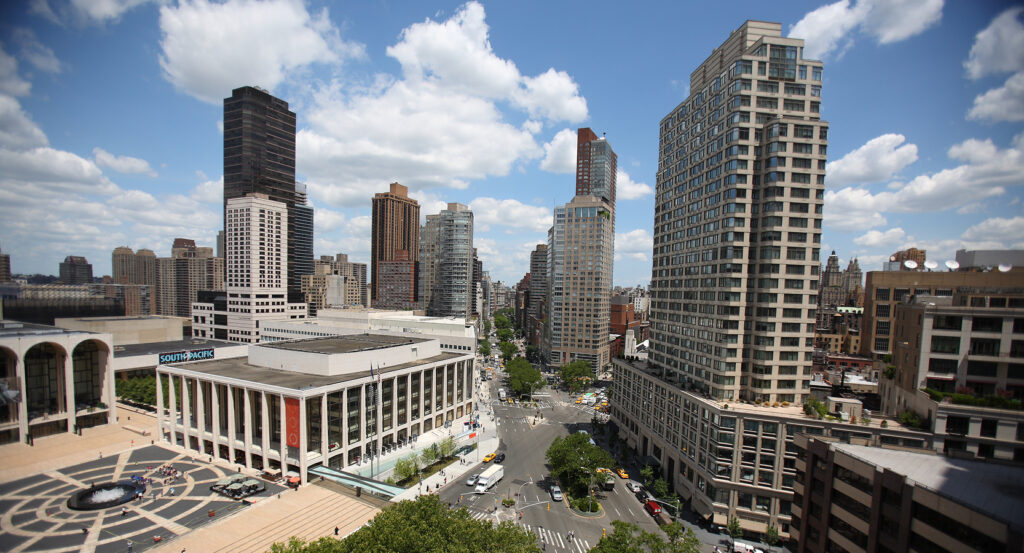
Set along Lincoln Center Plaza near Columbus Avenue and just steps from David Geffen Hall, the opera house occupies the western end of the campus axis, with its symmetrical frontage closing the principal approach across the plaza. Five soaring concrete arches divide the travertine facade, framing a glazed lobby whose broad interior staircases and multi-level circulation remain visible from the plaza after dark. Harrison organized the auditorium around a broad proscenium and six seating levels, with a fan-shaped ceiling carrying thousands of gold-leaf elements above the red seating and curved balcony fronts. The principal stage sits within an enormous backstage volume extending west toward Amsterdam Avenue, giving the building enough depth for scenery to move laterally and behind the performance area through machinery incorporated into the 1966 theater. The result is an opera house whose ceremonial facade, transparent lobby, tiered auditorium and unusually deep theatrical infrastructure give grand opera architectural scale on both sides of the proscenium.
What defines Metropolitan Opera House.
Metropolitan Opera House is best known for giving the Metropolitan Opera a technically advanced Lincoln Center home after more than eight decades at Broadway and 39th Street, where inadequate backstage facilities had constrained the company almost since its 1883 founding. Plans for a replacement stretched across nearly six decades before the Met joined the institutions assembled at Lincoln Center and Wallace K. Harrison became architect of the new house. Assistant General Manager Herman Krawitz played a decisive role in planning the auditorium and stage, fixing their principal configurations early even as the architectural team explored 44 versions of the exterior. The completed theater replaced manual scenery handling with an electric fly system, incorporated lifts into the main stage and installed three motorized stage wagons capable of carrying complete sets into performance position. A 57-foot-diameter turntable built into the rear wagon gave productions another means of preparing and changing entire scenes within the backstage complex. The Met commissioned Samuel Barber to compose Antony and Cleopatra for the new house, with a Shakespeare-derived libretto and Franco Zeffirelli production conceived to exploit the theater's technical capacity. Thomas Schippers conducted the September 16, 1966 world premiere with Leontyne Price as Cleopatra, Justino Díaz as Antony and Rosalind Elias as Charmian. Zeffirelli filled the opening scene with 250 performers, a huge golden pyramid and live animals as the production tested the hydraulic lifts, motorized scenery systems and immense performance area. Lady Bird Johnson attended alongside Ferdinand and Imelda Marcos, Governor Nelson Rockefeller and other prominent figures, with 3,000 bottles of Champagne prepared for the opening-night gathering. The commission tied the building's architectural debut directly to a new American opera, making Barber, Zeffirelli, Schippers and Price central participants in the inauguration of the Met's second home.
Visual art developed as a separate strand of the house through commissions placed throughout its public interiors. Marc Chagall created the enormous The Triumph of Music and The Sources of Music for the lobby, positioning the paintings on opposite sides of the building's central approach and making them visible through the glazed facade. Peter Gelb and curator Dodie Kazanjian extended the relationship between opera and contemporary art through Gallery Met, founded in 2006 with support from Marie Schwartz. The program expanded beyond its original ground-floor gallery during the 2018-19 season, when Cecily Brown created Triumph of the Vanities I and Triumph of the Vanities II, two oil paintings 26 feet wide installed on the Grand Tier and Dress Circle. George Condo followed with Constellation of Voices during 2019-20, and the reopening of the house in 2021 brought Rashid Johnson's two 9-by-25-foot The Broken Nine mosaics into upper public levels alongside work by Dana Schutz, Nicolas Party and Shara Hughes. The Met's sustained commissioning program places Chagall's mid-century paintings within a continuing relationship between opera and visual artists, turning circulation through the house into another artistic strand of the institution.
How Metropolitan Opera House fits.
Metropolitan Opera House works as the anchor for a Lincoln Square outing connecting American performing-arts preservation, conservatory education and a nineteenth-century religious complex shaped by major American artists.
Begin at New York Public Library for the Performing Arts, whose institutional ancestry reaches to the founding of NYPL's Theatre Collection in 1931, followed by a separate Dance Collection in 1944 and Lincoln Center's 1957 approach to librarian Carleton Sprague Smith about creating a dedicated library-museum for performance. The Lincoln Center institution opened in 1965, then expanded its preservation work when Jerome Robbins funded the Dance Division's Original Documentations program in 1967 and Betty Corwin founded the Theatre on Film and Tape Archive in 1970. That archive began filming live productions with Golden Bat: A Japanese Rock Musical, creating a permanent moving-image resource for an art form otherwise lost after closing night. Continue to The Juilliard School, whose ancestry begins with Frank Damrosch's Institute of Musical Art and acquired a second institutional strand after textile merchant Augustus D. Juilliard left $20 million for American music following his death in 1919. The Juilliard Graduate School followed in 1924, merged institutionally with the Institute of Musical Art and ultimately broadened beyond music when Peter Mennin created the Drama Division in 1968 with John Houseman as its first director and Michel Saint-Denis as consultant. The school moved to Lincoln Center in 1969, and the Juilliard Opera Center marked the opening of its new theater the following year with Stravinsky's The Rake's Progress. Conclude at Church of St. Paul the Apostle, whose cornerstone was laid in 1876 for the Mother Church of the Paulist Fathers founded by Isaac Hecker. Jeremiah O'Rourke prepared the architectural plans before Paulist priest and West Point engineer George Deshon carried the project to completion in 1885, drawing on early Christian basilicas in Ravenna for a church measuring 284 feet long. Hecker assembled an exceptional group of American artists for the interior: Stanford White designed the 1890 high altar in gold, onyx, alabaster, mosaic and Numidian marble, John La Farge contributed stained glass and marble work, Frederick MacMonnies supplied gilded bronze angels and Bertram Goodhue designed floor mosaics. The progression moves from the preservation of ephemeral performance at the Library for the Performing Arts through Juilliard's institutional development of performers and culminates in St. Paul's sustained collaboration among architecture, sculpture, stained glass and decorative art, extending Lincoln Square's artistic history across archives, education and sacred patronage.
Where your story begins.
Foresyte Travel reveals places that feel extraordinary long before you arrive.
Enjoy editorial crafted for luxury travelers.
Foresyte may earn a commission when you book.







































































































