
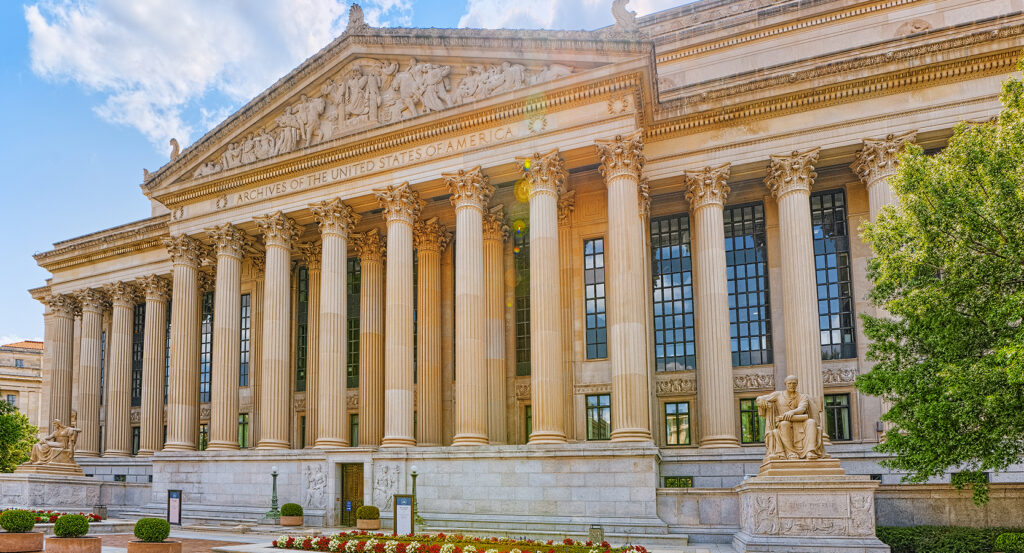
Why you should experience the Rotunda for the Charters of Freedom at the National Archives Museum in Washington, D.C.
The Rotunda for the Charters of Freedom at the National Archives Museum is one of America's most sacred spaces, a quiet temple to democracy itself.
Step inside, and the air seems to still. Beneath a soaring dome of marble and bronze lies the trio of documents that gave birth to the nation: the Declaration of Independence, the Constitution, and the Bill of Rights. These aren't distant relics, they are the living foundation of every freedom, every right, and every civic duty Americans hold today. The parchment glows faintly under protective lighting, its faded ink a reminder of both the fragility and endurance of liberty. The Rotunda's architecture, inspired by the Pantheon in Rome, lends the experience a cathedral-like gravity; voices drop to whispers, and even children seem to sense the weight of history. Standing before these manuscripts, you feel the hum of continuity, the same ideals that once stirred revolution still breathing within these fragile sheets.
What you should know about the Rotunda for the Charters of Freedom.
The Rotunda for the Charters of Freedom was designed by architect John Russell Pope, who envisioned it as a grand sanctuary worthy of the nation's founding documents.
Completed in 1935, the Rotunda was part of Franklin D. Roosevelt's broader vision to make the government's records accessible to its people, an act of democratic transparency. The documents themselves are preserved in state-of-the-art cases crafted by the National Institute of Standards and Technology, each filled with inert argon gas and sealed to maintain perfect temperature and humidity. They're lowered nightly into a secure underground vault, a ritual of reverence and protection. Few visitors realize that the murals flanking the room, painted by Barry Faulkner, depict the Founders not as deities but as citizens, collaborating in spirited debate. The symbolism is deliberate: the Charters are not untouchable idols, but living testaments to human effort, compromise, and vision. Even the lighting was re-engineered in 2003 to reveal the documents more clearly without endangering them, balancing modern preservation with public connection.
How to fold the Rotunda for the Charters of Freedom into your trip.
Begin your visit to the National Archives Museum here, it's the resonant center of the experience.
Arrive early in the day or near closing for a quieter, more contemplative atmosphere. Take your time reading the signatures, the flourishes, the imperfections, each mark tells a story of real people shaping destiny. If you look closely, you can see John Hancock's bold autograph, a symbol of defiance that still commands attention centuries later. Step back and absorb the Rotunda's symmetry, designed to evoke balance, the same principle that anchors the Constitution itself. Afterward, explore the Public Vaults to see how those founding ideals have been challenged and expanded through generations. Before leaving, take one last look at the Charters and imagine the countless eyes that have gazed upon them in reverence, presidents, schoolchildren, veterans, and dreamers alike. The Rotunda for the Charters of Freedom is more than a gallery; it's the heartbeat of a nation, reminding every visitor that liberty must be not only preserved, but continually renewed.
Where your story begins.
Foresyte Travel reveals places that feel extraordinary long before you arrive.
Experience premium editorial crafted for luxury travelers.







































































































