
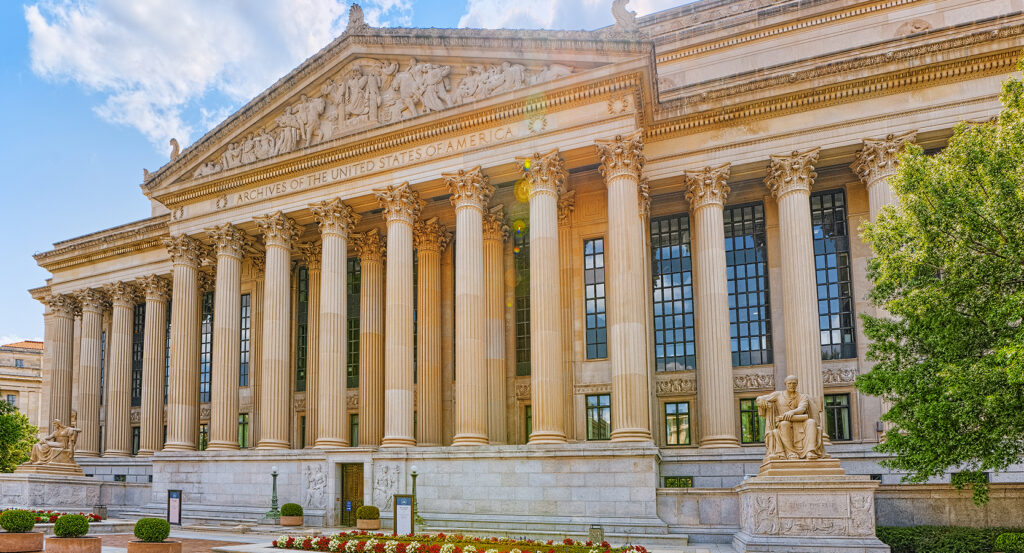
Why National Archives Museum matters.
National Archives Museum in Washington, D.C. is the quiet, beating heart of American democracy, a place where history breathes behind glass and the nation's founding words still whisper to those who come to listen.
Standing like a marble temple between the U.S. Capitol and the White House, the Archives invites you into a space that feels sacred, timeless, and alive with purpose. Designed by architect John Russell Pope, the same visionary behind the Jefferson Memorial, the museum opened in 1935 as a shrine to the written foundations of liberty. Its neoclassical façade, with towering Corinthian columns and inscriptions carved into Indiana limestone, gives the building a solemn majesty worthy of the treasures within. But step past those grand bronze doors and the reverent hush of the Rotunda of the Charters of Freedom will stop you cold. Under a soft amber glow lie the nation's three most important documents: the Declaration of Independence, the Constitution, and the Bill of Rights. They rest in nitrogen-filled cases beneath bulletproof glass, illuminated just enough to reveal the delicate ink that once defined an entire people's destiny. Standing before them, the noise of the modern world seems to fade away, replaced by a tangible awareness that these were not abstract ideals but lived promises, written by human hands that dared to reimagine the world.
What defines National Archives Museum.
Beyond the hallowed Rotunda, National Archives Museum holds a vast universe of stories, far more than its stately exterior might suggest.
The institution houses over 13 billion records, everything from the Emancipation Proclamation and the Louisiana Purchase to NASA mission logs and letters from soldiers written on the eve of war. Yet the museum itself curates this expansive archive into something intimate and accessible. The Public Vaults exhibition, tucked just beyond the main hall, plunges visitors into the living heartbeat of America's memory. Here, glass cases and digital displays bring documents to life, Thomas Jefferson's rough drafts, the telegram ordering the atomic bombing of Hiroshima, audio of President Kennedy's speeches, and census records that trace the fabric of generations. Each artifact is a reminder that history is not abstract, it's the accumulation of choices, hopes, and contradictions that form the nation's identity. Upstairs, the Records of Rights gallery expands that vision, weaving together the ongoing struggle for equality through photographs, petitions, and personal letters. From women's suffrage to civil rights marches and LGBTQ+ activism, this gallery reveals how the promise of the Bill of Rights has been tested, redefined, and reclaimed across centuries. The building itself has its own legends: during World War II, the Declaration and Constitution were secretly transported to Fort Knox for safekeeping, protected from potential attacks on the capital. Even today, the documents are lowered into an underground vault each night, a ritual that feels almost ceremonial, underscoring their fragility and power. The staff of the Archives see themselves not as curators, but as guardians, protectors of the written conscience of a nation. Few institutions in the world carry such a weight of moral stewardship, and yet the atmosphere remains welcoming, even intimate, as if inviting each visitor to join the unending act of remembering.
How National Archives Museum fits.
A visit to National Archives Museum is as much a resonant journey as it is an educational one, a pilgrimage through the living pages of the republic.
Begin your visit early in the day, when the crowds are light and the light filtering through the high skylights fills the Rotunda with a quiet radiance. Step inside and take your time before the Charters of Freedom, each document displayed in its own bronze-framed shrine, aged to a parchment gold that seems to shimmer softly against the green marble base. It's worth reading the signatures closely: Jefferson's elegant hand, Franklin's calm flourish, and Hancock's rebellious boldness, each a reminder of the courage it took to sign one's name to an act of rebellion. From there, move into the Public Vaults, where the museum's interactive exhibits deepen the experience with personal letters, videos, and diaries. This is where history stops being abstract and becomes human, you can hear the voice of a suffragist or read a soldier's last note home. The Records of Rights gallery is a must for reflection, offering context on how the nation continues to wrestle with its founding promises. For younger visitors, the museum also offers the Boeing Learning Center, a lively, hands-on space where kids can explore the Constitution and even “sign” their own copy. Outside, the museum's grand steps open directly onto Constitution Avenue, placing you in the midst of D.C.'s expansive core, a short walk from the National Mall, the Smithsonian museums, and the Washington Monument. Time your visit so that you emerge at dusk, when the marble glows pale pink in the fading light and the city hums softly around you. If you're lucky, you might catch a small group gathered on the steps reading aloud from the Declaration, a tradition that, though informal, captures the essence of what this place represents: a living discussion between past and present.
Where your story begins.
Foresyte Travel reveals places that feel extraordinary long before you arrive.
Enjoy editorial crafted for luxury travelers.
Foresyte may earn a commission when you book.







































































































