
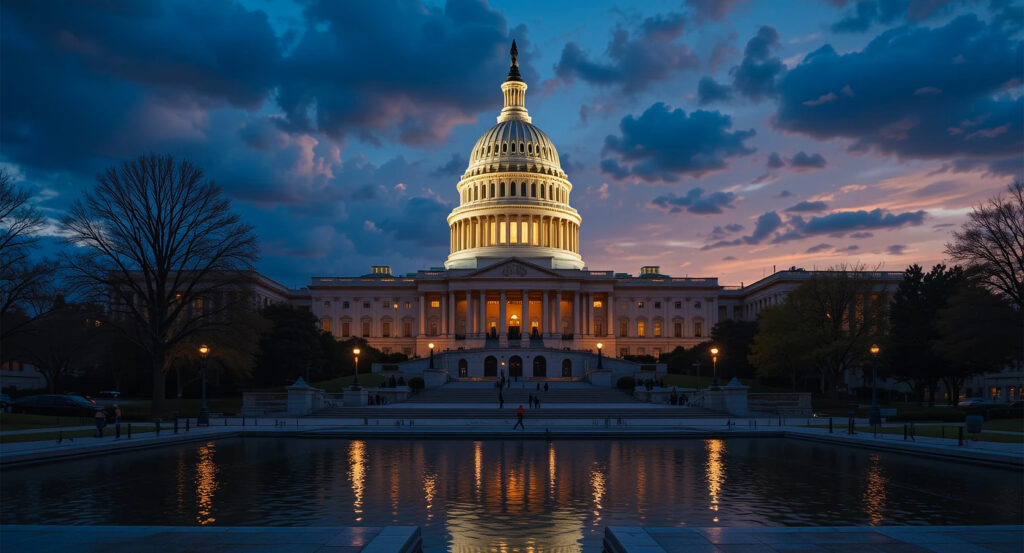
Why Washington Monument matters.
Washington Monument is a towering national memorial where the National Mall's ceremonial landscape meets the founding of the American republic, the architectural ambitions of Robert Mills and the nineteenth-century struggle to commemorate George Washington through one of the world's tallest stone structures.
Rising from the western half of the National Mall between Constitution Avenue and Independence Avenue, the obelisk occupies a prominent elevation south of the White House and east of the Lincoln Memorial, commanding the central axis of Washington, D.C.'s expansive civic landscape. Its tapering marble shaft ascends from a broad square base to a sharply pointed pyramidion, creating an austere geometric form visible across the capital. A subtle change in the color of the exterior stone marks the interruption of construction, preserving a physical distinction between the monument's early and later building campaigns. Fifty American flags encircle the landscaped grounds, establishing a ceremonial perimeter around the monument's substantial masonry foundation. The result is an imposing architectural presence whose extraordinary height, restrained classical form and commanding position establish a defining feature of the nation's capital.
What defines Washington Monument.
Washington Monument is best known for commemorating George Washington, the first president of the United States, through an ambitious obelisk whose construction extended across decades of political conflict, financial difficulties and changing architectural priorities. The movement to establish a national memorial began during Washington's lifetime, with the Continental Congress proposing an equestrian statue in 1783 to honor his leadership during the Revolutionary War. Following his death in 1799, Congress considered additional memorial proposals, including the construction of a mausoleum within the United States Capitol. Political disagreements and changing national priorities delayed these initiatives, leaving the proposed commemoration unrealized for several decades. The Washington National Monument Society formed in 1833, organizing a nationwide fundraising campaign intended to finance an expansive structure through private contributions. Architect Robert Mills won the design competition in 1836 with a proposal combining a towering Egyptian-inspired obelisk and an elaborate circular colonnade containing statues of Revolutionary War figures. The society ultimately concentrated on the obelisk, simplifying the project as financial limitations became increasingly apparent. Construction began on July 4, 1848, when a ceremonial cornerstone was laid before a large public gathering attended by prominent national figures. Early work employed marble quarried in Maryland, with substantial masonry blocks assembled around an interior structure designed to support the enormous vertical load. By 1854, construction had reached 152 feet, but inadequate funding and political controversy halted further progress. The Know-Nothing movement briefly gained control of the monument society, contributing to public distrust and the collapse of fundraising efforts. The outbreak of the Civil War further delayed construction, leaving the unfinished shaft standing above Washington for more than two decades. Congressional legislation in 1876 authorized federal support for completion, coinciding with the nation's centennial celebrations and renewed interest in national commemoration. The United States Army Corps of Engineers assumed responsibility for the project, with Lieutenant Colonel Thomas Lincoln Casey directing substantial engineering modifications to strengthen the foundation and complete the shaft. Construction resumed in 1879 using marble from a different quarry, producing the visible change in exterior coloration that distinguishes the monument's upper and lower sections. The final aluminum pyramidion was installed on December 6, 1884, completing the 555-foot, 5⅛-inch obelisk and establishing the world's tallest structure at the time. The monument was dedicated on February 21, 1885, and opened to the public in 1888, concluding one of the most prolonged and technically demanding memorial projects in nineteenth-century America.
Thomas Lincoln Casey's engineering work transformed the monument's structural foundation, replacing inadequate earlier arrangements with an enlarged system capable of supporting the completed shaft. The original foundation was substantially reinforced and extended, distributing the immense weight of the masonry across a broader underground structure. The monument's interior incorporates a central elevator shaft surrounded by a system of iron stairs and landings, allowing access to the observation level near the summit. Its walls gradually decrease in thickness as the structure rises, reducing weight while preserving the stability of the tapering obelisk. The exterior masonry incorporates marble, granite and sandstone, with carefully fitted blocks creating a continuous load-bearing shell. The aluminum apex, installed before the widespread commercial production of the metal, represented a notable technological achievement during the 1880s. Its upper surface bears inscriptions, including the Latin phrase Laus Deo, meaning Praise be to God. More than 190 commemorative stones were donated by states, cities, organizations and foreign governments, establishing an interior collection of inscriptions associated with the monument's national and international significance. The stones incorporate varied materials, decorative carvings and inscriptions reflecting the diverse communities that contributed to the memorial's construction. The observation level contains windows facing the cardinal directions, providing expansive views across Washington's expansive landscape and the surrounding Potomac River basin. The monument's immense height made it a significant engineering achievement during an era when steel-frame skyscrapers were only beginning to transform American cities. The completion of the Eiffel Tower in 1889 ended its brief position as the world's tallest structure, although the obelisk retained its distinction among expansive stone constructions. A major restoration completed in 2000 addressed deterioration in the masonry and modernized visitor facilities. The 2011 Virginia earthquake caused substantial cracking and displaced stones near the upper portions of the shaft, requiring extensive inspection and structural repairs. The monument reopened in 2014 following stabilization and restoration work, demonstrating the continuing technical challenges associated with preserving its historic masonry. Subsequent elevator modernization and security improvements strengthened public access to the observation level. Washington Monument's architectural significance rests in the combination of its ambitious nineteenth-century engineering, its restrained classical symbolism and its enduring position within the ceremonial geography of the United States.
How Washington Monument fits.
Washington Monument works as the architectural anchor for a National Mall outing connecting the founding principles of American democracy, the memorialization of presidential leadership and the cultural institutions that preserve the nation's historical and artistic heritage.
Begin at World War II Memorial, the expansive national memorial dedicated to Americans who served during the Second World War. Dedicated in 2004, the memorial was designed by architect Friedrich St. Florian and occupies a prominent position between the Washington Monument and the Lincoln Memorial. Its central plaza incorporates a substantial reflecting pool surrounded by fifty-six granite pillars representing the states and territories associated with the wartime United States. Two triumphal arches commemorate the Atlantic and Pacific theaters of military operations, establishing a symmetrical composition focused on the nation's collective wartime experience. The Freedom Wall incorporates 4,048 gold stars, with each star representing one hundred American military deaths. Continue to Lincoln Memorial, the expansive Greek Revival temple dedicated to President Abraham Lincoln. Designed by architect Henry Bacon, the building was completed in 1922 and incorporates thirty-six Doric columns representing the states of the Union at the time of Lincoln's death. Daniel Chester French created the expansive seated statue of Lincoln, whose contemplative expression and commanding scale establish the memorial's central sculptural feature. Interior inscriptions reproduce the Gettysburg Address and Lincoln's Second Inaugural Address, connecting the building's architecture with the nation's struggle over slavery, union and democratic government. The memorial became a defining site of the American civil rights movement when Martin Luther King Jr. delivered his I Have a Dream speech during the March on Washington in 1963. Conclude at National Museum of American History, the Smithsonian institution devoted to preserving and interpreting the material culture of the United States. Established in 1964 as the Museum of History and Technology, the institution occupies a substantial modernist building along Constitution Avenue. Its collections include the original Star-Spangled Banner that inspired Francis Scott Key's national anthem, the Greensboro lunch counter associated with the civil rights movement and significant artifacts from American political, industrial and cultural history. Exhibitions examine the development of American democracy, technological innovation and the changing social experiences of the nation's population. The progression moves from World War II Memorial's commemoration of national sacrifice through Lincoln Memorial's expansive expression of democratic principles and culminates at National Museum of American History's extensive historical collections, placing Washington Monument within the broader civic landscape devoted to the nation's founding, development and collective memory.
Where your story begins.
Foresyte Travel reveals places that feel extraordinary long before you arrive.
Enjoy editorial crafted for luxury travelers.
Foresyte may earn a commission when you book.







































































































