
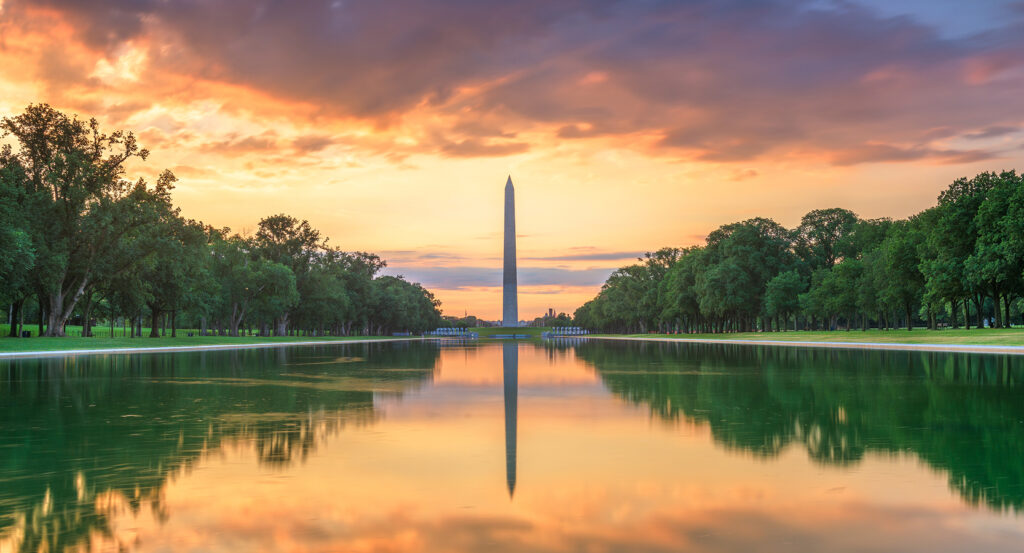
Why National Mall matters.
National Mall in Washington, D.C. is America's open-air soul, where history, memory, and democracy converge beneath a canopy of sky and symbolism.
Stretching two miles from the U.S. Capitol to the Lincoln Memorial, this expansive expanse holds the stories of a nation etched into marble and reflected in water. The air feels charged with quiet reverence, school groups gather by the Reflecting Pool, joggers weave between memorials, and the soft rustle of flags frames the skyline of domes and spires. Walking here is like tracing the heartbeat of the United States, every step crossing eras, from the struggles of independence to the victories of civil rights. Cherry blossoms flutter in the breeze each spring, while in winter the Mall glows with the light of the National Christmas Tree. Yet what makes it extraordinary isn't just the monuments, it's the stillness that sits between them, the sense of shared legacy and possibility. National Mall isn't a destination; it's a pilgrimage into the living narrative of a country.
What defines National Mall.
Behind its serene beauty lies centuries of vision, reinvention, and cultural evolution that shaped it into the symbolic heart of the United States.
The concept dates back to Pierre Charles L'Enfant's 1791 design for Washington, D.C., which envisioned a “grand avenue” to unite the Capitol and the President's House. For decades, the area was little more than swamp and farmland until the McMillan Plan of 1901 formalized its neoclassical grandeur, wide lawns, tree-lined paths, and sightlines that linked monuments to ideals. Over time, the Mall became more than a space for commemoration, it became a stage for history itself. From Martin Luther King Jr.'s “I Have a Dream” speech to presidential inaugurations and marches for justice, the Mall has witnessed the country's highest hopes and deepest reckonings. Its surrounding museums, the Smithsonian Institution's crown jewels, extend its legacy into art, science, and culture, making it among the most visited museum complexes in the world. Yet beneath the grandeur lies a delicate balance of preservation and progress: the Mall remains a living space, renewed by those who walk its paths and add their presence to its story.
How National Mall fits.
To experience National Mall is to walk through time, and to feel both humbled and inspired by the space between monuments.
Start at the U.S. Capitol, letting the dome's white silhouette guide your path westward. Wander past the National Gallery of Art, pausing to explore its sculpture garden before continuing toward the Washington Monument, a marble spire that catches the sunlight and the imagination alike. Descend to the Reflecting Pool, where the Lincoln Memorial rises in quiet majesty at the far end, and linger beneath its columns as history echoes in every inscription. Nearby, the World War II, Korean War, and Vietnam Veterans Memorials remind visitors of sacrifice and unity, each in its own distinct voice. Between stops, detour into the Smithsonian museums that line the Mall, from the Air and Space Museum's rockets to the National Museum of African American History and Culture's bronze lattice façade. Visit at sunset, when the monuments glow amber and the city softens into stillness, or at dawn, when the Mall feels entirely your own. National Mall in Washington, D.C. isn't just the nation's front yard, it's a living monument to its ideals, a space where past and present walk side by side.
Where your story begins.
Foresyte Travel reveals places that feel extraordinary long before you arrive.
Enjoy editorial crafted for luxury travelers.
Foresyte may earn a commission when you book.







































































































