
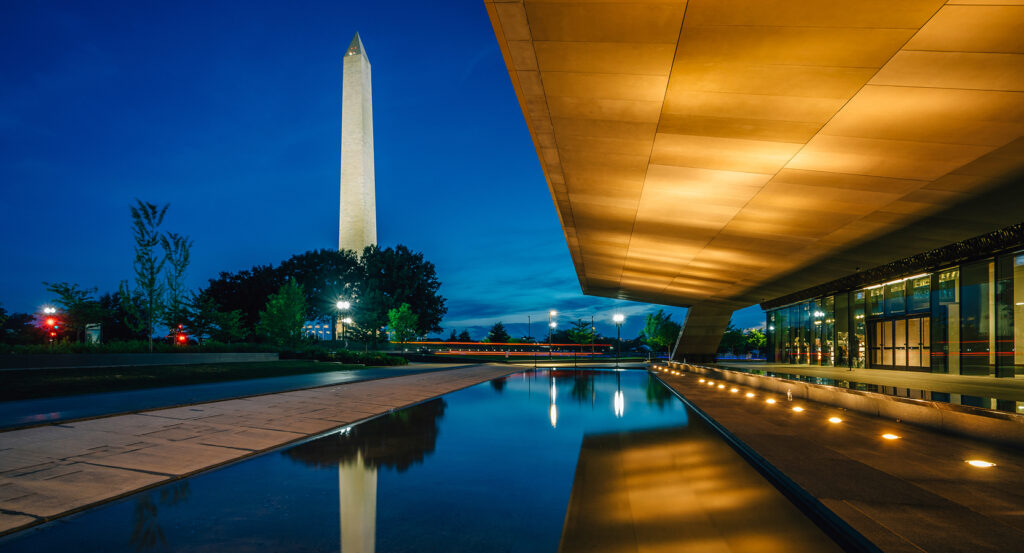
Why National Museum of African American History and Culture matters.
In the shadow of the Washington Monument, National Museum of African American History and Culture, or NMAAHC, rises from the National Mall like a bronze crown, a structure both modern and ancestral, shimmering with the resilience of a people whose story has shaped the soul of America.
From the moment you approach its intricate façade, inspired by Yoruban art and crafted from bronze-colored lattice panels, it's clear this is no ordinary museum. Inside, light and architecture dance in deliberate harmony, guiding you through centuries of triumph, struggle, art, and identity. The experience begins underground, where the story of enslavement unfolds with solemn power: shackles, auction blocks, and whispered names of those who endured. As you ascend floor by floor, history gives way to culture, to rhythm, to pride. Each level feels like exhalation, from the echo of spirituals to the electricity of jazz and hip-hop, from civil rights marches to modern-day activism. Every exhibit radiates intention, balancing grief with glory, silence with song. The NMAAHC isn't just a museum; it's a sacred space, a pilgrimage site that compels empathy, ignites reflection, and reminds every visitor that the American story is incomplete.
What defines National Museum of African American History and Culture.
National Museum of African American History and Culture, part of the Smithsonian Institution, opened in 2016 after nearly a century of advocacy to bring such an institution to life.
Its conception dates back to 1915, when African American veterans of the Civil War proposed a memorial to honor Black achievements, a dream delayed by political opposition but never forgotten. Architect David Adjaye's design honors that perseverance through symbolism: the building's three-tiered corona shape evokes a Yoruban crown, while the bronze panels pay tribute to the ironwork crafted by enslaved artisans in the South. The museum's collection now encompasses more than 40,000 artifacts, though only a fraction are displayed at any one time. Among its most powerful pieces are Harriet Tubman's personal hymnal, Emmett Till's casket, a Tuskegee Airmen aircraft, and Chuck Berry's red Cadillac, each object a vessel of memory. But beyond preservation, the museum tells stories through emotion and context. It offers an unflinching look at slavery and segregation while celebrating the unbreakable creativity that emerged from adversity, from gospel choirs and the Harlem Renaissance to Black cinema and the Obama presidency. Few visitors realize that the museum's architecture is as symbolic as its content: light wells strategically illuminate the journey upward, reflecting hope and rebirth, while the open top floor is surrounded by glass, framing the National Mall as both a stage and a mirror for America's ongoing narrative. Through its curation, programming, and scholarship, the NMAAHC redefines how history is told, not as a linear timeline but as a living conversation that spans generations.
How National Museum of African American History and Culture fits.
A visit to National Museum of African American History and Culture is not something to rush, it's a resonant and intellectual journey that rewards time and presence.
Plan for half a day to move through its six levels of galleries, beginning in the History Galleries located underground. Here, dimly lit halls immerse you in the early chapters of enslavement, resistance, and the birth of Black America, culminating in the Civil Rights Movement. As you rise to the upper levels, the atmosphere shifts, the Community Galleries and Cultural Expressions exhibits explode with life, celebrating achievements in art, music, film, fashion, and sports. Take a moment to stand before the glass walls on the uppermost floor, where sunlight pours over panoramic views of Washington, D.C., as if to suggest that illumination, both literal and spiritual, is the museum's final message. Don't miss the Contemplative Court, a quiet space centered around a cascading fountain that invites visitors to process what they've seen. The museum's Sweet Home Café, featuring regional dishes like Creole gumbo and Carolina barbecue, transforms food into heritage, linking culture to the land and people who shaped it. Admission is free, but timed entry passes are required, so plan ahead, especially during weekends or holidays. Afterward, explore the surrounding monuments of the National Mall, whose meanings deepen immeasurably after the visit. National Museum of African American History and Culture isn't just a place to learn, it's a place to feel, to reckon, and to remember. It stands as both tribute and torch, illuminating not just where we've been, but the promise of what America still can be.
Where your story begins.
Foresyte Travel reveals places that feel extraordinary long before you arrive.
Enjoy editorial crafted for luxury travelers.
Foresyte may earn a commission when you book.







































































































