
Why One Times Square matters.
One Times Square is a distinctive commercial tower where Times Square's theatrical performance meets early skyscraper history, immense electronic displays and the century-old New Year's Eve tradition centered on its rooftop.
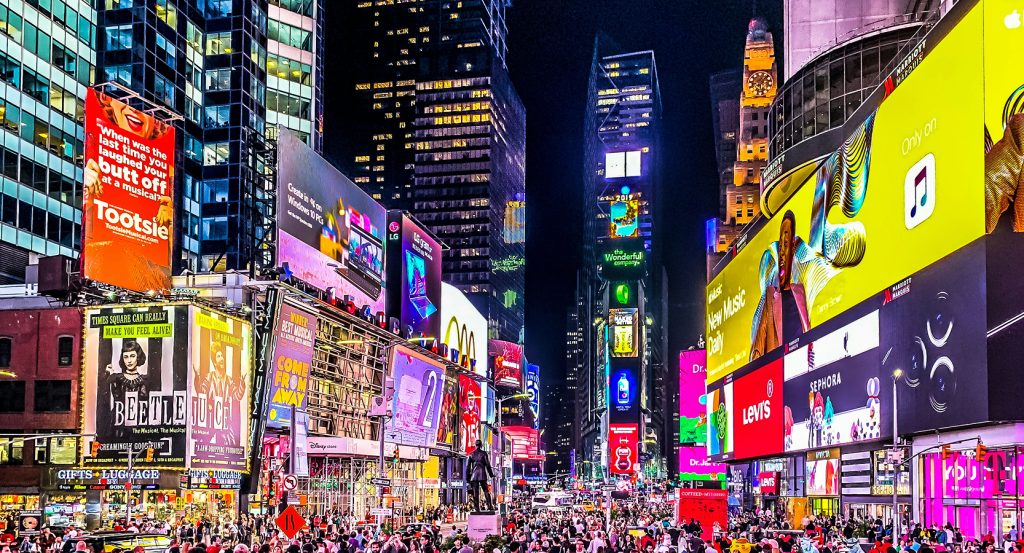
Set on the narrow triangular parcel where Broadway crosses 7th Avenue at West 42nd Street and just steps from the Paramount Building, the tower occupies the southern focal point of the bow-tie-shaped district that took its name from the newspaper headquarters once housed inside. The slender structure rises from a sharply pointed footprint whose restricted geometry produces narrow floor plates and an unusually exposed exterior visible along several major approaches through Times Square. Giant electronic displays now cover much of the elevations, turning the building envelope into an illuminated vertical surface above the pedestrian plazas surrounding its base. A rooftop mast carries the New Year's Eve Ball above the surrounding signs, placing the tower's uppermost structure directly within the principal sightline of the square. The result is a compact skyscraper whose triangular site, narrow vertical mass, electronic exterior and rooftop apparatus concentrate more than a century of Times Square's physical development into a single building.
What defines One Times Square.
One Times Square is best known for beginning as the headquarters of The New York Times and helping give Times Square both its modern name and its enduring New Year's Eve celebration. Publisher Adolph Ochs moved the newspaper toward the intersection of Broadway, 7th Avenue and 42nd Street after acquiring the former Pabst Hotel site, commissioning Cyrus L. W. Eidlitz and Andrew C. McKenzie for a tower completed in 1904. The building stood on four substantial basement levels constructed to accommodate the newspaper's heavy printing machinery, and its height placed the new headquarters among Manhattan's tallest structures. Ochs successfully promoted the renaming of Longacre Square as Times Square during the same year, permanently attaching his newspaper to the surrounding district. The first New Year's Eve celebration associated with the tower marked the headquarters opening in 1904, when an all-day street festival culminated with rooftop fireworks before a crowd exceeding 200,000 people. City restrictions ended the fireworks, prompting Ochs to seek another midnight signal. Metalworker Jacob Starr built the first illuminated ball from iron and wood with 100 25-watt bulbs, producing a five-foot sphere weighing 700 pounds that descended from the tower flagpole to welcome 1908. Starr's Artkraft Strauss subsequently handled the lowering for most of the twentieth century, connecting one Times Square sign company with the ceremony for generations. The New York Times left the tower for West 43rd Street in 1914, yet the annual event remained attached to its former headquarters and continued there apart from the wartime light restrictions of 1942 and 1943.
Where your story begins.
Foresyte Travel reveals places that feel extraordinary long before you arrive.
Enjoy editorial crafted for luxury travelers.







































































































