
Why Pacoima matters.
Pacoima is a resilient enclave where the Northeast San Fernando Valley's suburban character meets nineteenth-century railroad settlement, generations of Black and Latino cultural history and a postwar community shaped outside the Valley's prevailing patterns of racial exclusion.
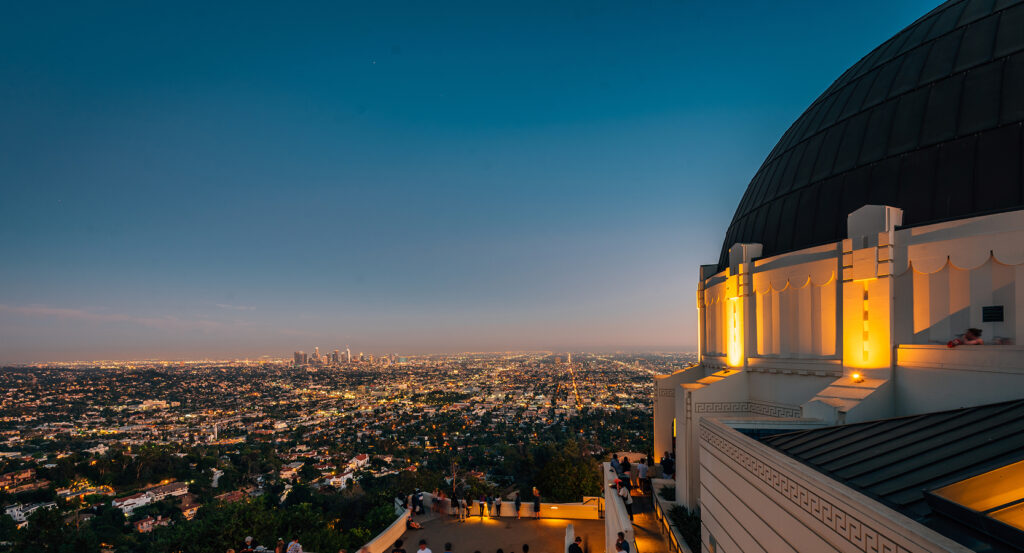
Positioned between San Fernando, Arleta, and Sun Valley, the neighborhood occupies the northeastern Valley floor where the San Gabriel Mountains rise abruptly beyond a broad urban plain crossed by Van Nuys Boulevard and long residential streets extending toward the foothills. Modest detached houses, low commercial buildings, mature residential blocks and broad transportation corridors create a horizontal built environment whose open scale contrasts sharply with the mountain wall dominating northern views. Van Nuys Boulevard supplies the primary encounter through a commercial spine extending across the neighborhood, concentrating storefronts, restaurants and civic gathering points along the route that has linked Pacoima with the wider Valley for generations. Residential streets east and west of that corridor create a secondary passage through compact postwar tracts interspersed with surviving properties from earlier phases of settlement, revealing the neighborhood's growth from a small railroad town into a densely inhabited urban community. The result is a neighborhood whose physical scale remains inseparable from the successive migrations that made Pacoima one of the San Fernando Valley's most consequential centers of Black and Latino life.
What defines Pacoima.
Pacoima is best known for developing from an 1887 railroad settlement into one of the San Fernando Valley's earliest multiethnic communities. Chattanooga lawyer Jouett Allen purchased 1,000 acres beside the Southern Pacific tracks during Southern California's late nineteenth-century real-estate boom, retained half and subdivided the remaining 500 acres for a new town. Allen installed curbs and cement sidewalks, constructed a subterranean dam for water and imposed a $2,000 minimum construction cost on new houses as part of an unsuccessful effort to attract affluent settlers. The regional property boom collapsed during the 1890s, and severe flooding in 1891 destroyed most of Pacoima's earliest buildings after only a depot, schoolhouse, hotel and small collection of houses had appeared. Completion of the Los Angeles Aqueduct in 1913 altered the surrounding Valley economy by supplying water that supported oranges, lemons, peaches, apricots, olives, alfalfa and poultry operations across the Pacoima area. Los Angeles annexed Pacoima with much of the San Fernando Valley in 1915, placing the former speculative railroad town inside the expanding municipality. Pacific Electric service began along Van Nuys Boulevard in 1911, strengthening transportation between the northeastern Valley and Los Angeles during the decades preceding mass automobile ownership. Agricultural land continued to define substantial portions of the area through the first half of the twentieth century before postwar residential construction accelerated its conversion into an urban neighborhood.
Racial restrictions elsewhere in the San Fernando Valley gave Pacoima a radically different social trajectory during the first half of the twentieth century, when Mexican, Japanese and Black households formed an interracial community east of the Southern Pacific tracks. Federal mortgage policies assigned Pacoima their lowest investment grade in 1939, yet the same area became one of the few Valley communities where families excluded from predominantly white subdivisions secured housing. Wartime aircraft production intensified Black migration into Southern California as workers arrived for defense employment at companies including Lockheed Vega in Burbank. By 1950, the San Fernando Valley contained 402,538 residents, with only 2,654 Black residents, and the largest share of that population lived in Pacoima. Churches, neighborhood businesses and gathering places subsequently supported a durable Black community through the postwar decades and the Civil Rights era. Calvary Baptist Church and StylesVille Barbershop & Beauty Shop both emerged in 1957, placing religious life and Black entrepreneurship within the same expanding community. Mexican American settlement grew alongside that history, and Tresierras Supermarket began operating on Van Nuys Boulevard in 1956 as a business closely associated with Pacoima's Latino population. Ritchie Vaview emerged from this cultural landscape during the closing 1950s, purchasing a Remington Street house for his mother in 1958 during the brief recording career that produced “La Bamba,” “Donna” and “Come On, Let's Go” before his death the following year. Pacoima's postwar significance rests in this convergence of migration, racial exclusion, homeownership, local institutions and popular culture, which gave the northeastern Valley a social history fundamentally different from the predominantly white suburban development surrounding it.
How Pacoima fits.
Pacoima works as the anchor for an outing connecting the Spanish colonial complex that gave the Valley its name, a collection built around exacting automobile restoration and an immense flood-control structure created after catastrophic regional inundation.
Begin at Mission San Fernando Rey de España, founded by Franciscan Fermín Lasuén on September 8, 1797 as the seventeenth of Alta California's twenty-one Spanish missions and positioned between San Gabriel and San Buenaventura along El Camino Real. The complex developed around successive adobe structures, with its surviving Convento completed after twelve years of construction in 1822 and distinguished by a long colonnade of nineteen arches; the building contained priests' quarters, a chapel, kitchen, winery, storehouse, reception hall and accommodations for travelers. Earthquake damage eventually claimed the original church, leaving the Convento as the principal surviving structure from the mission period. Continue to The Nethercutt Collection, created by J.B. and Dorothy Nethercutt around a restoration practice that achieved national stature after their 1930 duPont Model G Merrimac Town Car won Best of Show at the 1958 Pebble Beach Concours d'Elegance. J.B. Nethercutt spent nineteen months and $65,000 restoring that automobile, beginning a run that eventually produced six Pebble Beach Best of Show victories. The Sylmar institution now encompasses more than 250 American and European automobiles alongside mechanical musical instruments, antique furniture, a restored steam locomotive and railcar, with manufacturers represented in its Grand Salon including Duesenberg, Isotta-Fraschini, Hispano-Suiza, Rolls-Royce, Bugatti and Maybach. Conclude at Hansen Dam, where the U.S. Army Corps of Engineers constructed an enormous earth-fill barrier between September 1939 and September 1940 as part of the regional response to destructive Los Angeles flooding. The structure stands near the confluence of Big and Little Tujunga washes and works with Sepulveda and Lopez dams across the Los Angeles River drainage system. Its embankment extends 10,475 feet and rises 97 feet, placing one of the Valley's largest pieces of twentieth-century hydraulic engineering directly against the northeastern foothills. The progression moves from the colonial institution that named the San Fernando Valley through a twentieth-century collection devoted to mechanical craftsmanship and culminates at the immense engineering work that reconfigured the relationship between mountain runoff and settlement across the northeastern Valley.
Where your story begins.
Foresyte Travel reveals places that feel extraordinary long before you arrive.
Enjoy editorial crafted for luxury travelers.
Foresyte may earn a commission when you book.





































































































