Why Parc 55 San Francisco matters.
Parc 55 San Francisco is a metropolitan hotel where Union Square's downtown intensity meets the large-scale hotel development of the 1980s through a faceted high-rise by Daniel, Mann, Johnson and Mendenhall, decades of changing hospitality brands and a consequential culinary partnership with Kin Khao.
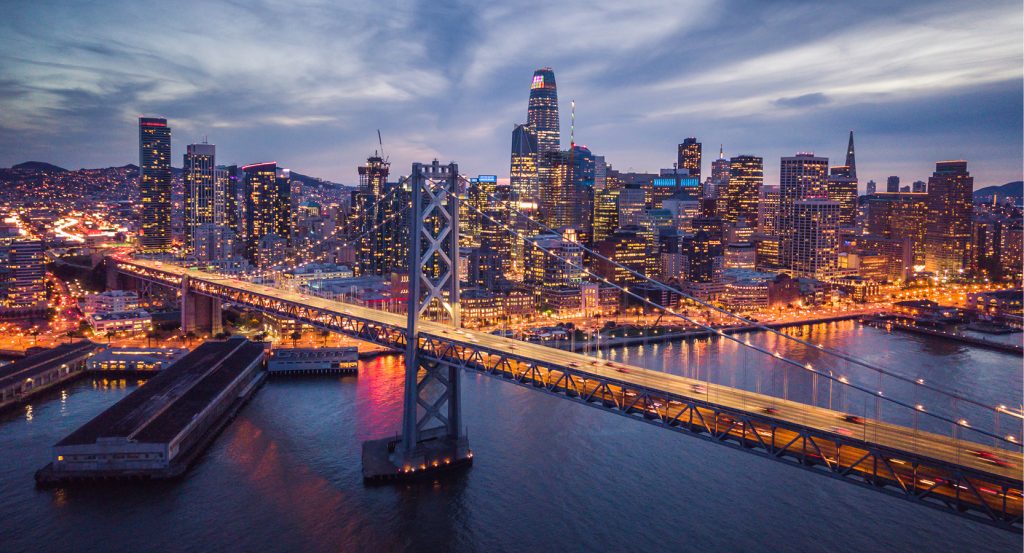
Set along Cyril Magnin Street near Ellis Street and just steps from the Powell Street cable-car turnaround, the hotel occupies Union Square's southern threshold between Market Street's transit spine, the theater blocks extending west through Mid-Market and the retail streets reaching north toward Powell Street, Stockton Street and Chinatown. The 32-story tower rises through a faceted concrete composition whose angled window bays give the broad elevations a strongly geometric profile. Floor-to-ceiling glazing opens upper levels toward downtown, Twin Peaks and San Francisco Bay. A substantial podium and second-floor reception level organize the transition between the vertical tower and the dense pedestrian streets surrounding Powell Station. The result is a hotel whose distinctive high-rise form and transit-centered setting preserve the architectural ambition of San Francisco's 1980s downtown hotel expansion.
What defines Parc 55 San Francisco.
Parc 55 San Francisco is best known for an unusually eventful succession of brands, owners and capital reinvestments that transformed the 1984 Ramada Renaissance into a major Union Square hotel whose history tracks four decades of consolidation across the American hospitality industry. Daniel, Mann, Johnson and Mendenhall designed the 350-foot tower for Ramada's upscale Renaissance division, giving the emerging brand a substantial San Francisco presence. Ramada Renaissance debuted in October 1984 during an era of major hotel construction and redevelopment around Union Square and the Moscone convention district. Oakland-based Park Lane Hotels acquired the property in 1989 and introduced the Parc Fifty Five identity. Marriott International brought the building into Renaissance Hotels in April 1998, producing the Renaissance Parc 55 Hotel name. Rockpoint Group and Highgate Holdings acquired the property for $170 million in December 2006 as part of a three-hotel transaction approaching $250 million. Marriott departed the following month and the building returned to the independent Parc 55 identity. Highgate subsequently directed a three-year renovation with Gensler and Plant Construction that renewed more than 900 private interiors, corridors, banquet areas, ballrooms and the porte cochere. That project relocated the hotel's social center to the second floor, created a new reception area and restaurant and infilled the fourth-floor atrium to expand meeting and pre-function areas. Wyndham Hotel Group incorporated the property in April 2010 as Parc 55 Wyndham San Francisco - Union Square. Blackstone acquired a 76.1 percent interest for $175 million in March 2012 after financial distress under the preceding ownership. Hilton purchased Parc 55 for $525 million in February 2015 through a larger $1 billion three-hotel transaction funded with proceeds from its $1.95 billion sale of the Waldorf Astoria New York. Park Hotels & Resorts assumed the asset through Hilton's 2017 real-estate separation before the hotel and neighboring Hilton San Francisco Union Square entered receivership following default on their shared mortgage. Newbond Holdings and Conversant Capital acquired the two properties for a combined $408 million in November 2025, 75 percent below their combined 2016 appraisal of $1.56 billion, and initiated another major capital-investment chapter.
Kin Khao gives the hotel a separate culinary significance through Pim Techamuanvivit's decision to build a serious Thai restaurant inside Parc 55 after a career in Silicon Valley design research. Techamuanvivit grew up in Thailand within a family culture of ambitious home cooking and taught herself preparations she remembered from her grandmother and aunt. Kin Khao debuted inside the hotel in early 2014 as her first professional restaurant venture. The Thai phrase kin khao translates literally as “eat rice” and functions colloquially as an invitation to eat, giving the restaurant a name grounded directly in Thai dining culture. Housemade curry pastes, sauces and relishes established the kitchen's foundation from its earliest service. Nam pla fish sauce and kapi shrimp paste imported from Thailand give staple preparations ingredients tied directly to the cuisine's country of origin. Northern California produce, locally sourced meat and seafood extend those foundations through ingredients drawn from the restaurant's Bay Area setting. Nam prik long rua combines caramelized pork belly and crispy catfish with spicy shrimp paste, concentrating Techamuanvivit's commitment to fermentation, heat and layered savory flavors in a single preparation. Hor mok develops another traditional form through steamed curry mousse paired with mushrooms and crisp puffed rice cakes. MICHELIN awarded Kin Khao a star in September 2015, one year after its debut, making it the first Thai restaurant in the United States to receive that distinction. Techamuanvivit subsequently assumed leadership of Nahm at COMO Metropolitan Bangkok, extending a restaurant career that began inside Parc 55 into one of Thailand's internationally prominent kitchens. Kin Khao closed with the hotel in March 2020 and returned in September 2022 after Parc 55 resumed operations, reassembling the restaurant around the same chef-owner and culinary direction. MICHELIN continues to include Kin Khao in its San Francisco selection, preserving an unusual relationship in which a large convention-oriented hotel contains one of the most consequential Thai restaurants in American dining.
How Parc 55 San Francisco fits.
Parc 55 San Francisco works as an anchor for an outing connecting the Tenderloin's preservation movement, Market Street's surviving movie-palace architecture and a century-old theater transformed by American Conservatory Theater into a contemporary performance institution.
Begin at Tenderloin Museum, whose origins reach to the 2009 creation of Uptown Tenderloin, Inc., a nonprofit formed to increase recognition of the neighborhood's architectural and cultural history. The organization sponsored the application that created the national Uptown Tenderloin Historic District, encompassing 409 buildings entered on the National Register of Historic Places. 100 historic building plaques and nine Lost Landmark sidewalk plaques subsequently carried that preservation work directly into neighborhood streets. Tenderloin Museum opened in 2015 after years of community planning, establishing a permanent institution devoted to local architecture, immigration, labor, nightlife, LGBTQ activism and music. More than 2,500 people entered during its first months, and neighborhood residents became guides for an extensive walking-tour program. Continue to The Warfield, commissioned by theater magnate Marcus Loew and designed by G. Albert Lansburgh as a vaudeville and movie palace. The building opened on May 13, 1922 as the 300th theater in Loew's expanding chain and took its name from San Francisco-born actor David Warfield. Albert Herter painted the elaborate mural above the proscenium, complementing an interior of marble, chandeliers, ornamental plaster and a grand balcony staircase. Bill Graham Presents converted the building into a concert hall in 1979 with a two-week Bob Dylan engagement, beginning a musical chapter later encompassing artists including Nirvana, Adele and H.E.R. Conclude at A.C.T.'s The Strand, a 1917 silent-film theater acquired by American Conservatory Theater in 2012 after years of decline and closure. Skidmore, Owings & Merrill transformed the building into a nonprofit performance complex centered on a 283-seat theater, an additional flexible performance room and educational facilities. The renewed Strand opened in 2015 and received a 2016 Urban Land Institute Global Award for Excellence. The progression moves from Tenderloin Museum's preservation of a nationally significant neighborhood through The Warfield's evolution from Loew vaudeville palace to concert hall and culminates in A.C.T.'s The Strand's conversion of a shuttered silent-film theater into a center for contemporary performance and arts education.
Where your story begins.
Foresyte Travel reveals places that feel extraordinary long before you arrive.
Enjoy editorial crafted for luxury travelers.
Foresyte may earn a commission when you book.