
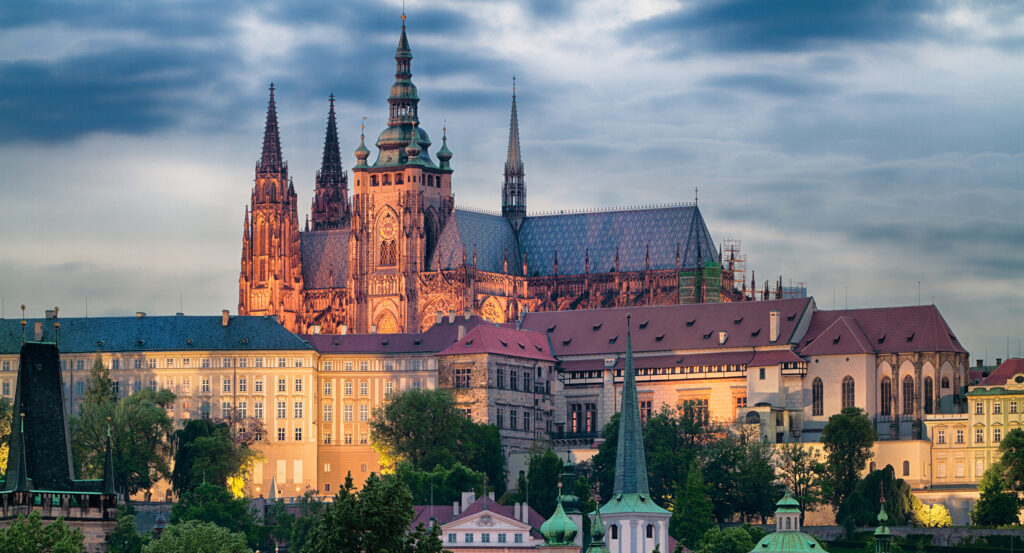
Why Golden Lane matters.
Golden Lane is Prague Castle's whispering corridor, a narrow cobbled street where centuries of stories linger behind brightly painted doors.
Unlike the towering grandeur of St. Vitus or the solemn vastness of the Old Royal Palace, this lane feels personal, almost secret. Its scale is disarmingly human, low ceilings, crooked windows, and houses so small they seem borrowed from a storybook. Yet within this modest stretch of stone lies the daily life of those who served the castle's greatness, alchemists, archers, goldsmiths, and dreamers. The pastel facades, blue, yellow, green, glow in soft light, while wooden shutters creak faintly in the wind. Walking here feels like slipping into the pages of a forgotten tale. Every step is an echo of quiet resilience, proof that the heartbeat of history doesn't always thunder; sometimes it hums.
What defines Golden Lane.
Despite its name, no gold was ever minted or discovered here.
The lane takes its title from the goldsmiths who once lived and worked in these miniature houses during the 16th century, crafting jewelry and relics for the royal court. Before them, the lane was home to castle guards, hence its earlier name, Zlatnická ulička, the Street of Goldsmiths. Over the centuries, it transformed into a microcosm of Prague's social evolution. In the 19th century, the poor and displaced occupied the abandoned workshops, turning them into makeshift homes. One of its most famous residents was Franz Kafka, who wrote here briefly in 1916 at house number 22, finding solace in its solitude. During the 20th century, many of the houses became studios for artists and writers, their interiors filled with books, canvases, and candlelight. After restoration in the 1950s, Golden Lane was preserved as a living museum, each house now curated to represent a different moment in time. Step inside, and you move from an alchemist's workshop to a 19th-century seamstress's room to a World War II soldier's quarters, a timeline compressed into a few meters of cobblestone. Few realize that beneath the lane, secret passages once linked to the castle's fortifications, tunnels used by guards and messengers during sieges and uprisings.
How Golden Lane fits.
Visit in the early morning or at twilight, when the street is quiet and shadows stretch across its uneven stones.
Enter from the north side of Prague Castle, descending the slope that leads to the lane's entrance beside Daliborka Tower. Take your time, each house tells its own story through details: a flickering lamp, a set of antique keys, a handwritten recipe pinned to a wall. The upper floors host small exhibits on medieval weapons, armor, and domestic life, offering a tactile sense of how people lived in the castle's shadow. Don't rush past Kafka's house; it's easy to miss, but worth pausing for. Imagine the writer at his desk, ink-stained fingers tracing words in the faint light of a single candle. End your visit near the exit at the White Tower, where the view opens toward the rooftops of Malá Strana, terracotta waves rolling toward the river. As dusk falls, Golden Lane transforms, lanterns flicker, windows glow, and the centuries between then and now dissolve. It's a rare place where history still feels alive in miniature, where whispers outlast empires.
Where your story begins.
Foresyte Travel reveals places that feel extraordinary long before you arrive.
Enjoy editorial crafted for luxury travelers.
Foresyte may earn a commission when you book.





































































































