
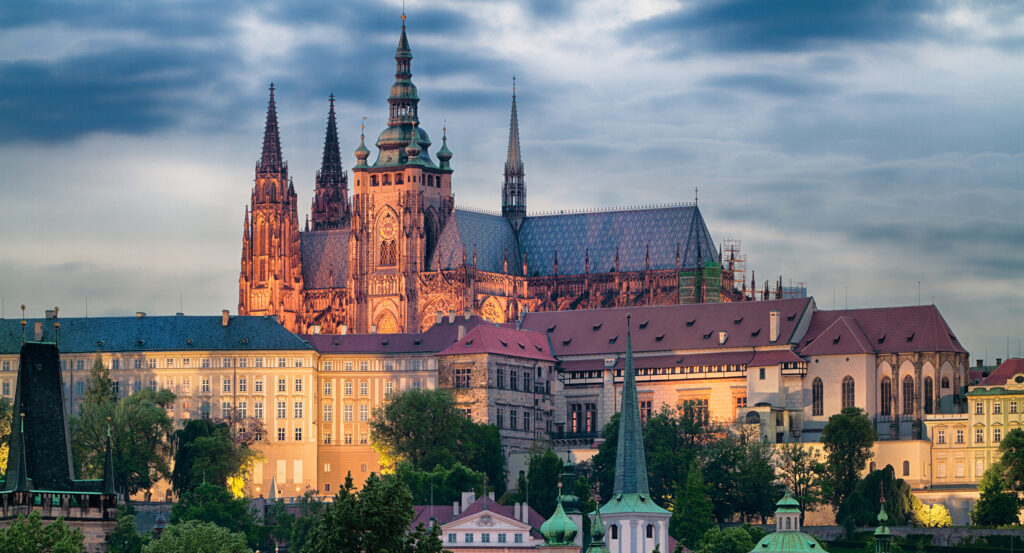
Why Old Royal Palace matters.
Old Royal Palace is where history feels close enough to touch, a structure that still breathes with the echoes of kings, courtiers, and revolutionaries.
It's less an opulent seat of monarchy than a tribute to endurance, a blend of Romanesque strength and Gothic grace that has shaped the political soul of Prague for centuries. Step inside Vladislav Hall and you feel it instantly: vast, vaulted ceilings rippling like fabric, sunlight pouring through tall arched windows, and a silence so dense it feels alive. The space is both austere and majestic, grand enough to host coronations and banquets, yet solemn enough for proclamations and parliaments. From the outside, its stone walls appear restrained; from within, they hold the gravity of decisions that have altered the course of nations. The palace doesn't shout its history, it connects with it.
What defines Old Royal Palace.
The palace began as a modest 12th-century Romanesque residence built for the Přemyslid dynasty before expanding into the Gothic masterpiece it is today.
King Wenceslas IV first enlarged it in the 14th century, but it was under Vladislav II in the late 15th century that the palace found its voice. Architect Benedikt Rejt designed the famed Vladislav Hall, an architectural marvel whose ribbed vaults twist and intersect like stone vines. At 62 meters long and 16 meters high, it was the largest secular hall in medieval Europe, used for royal feasts, knightly tournaments, and later, under the Habsburgs, parliamentary sessions. The adjoining Rider's Staircase, built wide enough for mounted horses to ascend directly into the hall, remains one of Prague's most iconic architectural gestures. Few visitors realize that beneath the palace lies a warren of chambers used as administrative offices and storage for the Bohemian Chancellery, the same offices where, in 1618, Protestant nobles defenestrated two imperial governors, triggering the Thirty Years' War. The palace's later Renaissance wings, added by Ferdinand I, introduced elegance to its gravity, vaulted loggias, painted ceilings, and arcaded galleries overlooking the castle's southern gardens. It is here that Czech democracy was first proclaimed in 1918 and where new presidents continue to be sworn in today, a bridge between medieval monarchy and modern statehood.
How Old Royal Palace fits.
Begin your visit in Third Courtyard, where the palace's façade appears understated beside the soaring bulk of St. Vitus Cathedral.
Enter through the Gothic portal into Vladislav Hall, pause in its center to look upward, where the ribs of the ceiling crisscross like the branches of a cathedral forest. Imagine the space alive with sound, trumpets, hoofbeats, and the murmurs of nobles awaiting royal decree. Follow the passage into the Diet Hall, where centuries of governance were debated beneath frescoed vaults, and then descend into the Romanesque cellars to glimpse the foundations of the original palace. Stand by the windows overlooking the city, Prague sprawls below like a painting in motion, its bridges and domes glowing in the afternoon light. Visit in the morning for calm reflection, or just before closing, when the last rays of the sun ignite the hall's sandstone walls. Before leaving, walk the Rider's Staircase, it's impossible not to imagine the performance of knights ascending in armor centuries ago. Old Royal Palace isn't just an architectural relic, it's a living memory of sovereignty, faith, and revolution, where stone and silence still carry the weight of a nation's destiny.
Where your story begins.
Foresyte Travel reveals places that feel extraordinary long before you arrive.
Enjoy editorial crafted for luxury travelers.
Foresyte may earn a commission when you book.





































































































