
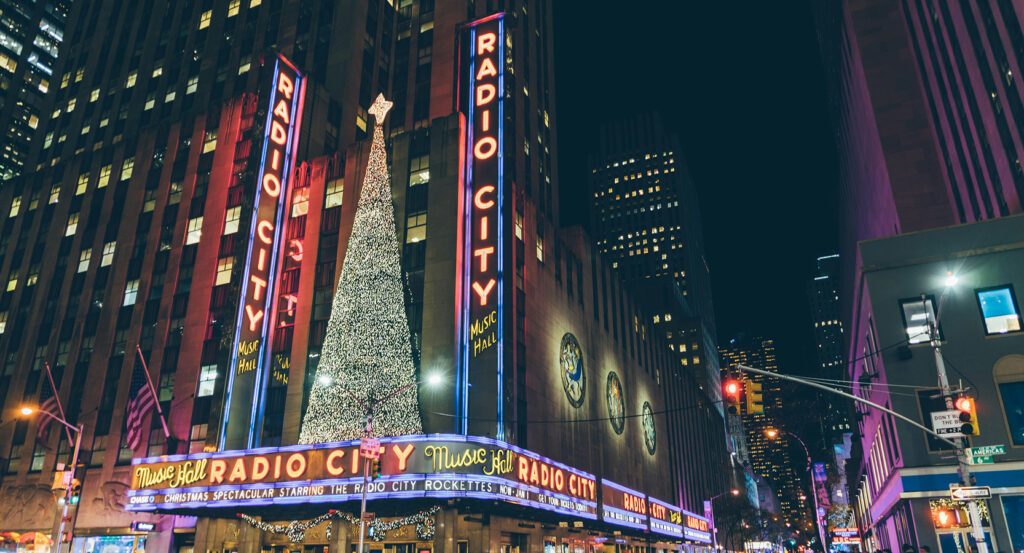
Why Radio City Music Hall matters.
Radio City Music Hall is a striking Art Deco theater where Rockefeller Center's entertainment heritage meets sweeping architectural curves, immense theatrical scale and Donald Deskey's coordinated vision for a modern American performance palace.
Set along 6th Avenue near West 50th Street and just steps from Rockefeller Plaza, the theater occupies the western edge of Rockefeller Center beneath the adjoining office tower at 1270 Avenue of the Americas. A vast auditorium unfolds beneath eight glowing ceiling arches, with three shallow mezzanines projecting from the rear wall without supporting columns interrupting views toward the stage. The 60-foot-high, 100-foot-wide proscenium frames a Great Stage engineered for cinema, dance, orchestral performance and elaborate scenic production across a room extending 160 feet between stage and rear wall. Public circulation passes through a soaring Grand Foyer and multiple lounges whose furniture, textiles, lighting and decorative art were conceived as components of the same architectural scheme. The result is a theater whose immense auditorium, uninterrupted sightlines, cascading ceiling arches, expansive stage and richly developed public rooms give mass entertainment an architectural scale rarely matched in New York.
What defines Radio City Music Hall.
Radio City Music Hall is best known for translating Samuel Lionel “Roxy” Rothafel's ideas about mass entertainment into a vast theater built within Rockefeller Center during the Great Depression. John D. Rockefeller Jr.'s original plans for the complex centered on a Metropolitan Opera development, but the collapse of that project after the 1929 financial crisis redirected the western blocks toward commercial and entertainment uses. Radio Corporation of America became central to the revised undertaking under president David Sarnoff, whose company joined broadcasting, motion pictures and technological development across the emerging complex. RKO, formed in 1928 through interests associated with Sarnoff and Joseph P. Kennedy, supplied another connection between radio and cinema as Rockefeller Center's entertainment district took shape. Rothafel brought experience from the Capitol and Roxy theaters to the new project, pursuing an immense house capable of combining stage performance with motion pictures for large audiences. Edward Durell Stone served as design supervisor within the Rockefeller Center architectural team, shaping the theater around an auditorium that held 6,200 seats when completed. Donald Deskey won the interior commission and rejected conventional European theater decoration for a modern program extending through furniture, carpets, wall coverings, lighting fixtures and commissioned art. Deskey employed aluminum, chrome, Bakelite, cork and richly finished woods alongside luxurious surfaces, giving industrial products a prominent place within an elite decorative commission. Radio City Music Hall opened in December 1932 as one of Rockefeller Center's earliest completed entertainment components and the world's largest indoor theater at the time. The early program combined stage entertainment, cinema, ballet, opera, jazz and precision dancing, placing multiple performance traditions within the same immense house.
A separate engineering history lies beneath the Great Stage, where machinery conceived for rapid theatrical change remains one of the building's most consequential technical achievements. Three enormous hydraulic elevators divide the stage floor into movable sections, with a separate orchestra elevator and a turntable supporting changes in elevation, musicians, scenery and production effects. The elevator system attracted attention from the United States Navy during World War II, and the hydraulic principles behind the machinery were studied during development of aircraft-carrier elevator technology. A Mighty Wurlitzer organ built for the theater contains two identical consoles and thousands of pipes distributed through chambers around the auditorium, allowing organists to command the instrument from either side of the stage. Radio City shifted heavily toward film presentations during the following decades, pairing major Hollywood releases with stage productions and the Rockettes. A proposed 1978 closure provoked a major preservation campaign, and New York City protected the interior that year as public pressure mounted against demolition or substantial alteration. The theater survived and continued operating, then entered an extensive restoration under Hugh Hardy and Hardy Holzman Pfeiffer Associates during 1999. The seven-month, $70 million undertaking covered 500,000 square feet, restoring early carpet patterns, wall coverings, upholstery, murals, Deskey furniture, light fixtures and exterior illumination while upgrading production lighting, sound and rigging. Original stage machinery remained in service alongside newer theatrical systems after the work, preserving an uncommon link between Depression-era engineering and contemporary production. Radio City Music Hall emerged from that campaign with its principal architectural and technical components renewed inside a building still devoted to large-scale performance.
How Radio City Music Hall fits.
Radio City Music Hall works as the anchor for a Midtown outing connecting broadcast preservation, Broadway history and the concert tradition that shaped New York performance long before Rockefeller Center rose.
Begin at The Paley Museum, rooted in William S. Paley's 1975 creation of an institution devoted to collecting, preserving and interpreting television and radio programming. The Museum of Broadcasting opened on November 9, 1976 with 718 broadcasts available across three floors of converted office space, then became The Museum of Television & Radio in 1991 as cable and satellite programming widened its remit. Philip Johnson designed the William S. Paley Building on West 52nd Street, which opened as the institution's new home that September. The Paley Archive has since grown beyond 160,000 programs, extending Paley's original preservation project across decades of broadcasting and electronic media. Continue to The Museum of Broadway, created by Julie Boardman and Diane Nicoletti with a curatorial team spanning theater history, costumes, props, scenic production and Broadway geography. Jennifer Ashley Tepper developed the Map Room, Ben West curated the historical timeline walls, Michael McDonald and Lisa Zinni worked with costumes and props, and John Kenrick contributed to the section devoted to pivotal theatrical developments. David Rockwell joined the creative roster through Rockwell Group, placing a major theater architect within a project devoted to the people and production disciplines behind Broadway. The institution organizes Broadway history through theatrical chronology and production craft, giving the commercial stage a dedicated museum within the Theater District. Conclude at Carnegie Hall, where Andrew Carnegie financed William Burnet Tuthill's Italian Renaissance concert building and opened the Music Hall in May 1891 with a five-day festival featuring Walter Damrosch and Pyotr Ilyich Tchaikovsky. Heavy masonry, iron-spotted brick, terra cotta and Guastavino vaulting shaped the original building, whose Main Hall quickly became a premier setting for classical music. Demolition threatened the property during the 1950s before violinist Isaac Stern led the Committee to Save Carnegie Hall, stopping the scheduled 1960 destruction and securing the building's survival. The hall subsequently continued across classical music, jazz, popular music and public speech, carrying a nineteenth-century concert institution deep into modern New York cultural history. The progression moves from Paley's preservation of broadcasting through a museum devoted to Broadway's creators and culminates in Carnegie's nineteenth-century concert hall, connecting three institutional chapters in the development and preservation of performance culture across Midtown.
Where your story begins.
Foresyte Travel reveals places that feel extraordinary long before you arrive.
Enjoy editorial crafted for luxury travelers.
Foresyte may earn a commission when you book.







































































































