
Why Rockefeller Center matters.
Rockefeller Center is an ambitious Art Deco complex where Midtown's commercial energy meets limestone towers, sunken public spaces and an integrated program of architecture, sculpture, murals and landscape conceived at the scale of several city blocks.
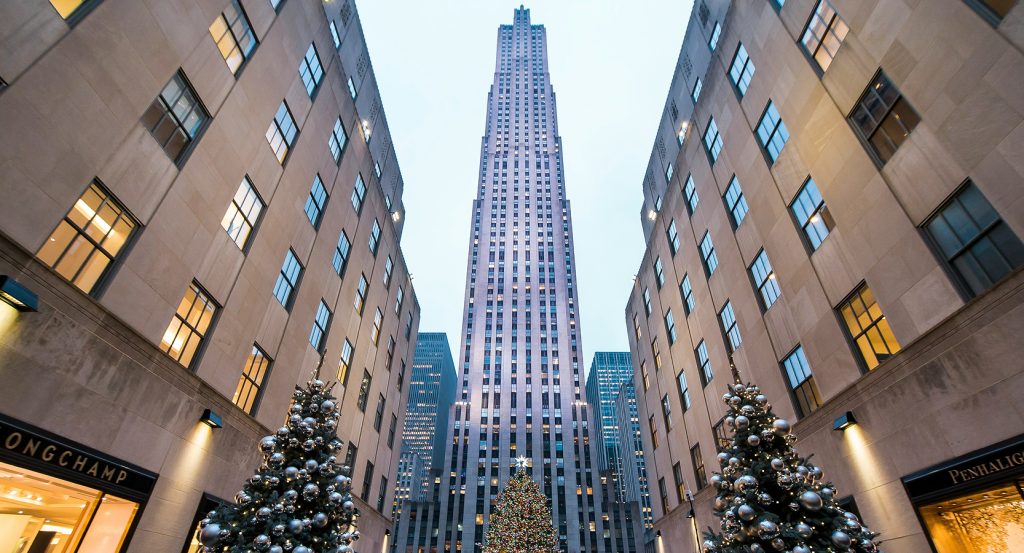
Set between Fifth and Sixth Avenues near West 49th Street and just steps from Saint Thomas Church Fifth Avenue, the complex occupies a 22-acre Midtown site organized around Rockefeller Plaza and a sequence of pedestrian spaces extending west from 5th Avenue. Indiana limestone unifies towers of different heights and functions, with setbacks, vertical piers and carefully proportioned masses directing attention toward the central axis rather than allowing any single facade to define the ensemble. The Channel Gardens establish an east-west approach through planted beds and fountains before the ground descends toward the Lower Plaza, turning changes in elevation into an integral part of movement through the complex. Rooftop gardens extend planted surfaces above several lower buildings, fulfilling an early planning strategy that treated views from surrounding offices as part of the architectural composition. The result is a coordinated urban complex whose towers, gardens, descending plazas and limestone architecture transform multiple Midtown blocks into a spatial composition designed as carefully between buildings as within them.
What defines Rockefeller Center.
Rockefeller Center is best known for converting John D. Rockefeller Jr.'s failed plan for a new Metropolitan Opera complex into one of the largest privately financed building campaigns of the Great Depression. Rockefeller began assembling the site in 1928, leasing land from Columbia University for the proposed opera project before the 1929 stock-market crash helped end the Metropolitan Opera's participation. Rockefeller proceeded with a commercial development financed substantially through his own resources, and construction employed more than 40,000 people during the Depression. John R. Todd directed development, with Raymond Hood becoming the strongest architectural voice among the Associated Architects, whose firms included Reinhard & Hofmeister, Corbett, Harrison & MacMurray, and Hood & Fouilhoux. Radio Corporation of America subsequently became a pivotal tenant, securing naming rights for the entertainment district, exclusive broadcasting privileges among the complex's tenants and its name atop the central skyscraper. Excavation for the RCA Building began with 300 workers in July 1931, steel construction followed in early 1932 and the enormous structure was completed only 13 months later. The central tower combined a 70-story eastern office block with lower sections extending more than 1,000 feet toward 6th Avenue, creating immense rentable capacity without sacrificing daylight around its principal vertical mass. Rockefeller Center began opening in May 1933, yet construction continued across the decade as additional buildings completed the original ensemble through 1940. New York City designated the complex as a historic district in 1985, formalizing architectural protection for a project whose planning had joined private finance, broadcasting, entertainment, offices and public space during one of the most difficult economic periods in American history.
An extensive art program gave the architecture a separate intellectual system centered on labor, knowledge, communication and technological advancement. Abby Aldrich Rockefeller supported modern artistic thinking during the Center's development, and more than 100 works eventually became associated with the campus. Lee Lawrie became one of its principal sculptors, creating Wisdom above the main entrance of 30 Rockefeller Plaza as a limestone and glass composition integrated directly into the skyscraper's facade. Lawrie also conceived Atlas for the 5th Avenue forecourt of 630 5th Avenue, with René Paul Chambellan modeling the heroic bronze figure carrying an armillary sphere representing the heavens. Paul Manship developed Prometheus for the Lower Plaza, placing the gilded mythological figure above the sunken level against a red granite wall carrying words adapted from Aeschylus. José Maria Sert filled the main lobby ceiling at 30 Rockefeller Plaza with Time and created American Progress for its west wall, joining expansive painting with the sculptural program embedded throughout the complex. Leo Friedlander contributed limestone panels devoted to television and radio above the tower's 49th and 50th Street entrances, tying the building's artistic program directly to the communications industries occupying it. René Paul Chambellan worked across additional commissions, executing bronze plaques and stainless-steel doors at Radio City Music Hall and designing six bronze fountainhead figures for the Channel Gardens. Rockefeller Center's artistic program became inseparable from its architecture, distributing sculpture, murals, mosaics and decorative metalwork across entrances, lobbies, gardens and plazas instead of confining commissioned art to a single ceremonial location.
How Rockefeller Center fits.
Rockefeller Center works as the anchor for a Midtown outing connecting nineteenth-century Catholic ambition, dramatic postwar architecture and an American Renaissance collection transformed from private library into public institution.
Begin at St. Patrick's Cathedral, where Archbishop John Hughes announced plans for a new cathedral in 1853 and commissioned James Renwick Jr. to design the white-marble Gothic Revival building between Fifth and Madison Avenues. The cornerstone was laid in 1858, construction stopped during the Civil War and resumed after Hughes's death under Archbishop John McCloskey, culminating in the formal opening on May 25, 1879. The twin spires were completed in 1888 under Archbishop Michael Corrigan, and the Lady Chapel followed from 1900 through 1908, with stained-glass windows produced in England, France and Germany arriving over the following decades. More than $4 million had been spent by the cathedral's 1910 consecration, tracing a building campaign extending across successive generations of New York Catholic leadership. Continue to Austrian Cultural Forum New York, where Raimund Abraham won a 1992 Republic of Austria competition against 225 other architects for an exceptionally narrow site measuring only 25 feet by 81 feet. Construction began in September 1998, and the 30,000-square-foot concrete, glass and steel tower opened publicly in April 2002 as Abraham's first major United States project. Twenty-four stories rise through alternating setbacks and sloping planes shaped by Manhattan zoning constraints, compressing galleries, a theater, library, seminar rooms, offices, a director's residence and an open-air upper loggia into the slender structure. Ove Arup & Partners supplied engineering for a building whose severe dimensional restrictions became the premise for one of Midtown's most distinctive contemporary architectural works. Conclude at The Morgan Library & Museum, where Pierpont Morgan commissioned Charles Follen McKim in 1902 to create a private library for manuscripts, rare books, drawings and prints that had outgrown Morgan's residences and storage arrangements. McKim completed the Tennessee pink-marble Italian Renaissance-inspired building in 1906, integrating architecture, sculpture, painting and exceptional craftsmanship around the collector's library and study. J. P. Morgan Jr. converted the collection into a public institution in 1924, Benjamin Wistar Morris completed an Annex in 1928 and Renzo Piano later united the historic buildings through steel-and-glass pavilions during the 2006 expansion. The progression moves from Renwick's multigenerational cathedral through Abraham's compressed Austrian cultural tower and culminates in McKim, Morris and Piano's evolving home for Pierpont Morgan's collections, tracing three radically different architectural responses to institutional ambition across Midtown.
Where your story begins.
Foresyte Travel reveals places that feel extraordinary long before you arrive.
Enjoy editorial crafted for luxury travelers.
Foresyte may earn a commission when you book.







































































































