
Why you should experience Raphael Room at Isabella Stewart Gardner Museum in Boston, Massachusetts.
Raphael Room at Isabella Stewart Gardner Museum is an extraordinary Renaissance gallery where Fenway-Kenmore's artistic legacy, Italian humanism, museum craftsmanship, and Isabella Stewart Gardner's curatorial vision converge within one of America's most celebrated museum interiors.
Set on the second floor of the Isabella Stewart Gardner Museum near the Early Italian Room and just steps from the Short Gallery, this richly appointed gallery surrounds visitors with Renaissance paintings, ancient Roman antiquities, sumptuous textiles, carved furnishings, and carefully orchestrated architectural details that evoke the atmosphere of an Italian palace. Deep crimson damask walls, Venetian furnishings, grand velvet draperies, and restrained natural light create an intimate setting where every artwork contributes to a unified artistic composition. Every object reflects Gardner's meticulous attention to harmony, proportion, and historical atmosphere. The result is a gallery defined by curatorial brilliance, Renaissance scholarship, and one of America's finest museum interiors.
What you should know about Raphael Room at Isabella Stewart Gardner Museum.
Raphael Room at Isabella Stewart Gardner Museum is best known for housing the first painting by Raphael ever brought to the United States, acquired by Isabella Stewart Gardner in 1898, an acquisition that inspired the creation of an entire gallery devoted to the ideals of the Italian Renaissance. When the museum opened in 1903, Gardner arranged the room as an immersive architectural environment rather than a conventional picture gallery, combining masterpieces by Raphael, Sandro Botticelli, Carlo Crivelli, Fra Angelico, Perugino, Neroccio di Bartolommeo de' Landi, and other fifteenth- and sixteenth-century Italian painters with ancient Roman wall paintings, marble sculptures, classical vases, Renaissance furniture, Venetian mirrors, majolica ceramics, and decorative arts spanning nearly two millennia. At the center of the gallery stands Raphael's Pietà (Lamentation over the Dead Christ), painted around 1504 as part of the Colonna Altarpiece for a convent in Perugia, intentionally displayed on an easel with a chair positioned before it to encourage quiet contemplation exactly as Gardner envisioned. The gallery also features Raphael's celebrated Portrait of Tommaso Inghirami, among only two surviving versions of the portrait, together with Botticelli's grand The Story of Lucretia, among the museum's most important Renaissance masterpieces. Gardner conceived every relationship between paintings, textiles, furniture, sculpture, and architecture as a unified work of art, even constructing the dramatic crimson wall coverings from numerous fragments of historic Italian silk damask painstakingly stitched together. Between 2014 and 2018, the museum undertook a meticulous $1.25 million conservation project that dismantled the gallery to its structural structure, restored more than 50 paintings, sculptures, furnishings, and textiles, recreated the historic wall fabrics using traditional weaving techniques developed with the renowned French textile house Prelle, introduced ultraviolet-protective glazing and improved environmental controls, and faithfully returned the room to the energetic appearance Gardner intended when the museum first opened in 1903.
The architectural composition exemplifies Gardner's revolutionary belief that individual masterpieces achieve greater meaning when experienced within a carefully choreographed historical environment. Heavy velvet curtains, richly layered silk textiles, Venetian furniture, Roman antiquities, and Renaissance paintings interact as a single immersive installation where color, scale, texture, and light are balanced with exceptional precision. The restoration reaffirmed Gardner's original philosophy by preserving not merely the paintings but the complete physical experience she created, allowing visitors to encounter the Renaissance through atmosphere as much as individual objects. Every detail demonstrates how visionary collecting, architectural design, conservation science, and curatorial scholarship have combined to preserve one of the most extraordinary museum galleries in the United States.
How to fold Raphael Room at Isabella Stewart Gardner Museum into your trip.
The Raphael Room works as the Renaissance centerpiece of an exploration through the Isabella Stewart Gardner Museum's extraordinary collections.
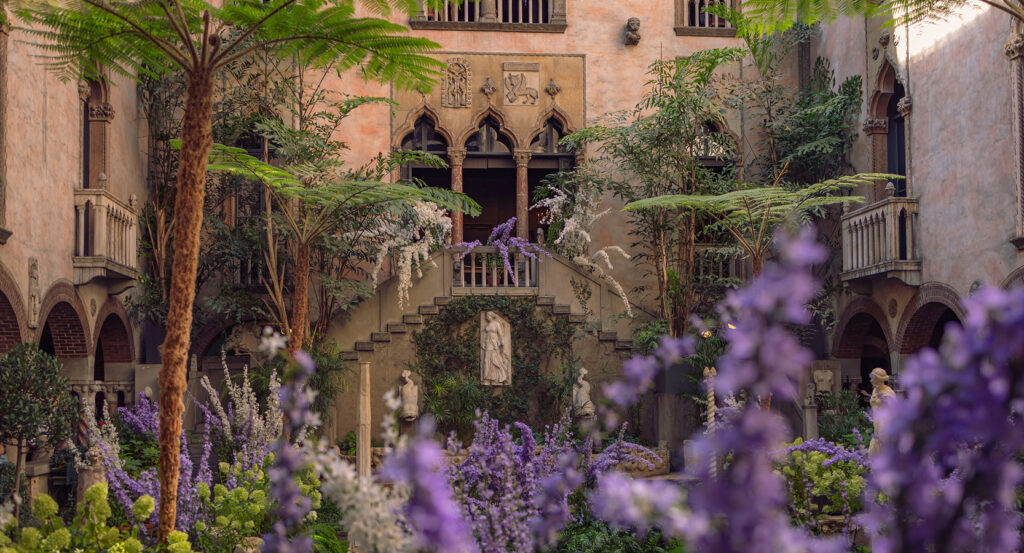
Begin in the Early Italian Room, where foundational works of medieval and early Renaissance painting establish the artistic evolution culminating in the Raphael Room. Continue to the Short Gallery, whose remarkable paintings and decorative arts naturally extend Gardner's masterful curatorial narrative. Conclude in the Courtyard, where the museum's Venetian-inspired architecture, seasonal plantings, and tranquil atmosphere provide a memorable finale celebrating Isabella Stewart Gardner's singular vision of art, architecture, and landscape as one unified masterpiece. The progression moves naturally from early Renaissance painting to Gardner's celebrated Raphael Room before concluding within the museum's iconic courtyard, revealing why the Raphael Room remains among America's greatest museum interiors.
Where your story begins.
Foresyte Travel reveals places that feel extraordinary long before you arrive.
Experience premium editorial crafted for luxury travelers.







































































































