
Why Residence Inn New York Manhattan/Central Park matters.
Residence Inn New York Manhattan/Central Park is a soaring hotel where Midtown's vertical intensity meets a record-setting dual-brand skyscraper, panoramic upper-floor perspectives and an unusually concentrated expression of Manhattan's twenty-first-century hotel boom.
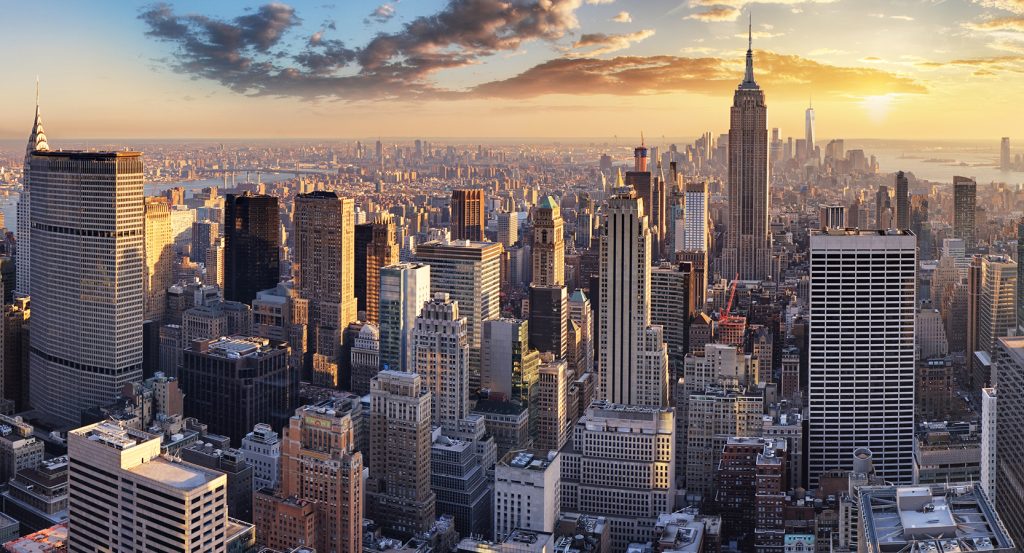
Set along Broadway near West 54th Street and just steps from the Ed Sullivan Theater, the hotel occupies a compact corner where the diagonal avenue cuts across Midtown's street grid amid theaters, glass towers, prewar masonry buildings and the dense vertical development extending south from Columbus Circle. A reflective glass curtain wall rises from a comparatively small footprint into an exceptionally slender rectangular shaft, giving the building a height-to-width relationship that sharply emphasizes its vertical form. Residence Inn occupies the tower's upper hotel floors, placing its principal accommodations high enough for broad sightlines across Central Park, the Hudson River, Times Square and successive layers of the Manhattan skyline. Floor-to-ceiling glazing turns those elevations into the primary encounter with the building, with changing perspectives across rooftops, towers, waterways and the street grid becoming progressively more expansive during the ascent. The result is a hotel whose extreme height, upper-tower position and transparent exterior make Manhattan's scale and geography central to the physical character of a stay.
What defines Residence Inn New York Manhattan/Central Park.
Residence Inn New York Manhattan/Central Park is best known for forming the upper half of 1717 Broadway, the Granite Broadway Development skyscraper conceived as a vertically stacked pairing of Marriott's extended-stay Residence Inn and transient-oriented Courtyard brands. Granite Broadway Development and Marriott International formalized the dual-brand project in 2011, with Interstate Hotels & Resorts selected to manage both operations inside a single tower. Architect Nobutaka Ashihara developed a glass skyscraper rising 752 feet 9 inches, making 1717 Broadway the tallest stand-alone hotel building in New York when the project reached completion. The development topped out in September 2012 after construction had begun the previous year, bringing an exceptionally slender new tower to a Broadway parcel previously occupied by low-rise structures. CNY Group completed the $160 million building with a floor-area ratio of 30:1, a figure the contractor characterized as the highest achieved by a New York City building at the time. That extraordinary density drew partly on Manhattan's Theater Subdistrict transfer system, through which Granite Broadway Development acquired 7,438 square feet of development rights from the Martin Beck Theatre property for the 1717 Broadway project. Residence Inn was placed above Courtyard inside the completed tower, turning Marriott's longer-stay brand into the higher of the two operations and giving it the building's broadest outward perspectives. The paired hotels officially opened on January 7, 2014, creating a single skyscraper in which two Marriott brands addressed different lodging patterns through separate accommodations and reservation systems inside shared infrastructure. Arne Sorenson, then Marriott International's president and chief executive, framed that division around the different stay profiles served by Courtyard and Residence Inn, making brand segmentation fundamental to the tower's organization. Fujitec supplied twelve elevators for the completed development, including high-speed passenger cars serving more than fifty stops and traveling at 488 meters per minute, an essential vertical system inside a building whose hotel functions extend through dozens of stacked floors. Residence Inn New York Manhattan/Central Park emerged from the convergence of transferable development rights, extreme site density, high-rise engineering and Marriott's dual-brand strategy, placing an extended-stay hotel at the summit of one of Manhattan's most unusual purpose-built hospitality towers.
Bill DeBilzan gave 1717 Broadway a separate artistic program that developed from hotelier Harry Gross's encounter with the Florida-based artist's work in Delray Beach. Gross entered DeBilzan's gallery during a visit to his sister and attempted to purchase the gallery's entire collection, beginning a relationship that eventually expanded into a commission for the New York tower. DeBilzan spent three months working at 1717 Broadway as the building moved toward operation. Twenty-five paintings formed part of his contribution, joined by painted pillars and sculpture distributed through the property. Large wall murals extended the commission beyond conventionally framed works and turned portions of the skyscraper itself into surfaces for DeBilzan's figurative compositions. Marriott continues to identify several floors containing his murals, paintings and sculpture, preserving the commission as a visible component of the hotel. DeBilzan brought an established international context to the project through work displayed in Dubai's Burj Khalifa and through paintings that had appeared in film and television productions. Gross intended the 1717 Broadway program to establish a stronger role for original art within Courtyard and Residence Inn properties, giving the commission significance beyond decorative procurement for a single development. Residence Inn New York Manhattan/Central Park carries an art program conceived at the scale of the entire skyscraper, with DeBilzan's extended on-site work turning paintings, structural surfaces and sculpture into a connected visual layer within the tower.
How Residence Inn New York Manhattan/Central Park fits.
Residence Inn New York Manhattan/Central Park works as the anchor for an outing connecting a threatened concert hall, a dramatic school for working artists and a fraternal temple converted into a civic performing-arts institution.
Begin at Carnegie Hall, where industrialist Andrew Carnegie financed a concert building designed by William Burnet Tuthill and constructed between 1889 and 1891 with thick masonry walls and Guastavino construction contributing to its celebrated acoustics. Pyotr Ilyich Tchaikovsky participated in the opening festival in May 1891, beginning a performance history that subsequently brought generations of major musicians to its stages. Demolition threatened the hall after the New York Philharmonic planned its move to Lincoln Center, prompting violinist Isaac Stern to spearhead a preservation campaign supported by Jacob M. Kaplan and prominent performers including Marian Anderson, Arthur Rubinstein and Leopold Stokowski. New York acquired the building in 1960 after state legislation enabled municipal ownership, securing the survival of a concert hall whose future had appeared exceptionally precarious only months earlier. Continue to Art Students League of New York, founded in 1875 by artists seeking an independent alternative to the National Academy of Design and established in its West 57th Street home in 1892. Henry Janeway Hardenbergh won a competition involving more than thirty architects for the American Fine Arts Society building, producing a French Renaissance headquarters shared by organizations committed to art and architecture. William Merritt Chase, Thomas Eakins, Daniel Chester French and Augustus Saint-Gaudens belonged to the League's early teaching history, and later generations connected the school with Georgia O'Keeffe, Jackson Pollock and other major figures in American art. Conclude at New York City Center, the neo-Moorish former Mecca Temple constructed for the Shriners during the 1920s and acquired by New York City after financial failure placed the building at risk. Mayor Fiorello La Guardia and City Council President Newbold Morris drove its conversion into a performing-arts center, and a New York Philharmonic concert inaugurated the institution in December 1943 with a top ticket price of $1.65. New York City Opera began its first season there in 1944, and the building subsequently became crucial to New York City Ballet, the Joffrey Ballet and performers spanning Leonard Bernstein, Paul Robeson, Beverly Sills and Orson Welles. The progression moves from Carnegie Hall's rescue through the Art Students League of New York's artist-governed educational tradition and culminates at New York City Center, where municipal intervention converted an endangered ceremonial building into a durable home for affordable performing arts.
Where your story begins.
Foresyte Travel reveals places that feel extraordinary long before you arrive.
Enjoy editorial crafted for luxury travelers.
Foresyte may earn a commission when you book.







































































































