Why Robert Mondavi Winery matters.
Robert Mondavi Winery is a modernist wine estate where Oakville's Cabernet Sauvignon heritage meets Robert Mondavi's transformation of American winemaking, the architectural ambitions of California's postwar wine industry and the international recognition of Napa Valley viticulture.
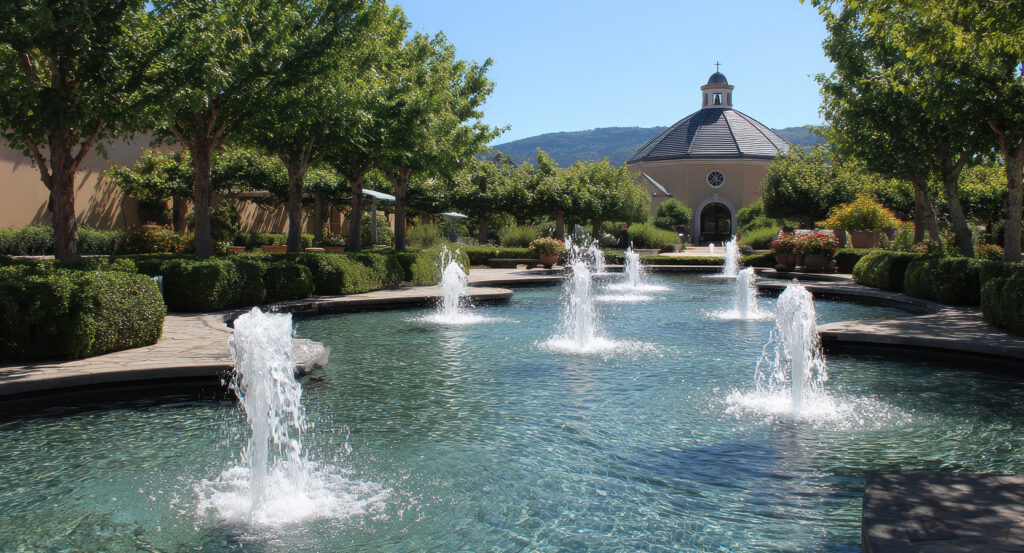
Set along St. Helena Highway near Oakville Cross Road and a short drive from the Oakville town center, the winery occupies the western side of Napa Valley's principal north-south corridor, where vineyard parcels extend toward the Mayacamas Mountains beneath the wooded slopes bordering the valley floor. A broad entrance arch and bell tower distinguish the estate's mission-inspired architecture. Vineyard rows extend across the surrounding agricultural land, with mountain slopes enclosing the western horizon. The principal buildings arrange production and hospitality functions around courtyards and landscaped approaches. The result is a winery estate whose architecture and vineyard setting connect California's wine industry with the agricultural geography of Oakville.
What defines Robert Mondavi Winery.
Robert Mondavi Winery is best known for its founding in 1966 by Robert Mondavi, its role in elevating Napa Valley's international reputation and its development of varietal wines associated with California's modern fine-wine industry. Mondavi was born in Minnesota in 1913 to Italian immigrant parents whose family entered the California wine business during Prohibition. His father, Cesare Mondavi, purchased Charles Krug Winery in St. Helena in 1943, establishing the family's position within Napa Valley's commercial wine industry. Robert and his brother Peter worked within the family enterprise, developing contrasting approaches to production, management and investment. A dispute between the brothers led Robert to leave Charles Krug and establish his own winery in Oakville. His new enterprise became the first major winery built in Napa Valley following Prohibition, marking a turning point in the region's modern commercial development. Architect Cliff May designed the original winery complex, incorporating California mission influences into a modern agricultural facility. Mondavi pursued improvements in fermentation, barrel aging and vineyard management, emphasizing the potential of Napa Valley grapes to produce wines of international standing. He promoted Cabernet Sauvignon and Chardonnay while introducing the Fumé Blanc designation for a dry, oak-influenced style of Sauvignon Blanc. His emphasis on varietal labeling and regional origin helped strengthen consumer recognition of California wines. In 1979, Mondavi entered a partnership with Baron Philippe de Rothschild of Château Mouton Rothschild to establish Opus One, connecting Napa Valley with one of Bordeaux's leading wine families. The partnership reinforced the international ambitions of California's premium wine industry. Mondavi also supported culinary education, cultural programming and the promotion of wine alongside food. Robert Mondavi Winery became a publicly traded company in 1993, reflecting the expansion of its commercial operations. Constellation Brands acquired Robert Mondavi Corporation in 2004, bringing the winery into a larger international beverage portfolio. Mondavi died in 2008, leaving an enterprise closely associated with the modernization of American viticulture and the development of Napa Valley's international standing.
To Kalon Vineyard forms the agricultural foundation of Robert Mondavi Winery's Oakville Cabernet Sauvignon program. The historic vineyard lies on the western side of the valley, where alluvial soils and the surrounding mountain geography contribute to the conditions supporting Cabernet Sauvignon cultivation. Its origins extend to the nineteenth-century plantings of Hamilton Walker Crabb, whose vineyard development established an early precedent for quality-focused grape growing in Oakville. Robert Mondavi Winery's relationship with To Kalon connects the estate's winemaking program with one of Napa Valley's most consequential vineyard sites. Cabernet Sauvignon from the vineyard forms an important component of the winery's reserve-level production. Vineyard management emphasizes grape selection, canopy development and harvest timing to achieve the desired balance of ripeness and structure. Fermentation techniques extract color, tannin and aromatic compounds from the grape skins, establishing the foundation for subsequent maturation. Oak barrels contribute controlled oxygen exposure and additional flavor development during aging. The winery's Fumé Blanc program applies a different production approach to Sauvignon Blanc, using fermentation and maturation choices that emphasize texture alongside varietal acidity. Chardonnay production incorporates techniques associated with barrel fermentation and lees contact, developing additional complexity through cellar management. The estate's winemaking facilities connect these technical processes with the vineyard parcels supplying the fruit. Its architectural arrangement historically allowed visitors to encounter production spaces alongside tasting and educational facilities. The winery's cultural programming included concerts and culinary events that helped establish Napa Valley as a center of wine-related tourism. Its influence extends through vineyard management, cellar technique and the broader development of American wine appreciation.
How Robert Mondavi Winery fits.
Robert Mondavi Winery works as the Oakville centerpiece for a Napa Valley itinerary connecting historic wine production, the development of American fine-wine institutions and the agricultural landscape surrounding the valley's principal vineyards.
Begin at Oakville Grocery, the historic general store established in 1881 along St. Helena Highway. The business developed during Napa Valley's nineteenth-century agricultural expansion, serving residents, travelers and workers associated with the surrounding vineyards. Its wooden commercial building preserves the scale of the valley's earlier roadside settlements. The store's development preceded the modern transformation of Napa Valley into an internationally recognized wine region. Its food and wine offerings connect the agricultural community's historic service economy with the valley's contemporary culinary traditions. The surrounding Oakville landscape contains vineyards extending toward both mountain ranges, preserving the rural setting that shaped the settlement's original function. Continue to Opus One Winery, the estate established through the partnership between Robert Mondavi and Baron Philippe de Rothschild. The joint venture originated in 1979 and developed a Bordeaux-inspired red wine program centered on Napa Valley Cabernet Sauvignon. The winery's building, designed by architect Scott Johnson of Johnson Fain, incorporates a symmetrical composition and a landscaped roof that rises from the surrounding vineyard terrain. Its production program emphasizes vineyard selection, fermentation management and barrel maturation associated with premium red wine. The partnership connected California viticulture with the established traditions of Bordeaux, strengthening Napa Valley's international reputation. Conclude at Bothe-Napa Valley State Park, the protected landscape situated north of Oakville near Calistoga. The park preserves a substantial section of the valley's forested western slopes, including coastal redwoods, Douglas firs and mixed woodland. Its terrain contains creeks, shaded valleys and trails extending through the Mayacamas foothills. The park's natural environment provides a geographical counterpart to the cultivated vineyards occupying the valley floor. Historic sites within the surrounding area connect the landscape with earlier patterns of settlement, transportation and resource use. The progression moves from Oakville's nineteenth-century commercial settlement through an international winemaking partnership and culminates in the forested terrain of the Mayacamas Mountains, connecting Robert Mondavi Winery with the agricultural and environmental history of Napa Valley.
Where your story begins.
Foresyte Travel reveals places that feel extraordinary long before you arrive.
Enjoy editorial crafted for luxury travelers.
Foresyte may earn a commission when you book.