
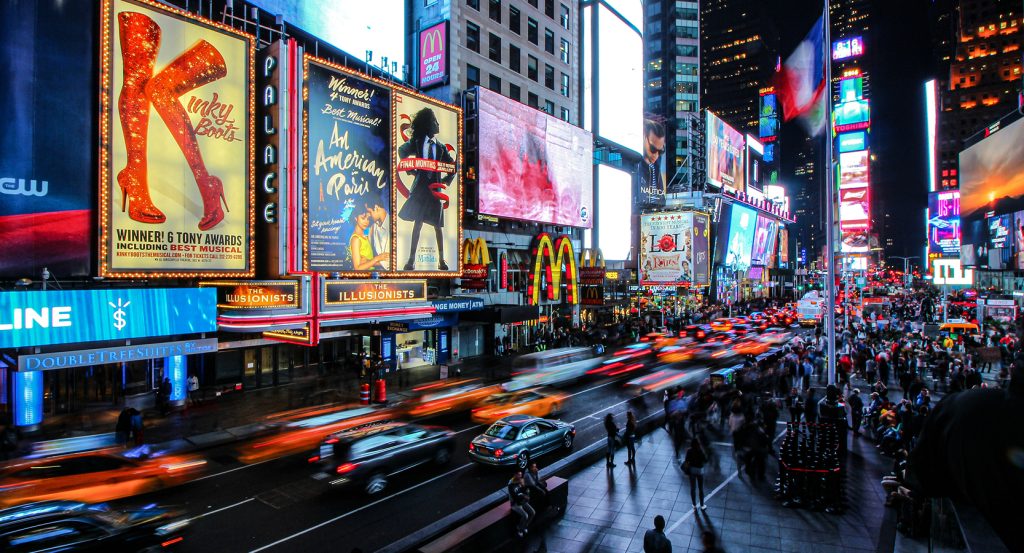
Why Shubert Theatre matters.
Shubert Theatre is an ornate Broadway playhouse where the Theater District's performance culture meets Henry B. Herts's Venetian Renaissance architecture, richly painted interiors and more than a century of major American stage history.
Set along West 44th Street near Broadway and just steps from the Richard Rodgers Theatre, the playhouse occupies a prominent corner position within the dense concentration of Broadway houses surrounding Times Square. Henry B. Herts gave the exterior an unusual sgraffito treatment, using etched plaster ornament across a composition unified architecturally with the adjoining Booth Theatre despite the two buildings containing completely separate auditoriums. Elaborate plasterwork frames the Shubert auditorium, with painted theatrical panels extending across the boxes, ceiling and area above the proscenium arch as ornament rises through three audience levels. A 39-foot-9-inch proscenium opens onto a stage extending 36 feet from its rear wall to the front edge, placing substantial production depth behind the decorated auditorium. The result is a Broadway house whose sgraffito exterior, painted interior, layered plasterwork and substantial stage preserve Herts's unusually elaborate theatrical architecture inside the tightly packed blocks of the Theater District.
What defines Shubert Theatre.
Shubert Theatre is best known for becoming the architectural and institutional centerpiece of the theatrical empire built by brothers Sam, Lee and Jacob J. Shubert after their arrival in New York at the beginning of the twentieth century. Sam died in a railroad accident in 1905, and Lee and J.J. continued expanding the enterprise in his absence, eventually naming their new West 44th Street house the Sam S. Shubert Memorial Theatre in his honor. The project grew from the failed New Theatre experiment on Central Park West, whose backers had leased property between West 44th and West 45th Streets for another venue before abandoning the plan. Lee Shubert and former New Theatre partner Winthrop Ames subsequently acquired the site and divided the project into two adjoining playhouses, with Lee and J.J. controlling the larger Shubert and Ames operating the smaller Booth Theatre. Architect Henry B. Herts designed the pair as a unified exterior composition containing independent interiors, and the private roadway between the theaters and the former Astor Hotel evolved into Shubert Alley. Lee placed an office and apartment above his theater, embedding the Shubert business directly within the building that commemorated his brother; those upper rooms later became executive offices of the Shubert Organization. British actor Johnston Forbes-Robertson brought his repertory company into the new house in 1913 with Shakespearean productions including Hamlet, The Merchant of Venice and Othello. The Shubert brothers expanded far beyond the building during the following decade, and by the mid-1920s their organization owned, operated, managed or booked more than 1,000 theaters across the United States. New York City designated the Shubert Theatre in 1987, securing Herts's 1912-13 building within the surviving architectural fabric created during the brothers' extraordinary expansion of Broadway.
Where your story begins.
Foresyte Travel reveals places that feel extraordinary long before you arrive.
Enjoy editorial crafted for luxury travelers.







































































































