Why you should experience Apollo 11 Command Module Columbia in Washington, D.C.
Apollo 11 Command Module Columbia at Smithsonian's National Air and Space Museum in Washington, D.C. is humanity's return ticket from the moon.
Displayed at the Smithsonian National Air and Space Museum, this scorched, bronze-hued capsule captures the moment when human ambition broke the bounds of Earth and touched the infinite. Standing before it, you can see the burn marks left by re-entry, physical proof of a journey that pushed every limit of courage, science, and imagination. Inside this compact, cone-shaped vessel, Neil Armstrong, Buzz Aldrin, and Michael Collins spent eight days traveling 953,000 miles through space, carrying the hope of an entire planet. The craftsmanship is astonishing, dials, toggles, and hand-labeled switches that look almost primitive compared to their cosmic purpose. Yet from this modest capsule came one of history's greatest achievements. To see Columbia up close is to feel the weight of the impossible made real, a relic that reminds us what humanity can do when it looks upward together.
What you should know about Apollo 11 Command Module Columbia.
Apollo 11 Command Module Columbia is the only portion of the original spacecraft that returned safely to Earth after the first successful lunar landing in July 1969.
Built by North American Aviation, Columbia served as the nerve center of the mission, handling navigation, communication, and re-entry. Its interior, barely large enough to fit three astronauts in their suits, contains over 500 toggle switches, 70 circuit breakers, and the handwritten checklist that helped the crew survive deep space. The scorch marks you see on its outer shell were caused by re-entry friction at 25,000 miles per hour, generating temperatures hotter than the surface of the sun. The capsule was recovered from the Pacific Ocean by the USS Hornet and transferred to NASA for study before becoming one of the most revered artifacts in the Smithsonian's collection. In recent years, advanced 3D scanning has revealed previously unseen details, like etched notes from the crew and pencil markings made during the mission itself. These human traces transform Columbia from an artifact into a time capsule, an echo of the heartbeat that changed history.
How to fold Apollo 11 Command Module Columbia into your trip.
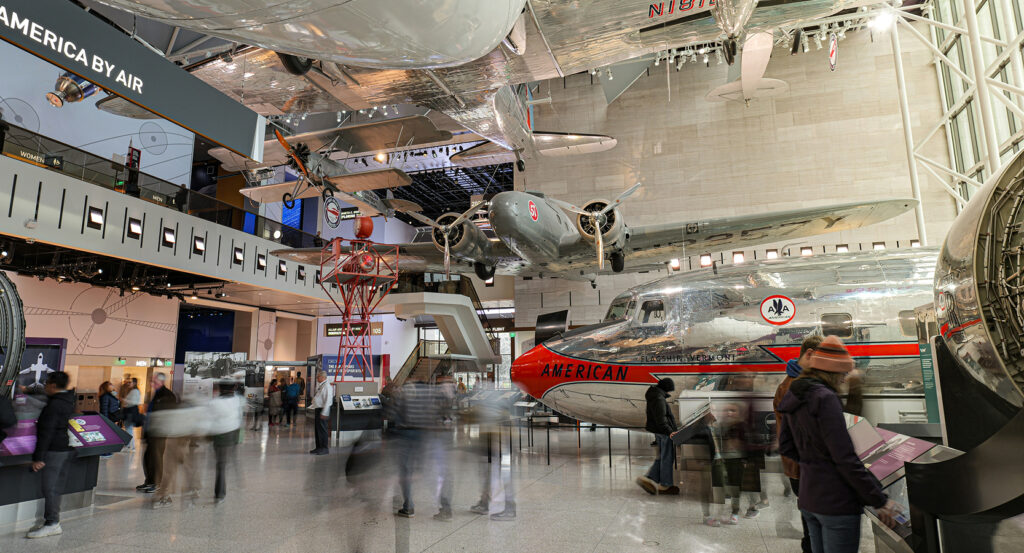
Begin your visit to the Smithsonian National Air and Space Museum in the Destination Moon Gallery, where Apollo 11 Command Module Columbia holds pride of place.
Take time to walk around it slowly; the museum's lighting is designed to mimic the lunar glow, revealing every curve and scorch pattern in vivid relief. Nearby, you'll find Neil Armstrong's spacesuit, the lunar module replica, and multimedia exhibits that project the original mission footage in full resolution. If you're visiting with family or students, the interactive stations explaining propulsion, heat shielding, and guidance systems bring the mission's complexity to life. Continue your journey by exploring the Milestones of Flight Hall, where Columbia's story connects to the legacy of exploration that led from Kitty Hawk to the cosmos. Before leaving, visit the museum's gift shop, where replicas of the capsule and mission patches offer tangible reminders of a world forever changed. Apollo 11 Command Module Columbia isn't just a piece of space history, it's a symbol of what happens when curiosity, courage, and collaboration align to take humanity one giant leap forward.
Where your story begins.
Foresyte Travel reveals places that feel extraordinary long before you arrive.
Experience premium editorial crafted for luxury travelers.