
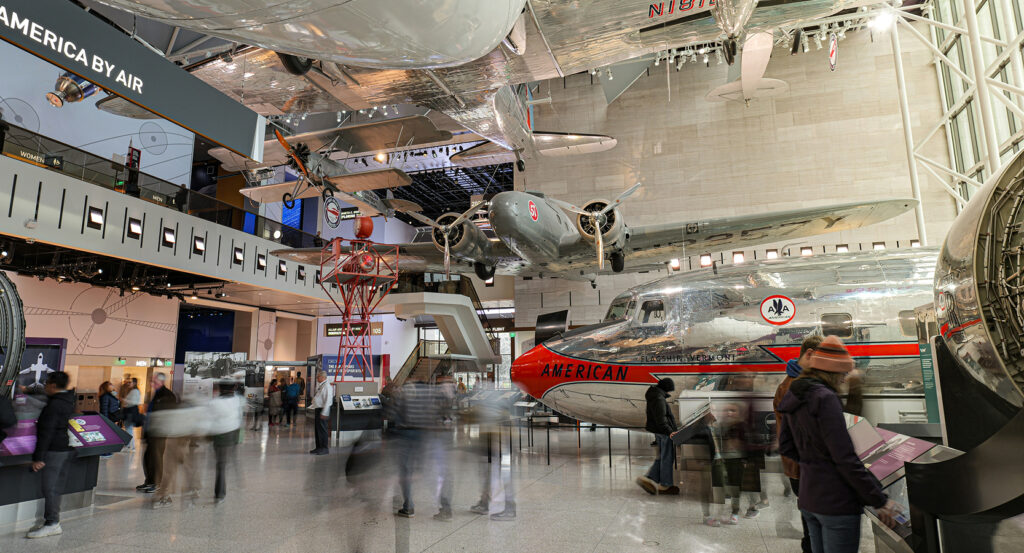
Why you should experience Smithsonian's National Air and Space Museum in Washington, D.C.
Smithsonian's National Air and Space Museum in Washington, D.C. is humanity's flight log, written in wings, engines, and starlight.
From the moment you enter its vast, light-filled galleries on the National Mall, you feel the gravity of history give way to the thrill of possibility. Overhead hang icons of innovation, the Wright brothers' Flyer, Lindbergh's Spirit of St. Louis, the Apollo 11 command module Columbia. Every artifact tells a story of daring and imagination, of ordinary people who defied gravity and forever changed the world's perspective. The hum of awe is constant as visitors, families, dreamers, engineers, and children with stars in their eyes, stand shoulder to shoulder beneath spacecraft that have touched the moon and jets that once tore through the sound barrier. The museum's design draws you upward, guiding your gaze from the early days of wooden propellers to the gleaming promise of interplanetary exploration. It's not just about machines; it's about motion, the human drive to move faster, climb higher, and look beyond. In every polished fuselage and lunar rock, there's the pulse of ambition, the whisper of wind at takeoff, and the infinite expanse of a sky we've learned to call home.
What you should know about Smithsonian's National Air and Space Museum.
Behind its glass walls lies one of the most significant collections of human achievement on Earth, more than 60,000 artifacts chronicling the story of flight from the first glider to the farthest reaches of space.
The museum opened in 1976 as part of America's Bicentennial celebration, but its roots stretch back to 1946, when the Smithsonian began collecting historic aircraft in the aftermath of World War II. The building itself, designed by architect Gyo Obata, was conceived as a temple to technology and imagination, its soaring halls inspired by the limitless expanse of the sky. The museum's reach extends far beyond Washington, too: its companion facility, the Steven F. Udvar-Hazy Center in Virginia, houses full-size aircraft and spacecraft that couldn't fit in the downtown location, including the space shuttle Discovery and the SR-71 Blackbird. Few visitors realize that the museum's preservation labs are among the most advanced in the world, using cutting-edge methods to restore delicate materials that once braved the stratosphere. The museum is also a hub for education and research, home to one of NASA's primary archival centers and a team of curators working to ensure the story of flight keeps pace with the future. And it's evolving once again, undergoing a massive, multi-year renovation to reimagine every gallery with immersive, multiphysical storytelling. What was once a monument to history is becoming a living chronicle of exploration, where the past, present, and future of flight are displayed not as static moments, but as continuous motion toward the stars.
How to fold Smithsonian's National Air and Space Museum into your trip.
Visiting Smithsonian's National Air and Space Museum is more than an afternoon activity, it's a journey through the imagination.
Start early to beat the crowds and give yourself time to absorb each section, from the early aviation gallery, where you can trace humankind's first fragile flights, to the gleaming spacecraft that carried astronauts into orbit. The museum sits along the National Mall, within walking distance of the U.S. Capitol and other Smithsonian institutions, making it easy to build a full day around your visit. Inside, the interactive exhibits invite you to do more than observe, you can pilot a flight simulator, touch a real moon rock, or walk through a life-size model of the International Space Station. If you're traveling with kids or space enthusiasts, plan to catch a show at the Albert Einstein Planetarium, where digital projection wraps the cosmos around you in breathtaking clarity. Don't miss the “Destination Moon” exhibit, which displays Neil Armstrong's spacesuit, still dusted with lunar soil, or the galleries devoted to the future of flight, where prototypes and rovers hint at humanity's next frontier. When you step outside again, the Washington skyline will look different, not because it's changed, but because you have. You'll leave with your gaze tilted slightly upward, your mind buzzing with the vastness of what's possible. Smithsonian's National Air and Space Museum isn't just about looking back at how we got to the skies, it's about reminding you that we're still climbing.
Where your story begins.
Foresyte Travel reveals places that feel extraordinary long before you arrive.
Experience premium editorial crafted for luxury travelers.







































































































