Why Snoqualmie Falls matters.
Snoqualmie Falls is a striking Cascade foothills waterfall where the Snoqualmie Valley's Indigenous heritage meets the geological force of the Snoqualmie River, pioneering hydroelectric engineering and Washington's enduring tradition of landscape preservation.
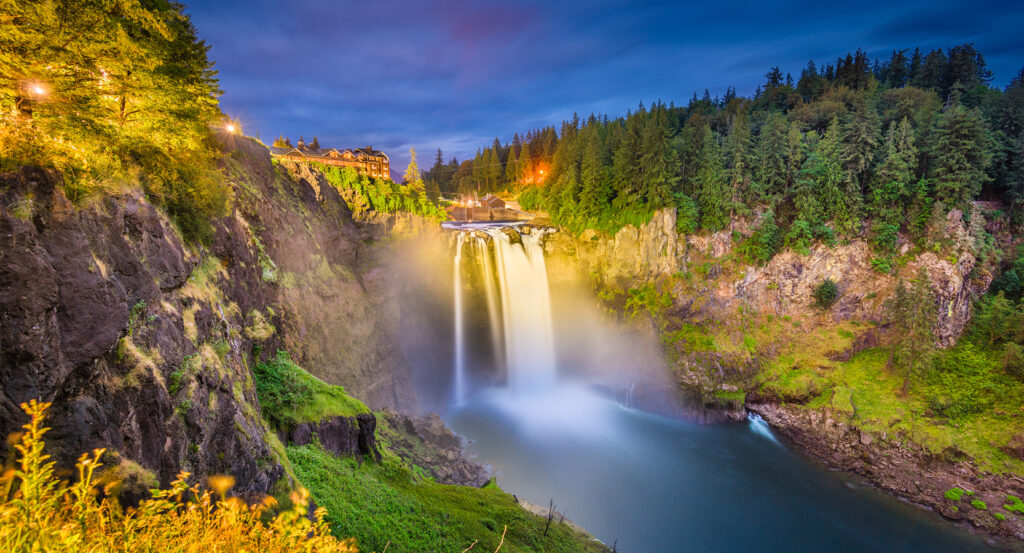
Set along Railroad Avenue Southeast near Southeast 69th Place and just steps from the historic Salish Lodge, the waterfall occupies a steep river gorge east of Seattle, where the Snoqualmie River descends from the Cascade foothills toward the agricultural lowlands of the Snoqualmie Valley. Water plunges over a broad basalt ledge into a deep plunge pool, sending mist across forested cliffs and the rocky riverbanks below. A landscaped upper observation area provides an expansive view of the falls, with additional pathways descending through mature conifer forest toward the river. The surrounding terrain incorporates steep volcanic rock faces, moss-covered slopes and dense stands of Douglas fir and western red cedar. The result is an exceptionally dramatic natural destination whose powerful waterfall, forested gorge and historic structures connect the geological and cultural heritage of western Washington.
What defines Snoqualmie Falls.
Snoqualmie Falls is best known for its 268-foot plunge, its profound spiritual importance to the Snoqualmie Tribe and its pioneering role in the development of hydroelectric power in the Pacific Northwest. The waterfall occupies a central place in Snoqualmie creation traditions, which describe the site as the birthplace of the Snoqualmie people. Its rising mist carries spiritual significance as a connection between the earth and the heavens. The Snoqualmie Tribe maintains an enduring relationship with the falls as a sacred ancestral site, and its cultural importance extends across generations of Indigenous history. European American settlement transformed the surrounding valley during the nineteenth century as logging, agriculture and transportation networks expanded into the Cascade foothills. Engineer Charles H. Baker recognized the waterfall's potential for electrical generation and began developing an ambitious hydroelectric project during the 1890s. Construction required workers to excavate an underground chamber within the rock beside the falls, creating an innovative generating facility beneath the river's surface. Snoqualmie Falls Hydroelectric Plant 1 began operating in 1899, becoming one of the world's earliest underground hydroelectric power stations. Its turbines converted the river's gravitational energy into electricity transmitted to communities across the growing Puget Sound region. A second generating facility followed in 1910, increasing electrical production through a separate powerhouse downstream. The installation contributed to the electrification of Seattle and surrounding communities during a period of substantial industrial expansion. Puget Sound Energy subsequently undertook major restoration and modernization work to preserve the historic facilities and improve their generating efficiency. The Snoqualmie Falls Hydroelectric Project received designation as a National Historic Civil Engineering Landmark, recognizing its technical significance. The waterfall's continuing importance rests in the convergence of Indigenous sacred geography, natural hydrology and an engineering achievement that helped transform the region's electrical infrastructure.
The Snoqualmie River descends through a watershed shaped by the western Cascade Mountains, gathering water from forested valleys and mountain tributaries before reaching the falls. Seasonal precipitation and snowmelt produce substantial changes in river volume, creating particularly powerful flows during periods of heavy rainfall. The waterfall's basalt formations originated through volcanic processes that shaped the region's geological structure. Erosion progressively developed the steep gorge, exposing rock layers and producing the vertical drop that distinguishes the site. The upper observation platform provides a direct view across the river toward the falling water and the forested cliffs surrounding the plunge pool. A descending trail extends 0.7 miles toward the lower observation area, passing through a mature forest containing ferns, mosses and substantial coniferous trees. Its steep gradient requires a sustained uphill return, creating a considerably more demanding walk than the short approach to the upper viewpoint. The lower observation area introduces a contrasting perspective, revealing the height of the gorge and the force of the water entering the river below. A restored boardwalk and riverfront pathway provide additional access to the surrounding landscape. Interpretive displays explain the site's electrical history and the relationship between the waterfall's natural features and its generating facilities. The surrounding two-acre park incorporates landscaped paths, viewing areas and public gathering spaces. Salish Lodge occupies the cliff above the falls, continuing a hospitality tradition that began with the Snoqualmie Falls Lodge in 1916. The property subsequently developed into a luxury hotel recognized for its regional dining, spa facilities and dramatic setting above the river. The waterfall gained further international recognition through its appearance in the television series Twin Peaks, whose opening sequence incorporated its distinctive landscape. Its enduring appeal emerges through the immediate visual force of the falling river and the remarkable concentration of cultural, geological and industrial history surrounding the gorge.
How Snoqualmie Falls fits.
Snoqualmie Falls works as the natural anchor for a Cascade foothills outing connecting the region's railroad heritage, the preserved landscapes of the Snoqualmie Valley and the mountain scenery surrounding one of Washington's most celebrated alpine destinations.
Begin at Northwest Railway Museum, the heritage institution established in 1957 to preserve the railroad history of the Pacific Northwest. Its principal campus occupies the historic Snoqualmie Depot, an elaborate Victorian railway station completed in 1890 for the Seattle, Lake Shore and Eastern Railway. The building's decorative woodwork, distinctive roofline and carefully restored interiors preserve the architectural character of late nineteenth-century railroad development. The museum's collection includes historic locomotives, passenger cars and freight equipment associated with the transportation networks that supported regional logging, agriculture and industrial expansion. Heritage train excursions operate along preserved railway tracks through the surrounding valley, connecting the depot with the historical development of nearby communities. Continue to Meadowbrook Farm, the expansive historic landscape occupying the Snoqualmie Valley between the communities of Snoqualmie and North Bend. The property developed through agricultural and dairy operations established during the region's early settlement period, contributing to the valley's productive farming economy. Its open fields and surrounding forested slopes preserve substantial views toward Mount Si and the Cascade foothills. The site also holds cultural significance for the Snoqualmie Tribe, whose ancestral relationships with the valley precede European American settlement. Contemporary public access includes walking trails and interpretive opportunities exploring the landscape's agricultural and cultural development. Conclude at Mount Si, the imposing mountain rising above North Bend and forming one of the most recognizable geological features of the Central Cascade foothills. Its summit reaches 4,167 feet above sea level, with steep forested slopes and exposed rocky formations dominating the surrounding valley. The mountain's principal hiking route extends four miles each way, gaining more than 3,000 feet in elevation through sustained switchbacks and increasingly rugged terrain. Dense conifer forest occupies the lower slopes, gradually giving way to exposed rock and expansive mountain views near the summit. The mountain is associated with Snoqualmie oral traditions and remains an important cultural feature within the tribe's ancestral territory. Its substantial elevation and proximity to metropolitan Seattle have established it as one of Washington's most frequently climbed mountains. The progression moves from Northwest Railway Museum's preservation of regional transportation history through Meadowbrook Farm's agricultural and Indigenous landscape and culminates at Mount Si's commanding mountain terrain, connecting three significant dimensions of the Snoqualmie Valley's cultural and natural heritage.
Where your story begins.
Foresyte Travel reveals places that feel extraordinary long before you arrive.
Enjoy editorial crafted for luxury travelers.
Foresyte may earn a commission when you book.