
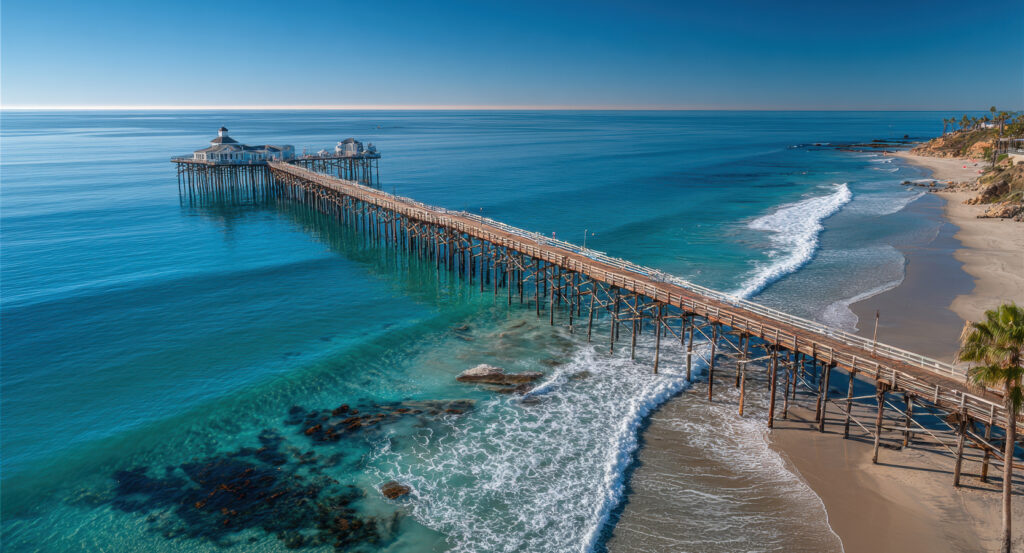
Why Surfrider Beach matters.
Surfrider Beach is a storied point-break shoreline where Central Malibu's coastal character meets long peeling waves, modern surfing history and a beach whose underwater contours helped reshape the sport itself.
Set along Pacific Coast Highway near Cross Creek Road and just steps from Legacy Park, the beach occupies a curved reach of Santa Monica Bay where Malibu Creek approaches the ocean and a cobblestone point projects into a shoreline backed by the Santa Monica Mountains. Three successive takeoff zones divide the surf across the point, with First Point closest to the eastern beach and longer lines of swell wrapping across the coast as underwater topography redirects incoming wave energy. Entering the water shifts the encounter from a relatively narrow strand into an elongated right-breaking wave whose gradual peel gives riders unusual time to trim, turn and move along the board before reaching the inside shore. Sand movement, creek outflow and submerged cobbles continually shape the boundary between land and water, tying the quality of the break to physical processes extending inland through the Malibu Creek watershed. The result is a compact stretch of coast whose geography produces an exceptionally long surfing canvas, allowing one set of waves to influence board construction, riding technique and California beach culture across generations.
What defines Surfrider Beach.
Surfrider Beach is best known for its central role in the development of modern surfing during the years after World War II, when the characteristics of Malibu's waves encouraged simultaneous advances in surfboard construction and riding technique. Bob Simmons devoted himself to board shaping beginning in 1945 and experimented with hydrodynamics, lighter construction, fiberglass and polyester resin as surfers sought equipment capable of exploiting Malibu's extended rides. Joe Quigg and Matt Kivlin developed the work further through increasingly maneuverable balsa boards, including the family of designs that became known as Malibu Chips. Lighter weight, refined rails, rocker and fins gave riders greater control across the face of a wave, changing surfing from the comparatively direct path favored by earlier heavy wooden boards into a discipline built around trimming, turning and positioning. Malibu supplied an unusually demanding proving ground: its long right-breaking walls rewarded equipment capable of remaining near the fastest section of the wave for extended distances. Miki Dora subsequently became one of the break's most influential stylists, adapting Kivlin's low-armed stance and precise footwork into an approach closely associated with Malibu during the 1950s. Kathy Kohner arrived among this community as a teenager in 1956, acquired the nickname Gidget from Terry “Tubesteak” Tracy and supplied her father Frederick Kohner with the experiences behind his 1957 novel Gidget: The Little Girl with Big Ideas. Columbia Pictures adapted the book into the 1959 film Gidget, carrying a localized Malibu surfing community into American popular culture at the end of the period now formally associated with the break's greatest influence on modern surfing. The Malibu Historic District entered the National Register of Historic Places in 2018 with a period of significance extending from 1945 through 1959, recognizing the surf breaks themselves as historically consequential resources in the development of the sport.
The coastline later became an important proving ground for the protection of surf breaks as cultural and environmental resources. Construction work associated with Malibu Lagoon State Park in 1983 redirected lagoon outflow toward First Point, cutting a channel through the beach and altering the underwater configuration upon which the wave depended. Surfer Lance Carson challenged the practice after watching bulldozers excavate the outlet, then connected with Glenn Hening, whose plans for a surfer-led service organization gained an immediate conservation objective. Hening and Carson joined Tom Pratte, Dan Young, Chris Blakely and Steve Merrill in founding the Surfrider Foundation in Malibu in 1984, with Pratte contributing expertise in California coastal law as the group pressed state officials for a different approach to lagoon management. Hening and Pratte produced graphics explaining the effects of the excavated channel and presented an alternative plan during an October 12, 1984 public hearing at Point Dume Elementary School. State officials accepted a revised approach, giving the new organization an early victory before Surfrider expanded into a much broader coastal-protection organization. Another preservation model followed when Save The Waves approved Malibu in October 2009 for its World Surfing Reserves program, created to protect surf breaks and their surrounding cultural and environmental resources. A sunrise blessing led by Chumash leader Mati Waya and a paddle-out of 100 surfers accompanied the October 9, 2010 dedication, making Malibu the first World Surfing Reserve. The two campaigns placed the same waves at the center of successive ideas about coastal stewardship: first as a resource whose physical functioning required organized defense, then as a culturally significant landscape warranting international recognition.
How Surfrider Beach fits.
Surfrider Beach works as the anchor for a coastal sequence through Central Malibu, tracing how ranch infrastructure, decorative arts and Franciscan stewardship preserved distinct chapters of the community that developed around this stretch of the Pacific.
Begin at Malibu Pier, constructed in 1905 to support Frederick Hastings Rindge's Malibu Rancho, with hides, grain and fruit leaving by water as building supplies and other necessities arrived for the property. The Rindge private railroad terminated beside the pier, tying the landing to an internal transportation system before the structure opened for public and charter fishing in 1934. Bondholders assumed control after the Marblehead Land Company bankruptcy in 1936, and extension work brought the structure to its present 780-foot length by the end of the decade. A U.S. Coast Guard daylight lookout occupied the ocean end during World War II until a severe winter storm destroyed that portion in 1943-44; William Huber's Malibu Pier Company subsequently acquired the surviving structure for $50,000 and rebuilt the end with the twin buildings that became a lasting part of its appearance. Continue to Adamson House, the 1929 residence Stiles O. Clements designed for Rhoda Rindge Adamson and Merritt Huntley Adamson on 13 acres given to Rhoda by her mother, May Knight Rindge. The 5,000-square-foot house brought Clements together with decorator John Holtzclaw, Malibu Potteries manager Rufus Keeler and artists Ejnar Hansen and Peter Nielsen across interiors combining painted woodwork, frescoes, wrought iron, lead-framed glass and extensive ceramic decoration. May Rindge had founded Malibu Potteries in 1926, and its factory employed as many as 125 workers producing up to 30,000 square feet of tile a month before closing in 1932; the house preserves its most comprehensive surviving collection, including William Handley's 674-tile Persian carpet composition. Conclude at Serra Retreat, where May Rindge began an elaborate hilltop residence whose unfinished estate passed to the Marblehead Land Company during bankruptcy proceedings. Franciscan Friars purchased the 26-acre property for $50,000 in May 1942 while seeking a seminary site, then changed course the following year and created a retreat center for laymen under the patronage of Junípero Serra. Michael Braun joined the staff in 1942 and spent more than two decades extending the architectural scheme with decorative tile before a 1970 wildfire swept across Serra Hill and destroyed the mansion. The Franciscans rebuilt around surviving portions of the property, preserving a religious institution born from the unfinished ambitions of the Rindge era. The progression moves from a ranch shipping pier through the Adamson family's extraordinary ceramic residence into a Franciscan retreat created from May Rindge's abandoned hilltop project, connecting three surviving places to the family whose landholding shaped modern Malibu.
Where your story begins.
Foresyte Travel reveals places that feel extraordinary long before you arrive.
Enjoy editorial crafted for luxury travelers.
Foresyte may earn a commission when you book.





































































































