Why The Huntington Hotel matters.
The Huntington Hotel is a storied hotel where Nob Hill's elevated residential character meets 1920s architecture, generations of San Francisco society and a restored grand-hotel tradition at the crest of California Street.
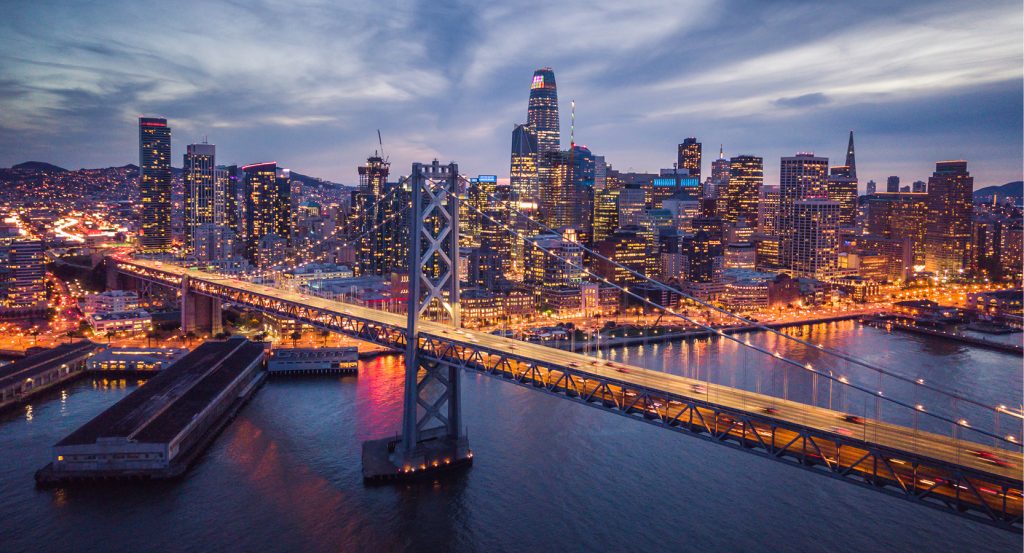
Set along California Street near Taylor Street and just steps from Grace Cathedral, the hotel occupies the summit of Nob Hill between Huntington Park's open square, the steep descent toward Chinatown and the closely spaced institutional buildings and grand hotels defining the ridge. The twelve-story red-brick structure rises above the park with a Georgian composition whose regular window bays, pale stone detailing and prominent rooftop sign make the building legible across the surrounding hills. Large windows capitalize on the elevation through long views toward downtown, the Bay and the northern waterfront, preserving the relationship between the building's apartment-house origins and its commanding position above San Francisco. Interior designer Ken Fulk's restoration retained residential elements including wrought-iron stair railings, corridor mail slots, plasterwork ceilings and paneled walls, carrying the building's domestic lineage into its revived hotel interiors. The result is a hotel whose hilltop massing, residential architectural inheritance and immediate relationship with Nob Hill's surviving civic landscape give the property an unusually concentrated connection to San Francisco history.
What defines The Huntington Hotel.
The Huntington Hotel is best known for evolving from Weeks and Day's 1920s apartment project into a Nob Hill institution shaped by the Fritz and Cope families, international ownership and a major twenty-first-century revival. The building originated as the Huntington Apartments, a $2 million residential project named for railroad magnate Collis P. Huntington, whose mansion had stood across California Street before the 1906 earthquake and fire. Architects Charles Peter Weeks and William Peyton Day designed the twelve-story brick building, extending the firm's substantial influence on San Francisco architecture during the city's post-earthquake development. Developer Eugene N. Fritz Jr. acquired the property in 1924 and converted it into the Huntington Hotel, beginning a family association that endured for generations. Fritz later gave the property to his daughter Dorothy “Dolly” Fritz, who became one of the central figures in its emergence as a favored address for prominent visitors and San Francisco society. Dolly Fritz and her husband Newton Cope subsequently created the Big Four in 1976 as a dark, club-like tribute to Collis Huntington, Leland Stanford, Mark Hopkins and Charles Crocker, surrounding diners with railroad memorabilia, green upholstery and nineteenth-century imagery. The Cope family retained the property until its 2011 sale to Singapore-based Grace International for $42 million, ending almost nine decades of family stewardship. Grace closed the hotel in January 2014 for a $15 million renovation and reopened it that May as The Scarlet Huntington, introducing a design influenced by Peranakan culture and making the property the Singapore company's first hotel outside its home market. Woodridge Capital acquired the property in 2018 and restored the Huntington Hotel name before the pandemic forced another closure in 2020. Financial distress subsequently placed the property's $56.2 million mortgage in default, leading Highgate and Flynn Properties to acquire the delinquent debt and take possession in 2023. Flynn Properties then undertook a comprehensive revival with Highgate, Ken Fulk, preservation specialists Page & Turnbull and additional architectural and construction teams. The National Register of Historic Places added the Huntington Hotel on September 23, 2025, giving federal recognition to the building shortly before its March 2026 return.
Cary Grant stayed at the Huntington during production of the 1957 film Kiss Them for Me, placing the hotel within the midcentury Hollywood traffic that repeatedly crossed Nob Hill. Truman Capote also lodged there, extending the guest history beyond film into American literary culture. Princess Margaret and Lord Snowdon occupied several upper floors during their 1965 San Francisco visit, arriving with 75 pieces of luggage during one of the property's most conspicuous royal stays. The Rolling Stones reached the hotel after the 1969 Altamont Free Concert, connecting its polished Nob Hill interiors with one of the most turbulent episodes in Bay Area rock history. Claudette Colbert, Lauren Bacall, Humphrey Bogart and Marlene Dietrich added successive generations of screen celebrity to the guest register. Luciano Pavarotti later extended that association into international opera. The Big Four developed a parallel local social history downstairs, where former San Francisco mayor Willie Brown and Senator Dianne Feinstein belonged to the political figures associated with its booths and piano-driven dining room. Lee Radziwill became another familiar presence during her relationship with Newton Cope, linking the restaurant's society culture directly to the family that had shaped the hotel. Ken Fulk preserved the Big Four's carved wooden columns, ram-horn sconces, engraved mirrors and central piano during the 2026 revival, retaining physical artifacts from the restaurant's earlier life. The Huntington carries its social history through an unusually broad succession of Hollywood actors, writers, royalty, musicians, politicians and San Francisco regulars whose presence turned a residentially scaled Nob Hill hotel into a durable gathering place.
How The Huntington Hotel fits.
The Huntington Hotel works as the hilltop anchor for an outing connecting San Francisco's surviving cable-powered transportation machinery, Chinese American institutional history and the cathedral that transformed a railroad fortune's former Nob Hill estate into a major civic and religious site.
Begin at Cable Car Museum, occupying the Washington and Mason cable car barn and powerhouse where the machinery beneath San Francisco's most distinctive transit system becomes physically visible. The Ferries and Cliff House Railway developed the site during the 1880s, and enormous winding wheels still pull the moving cables that grip cars beneath the streets. The museum, founded in 1974, adds mechanical artifacts, grips, track components and three nineteenth-century cars, including Clay Street Hill Railroad grip car 8, the surviving car from the city's first cable railway. Continue to Chinese Historical Society of America, housed in a Julia Morgan building that places another foundational San Francisco history within the streets descending from Nob Hill toward Chinatown. Morgan designed the structure as the Chinatown YWCA, bringing the work of California's pioneering female architect into a neighborhood where Chinese American institutions had developed through exclusion, immigration restrictions and the rebuilding that followed the 1906 disaster. Conclude at Grace Cathedral, whose Nob Hill site originated with the Crocker family's donation of its fire-damaged mansion block after the 1906 catastrophe. Lewis Hobart carried the cathedral through decades of construction after earlier plans by George Bodley and Cecil Hare, with the Depression interrupting work before completion and consecration in 1964. Martin Luther King Jr. preached there in March 1965 before a congregation of 5,000, adding national civil-rights history to a building born from Nob Hill's post-earthquake reconstruction. The progression moves from the machinery that conquered San Francisco's grades through a Chinese American institution shaped by the city's social history and culminates at a cathedral built across the former estate of the Crocker railroad family, revealing how transportation, migration, catastrophe and inherited wealth reshaped the hills surrounding the Huntington.
Where your story begins.
Foresyte Travel reveals places that feel extraordinary long before you arrive.
Enjoy editorial crafted for luxury travelers.
Foresyte may earn a commission when you book.