
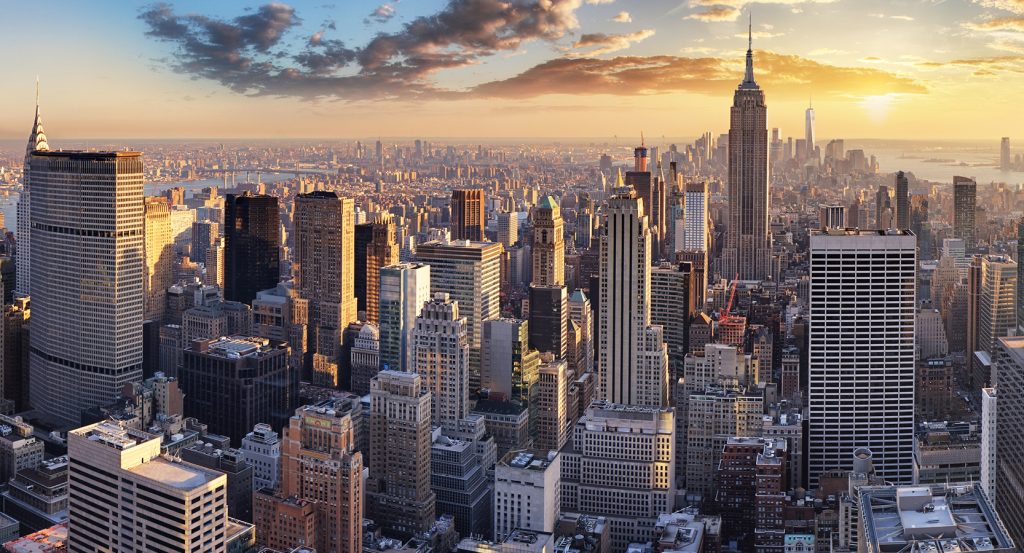
Why The St. Regis New York matters.
The St. Regis New York is a patrician hotel where Midtown's Gilded Age grandeur meets John Jacob Astor IV's vision of residential luxury, a century of celebrated residents and gatherings, and the original property that ultimately gave an international hotel brand its name.
Set along East 55th Street near 5th Avenue and just steps from Fifth Avenue Presbyterian Church, the hotel occupies a pivotal Midtown corner amid the clubs, churches and former mansion sites that marked 5th Avenue's transformation into New York's premier social corridor. Limestone façades, a rounded corner and disciplined Beaux-Arts composition preserve the formal presence established when the avenue still carried the architectural imprint of the Astors, Vanderbilts and Rockefellers. Marble surfaces, gilded detailing and richly appointed public rooms continue the domestic scale John Jacob Astor IV sought within a metropolitan hotel of unprecedented ambition. 5th Avenue immediately outside places that interior world against one of New York's densest concentrations of cultural institutions and luxury commerce. The result is a hotel whose physical refinement carries the social ambitions of Gilded Age New York into a property that became internationally synonymous with the St. Regis name.
What defines The St. Regis New York.
The St. Regis New York is best known for John Jacob Astor IV's attempt to advance his family's hotel legacy at the moment 5th Avenue was changing from a mansion district into a commercial and social center. His great-grandfather John Jacob Astor had opened Astor House in Lower Manhattan in 1836, and John Jacob IV later shared ownership of the original Waldorf-Astoria before pursuing a property under his own direction. Land at 5th Avenue and 55th Street had passed through his father William Backhouse Astor Jr. and his mother Caroline Schermerhorn Astor, the dominant figure of New York high society whose gatherings helped codify the social world surrounding the family. Astor selected the St. Regis name from Upper St. Regis Lake in the Adirondacks and invested $5.5 million in the project before its September 1904 debut. Trowbridge & Livingston gave his venture a Beaux-Arts form conceived for a 5th Avenue corridor in rapid transition, and Astor coupled that form with technological systems intended to push metropolitan hotelkeeping beyond prevailing standards. Opposition from Fifth Avenue Presbyterian Church complicated the hotel's liquor license before opening, prompting operator Rudolph Haan to acquire a nearby house and shift the principal entrance to 55th Street to satisfy distance requirements. Prince Fushimi Sadanaru of Japan attended an early banquet, and Arturo Toscanini was honored there in 1908 as the property entered the ceremonial life of New York society. Astor died aboard Titanic in April 1912, severing his personal connection with the hotel less than eight years after its debut. His son Vincent Astor eventually inherited the family interest, sold the property to Benjamin Newton Duke in 1927 and reacquired it during the following decade. Duke's period produced the 55th Street expansion and St. Regis Roof, whose later performers connected the property with New York jazz. Vincent retained ownership until his death in 1959, closing an Astor stewardship that had carried the hotel from one family's 5th Avenue ambitions into an established New York institution.
Maxfield Parrish gave the hotel's cultural life one of its enduring works when his grand Old King Cole mural entered the property during Vincent Astor's stewardship. Fernand Petiot subsequently took charge behind the King Cole Bar after developing his craft in Paris, and in 1934 he refined the vodka-and-tomato preparation served there as the Red Snapper. Serge Obolensky helped prompt Petiot's spiced version, linking a Russian aristocrat, a French-trained bartender and an American hotel to a drink that later became a signature across the St. Regis portfolio. Salvador Dalí and Gala occupied the hotel during autumn and winter seasons from 1966 through 1973, extending its residential tradition into New York's twentieth-century art world. Marlene Dietrich, Alfred Hitchcock, Marilyn Monroe, Rex Harrison and Joan Fontaine belonged to the broader theatrical and film society associated with the property during that era. Sheraton took control in 1966 under a lease that protected the building from office conversion, an unusually consequential provision during a period when prominent New York hotels were disappearing. A sweeping closure beginning in 1988 led to a restoration exceeding $100 million and a 1991 reopening, after which the hotel became flagship of ITT Sheraton's Luxury Collection. Starwood's acquisition of Sheraton supplied the next institutional turn: the New York property became the foundation for the St. Regis Hotels & Resorts brand launched at the end of the decade, exporting its name and service traditions internationally. Marriott International acquired Starwood in 2016, carrying the original property into another global hospitality organization. Qatar Investment Authority purchased the building for $310 million in 2019 under an arrangement retaining Marriott as operator, separating ownership of the 5th Avenue real estate from stewardship of the hotel brand descended from Astor's original venture.
How The St. Regis New York fits.
The St. Regis New York works as a Midtown base for a sequence connecting the intellectual ambitions of New York's private-club era, an Episcopal parish repeatedly rebuilt after catastrophe, and a craftsmen's institution whose educational mission reaches back to the early republic.
Begin at University Club of New York, chartered in 1865 for the promotion of literature and art before its membership growth drove a move to 5th Avenue and 54th Street. Charles Follen McKim, himself a member, received the commission for the permanent clubhouse, and McKim, Mead & White developed a palazzo-inspired home that opened in 1899 as elite New York clubs migrated uptown. The project occupied part of the former St. Luke's Hospital property and cost more than $2 million including its land and furnishings, fixing the institution beside the corridor the Astors were simultaneously reshaping. Continue to Saint Thomas Church Fifth Avenue, whose congregation began downtown in 1823 and reached its 5th Avenue site in 1870. Fire destroyed Richard Upjohn's celebrated third church in 1905, leaving an altar cross that survived into the replacement designed by Ralph Adams Cram and Bertram Grosvenor Goodhue. Lee Lawrie's sculptural work joined the architectural program, and later exterior figures commissioned under rector Frederick Myers Morris connected the church with figures associated with emancipation and the Civil Rights era. Conclude at General Society of Mechanics and Tradesmen, founded in 1785 by twenty-two craftsmen meeting at Walter Heyer's public house. The organization established educational and charitable programs for skilled tradespeople and acquired its West 44th Street home in 1899. Andrew Carnegie joined in 1903 and contributed more than half a million dollars during the following years, helping the Mechanics Institute expand as industrial technology transformed the building trades. The John M. Mossman Lock Collection subsequently brought hundreds of locks, keys and safes into the institution, preserving physical evidence of American mechanical ingenuity alongside its educational mission. The progression moves from an elite institution created around literature and art through a parish repeatedly rebuilt amid 5th Avenue's transformation and culminates with craftsmen whose organization has carried practical education and mechanical heritage through more than two centuries of New York history.
Where your story begins.
Foresyte Travel reveals places that feel extraordinary long before you arrive.
Enjoy editorial crafted for luxury travelers.
Foresyte may earn a commission when you book.







































































































