
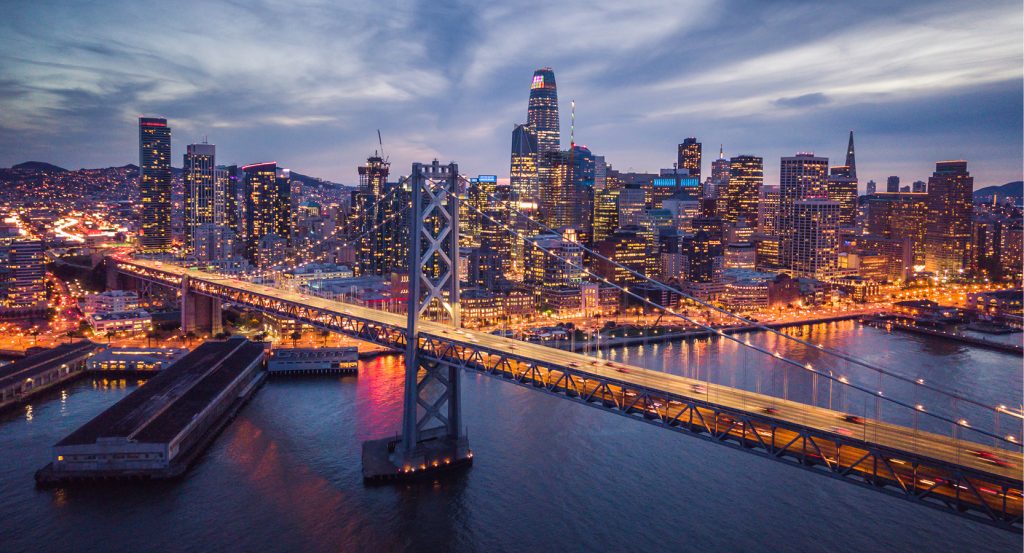
Why The St. Regis San Francisco matters.
The St. Regis San Francisco is an art-centered hotel where SoMa's museum district meets the St. Regis tradition of metropolitan hospitality through Skidmore, Owings & Merrill architecture, a historic structure incorporated into the complex and a direct institutional relationship with the Museum of the African Diaspora.
Set along 3rd Street near Mission Street and just steps from Jessie Square, the hotel occupies Central SoMa between the cultural institutions lining Mission Street, the convention district extending south toward Howard Street and the dense downtown blocks reaching north toward Market Street and Union Square. The slender glass tower rises above a masonry base whose differing architectural periods create a distinctive transition between historic fabric and twenty-first-century vertical construction. Expansive glazing opens the upper levels toward downtown, the bay and the surrounding cultural district. Interior spaces use stone, metal, leather and contemporary art to develop a polished counterpoint to the tower's restrained exterior geometry. The result is a hotel whose architecture and immediate cultural setting place luxury hospitality directly inside one of San Francisco's most concentrated districts for contemporary art.
What defines The St. Regis San Francisco.
The St. Regis San Francisco is best known for integrating the St. Regis brand into the redevelopment of San Francisco's Yerba Buena cultural district through a tower that joins luxury hospitality, private residences, contemporary art and a dedicated museum within one architectural project. Starwood Hotels & Resorts developed the St. Regis Museum Tower as the brand's first newly constructed American hotel under Barry Sternlicht's direction. Skidmore, Owings & Merrill joined the design team for the high-rise project, translating the program into a glass tower rising above a substantial urban base. Yabu Pushelberg developed the original interiors, giving the San Francisco property a contemporary interpretation of the St. Regis lineage established by John Jacob Astor IV in New York in 1904. The project incorporated the historic Williams Building, which underwent extensive structural work as it became part of the larger development. A separate museum component formed part of the development approvals and became the permanent home of the Museum of the African Diaspora. MoAD occupies the Mission Street base of the complex and developed into one of the few museums internationally devoted specifically to the art, culture and history of the African Diaspora. A three-story glass artwork on its facade uses 2,100 photographs submitted by people of African descent to construct the image of a child derived from a Chester Higgins Jr. photograph. Marriott International acquired Starwood in 2016 and sold the hotel later that year to Qatar Investment Authority for $175 million under a long-term Marriott management agreement. The ownership change placed the property within QIA's international luxury real-estate portfolio and separated the underlying asset from brand management. A multi-phase redesign subsequently brought Chapi Chapo Design back to the property after the studio's principals had participated in its original design. Chapi Chapo renewed the private interiors and meeting areas through custom furniture, metallic tones referencing California's Gold Rush and Christo Saba artwork built around figures associated with San Francisco innovation. London studio Blacksheep redesigned the principal bar with a sweeping brass trellis referencing the city's cable-car lines. Forbes Travel Guide awarded the property Five-Star status again in 2025, extending its position among San Francisco's highest-rated luxury hotels two decades after the tower entered the city's museum district.
Astra gives the hotel's culinary program a Northern California focus through seasonal cooking developed around produce and regional ingredients. Chef de Cuisine Mikey Adams led the restaurant when it became part of the property's extensive redesign, placing food at the center of the renewed ground-floor social spaces. Breakfast establishes the restaurant's first daily service through American staples, fruit, baked preparations and savory dishes. Lunch shifts the kitchen toward salads, sandwiches and composed plates suited to the surrounding museum and business district. Dinner deepens the regional direction through seasonal vegetables, seafood and meat preparations tied to California sourcing. The St. Regis Bar forms the adjoining drinking counterpart through signature cocktails and a menu of smaller savory plates. Bloody Mary service carries one of the brand's oldest culinary traditions from the King Cole Bar in New York, where bartender Fernand Petiot developed the Red Snapper version associated with St. Regis history. Champagne sabering provides another inherited ritual, tracing its ceremonial association to the St. Regis brand's interpretation of Napoleonic-era celebrations. Afternoon Tea adds the social tradition associated with Caroline Astor, whose gatherings helped define New York society during the Gilded Age and became part of the wider St. Regis cultural program. Blacksheep's bar design grounds those inherited rituals in Northern California through dark green and dusty rose upholstery, sculptural stone tables, brass details and patterns derived from regional landscapes. Randy Hibberd's golden abstract painting Solitude establishes an artistic focal point at reception, extending the property's larger relationship with contemporary art into the renewed public floor. Janie Rochfort's Mountain Mist adds another locally oriented work through a watercolor composition shaped by fog and the geography surrounding San Francisco. Astra and The St. Regis Bar join California ingredients, brand rituals and contemporary art within the same redesigned ground-floor sequence, connecting the hotel's culinary life with both its New York lineage and its San Francisco setting.
How The St. Regis San Francisco fits.
The St. Regis San Francisco works as an anchor for an outing connecting the institutional development of West Coast modern art, the architecture of San Francisco's Yerba Buena cultural redevelopment and a museum created around hands-on experimentation with art, design and technology.
Begin at San Francisco Museum of Modern Art, founded in 1935 as the first museum on the West Coast devoted to modern and contemporary art. The institution initially occupied the War Memorial Veterans Building before moving into Mario Botta's purpose-built SoMa museum in 1995. Snøhetta subsequently designed a vast expansion that integrated Botta's building with a new 10-story addition. The transformed museum reopened in 2016 after a three-year closure, with the project expanding gallery capacity to accommodate the Fisher Collection, the Pritzker Center for Photography and hundreds of additional works secured through the Campaign for Art. More than 700 individually shaped facade panels embedded with Monterey County silicate crystals give the eastern elevation its rippled surface. Continue to Yerba Buena Center for the Arts, which opened in 1993 as the cultural anchor of the wider Yerba Buena redevelopment. Pritzker Prize laureate Fumihiko Maki designed its Galleries and Forum with local firm Robinson Mills + Williams, creating his first West Coast commission. Maki conceived the light metallic building through horizontal forms associated with a ship approaching San Francisco's port, giving the institution a deliberate connection with the city's maritime geography. AIA San Francisco honored the project with a design award in 1994. Conclude at Children's Creativity Museum, founded during the downtown redevelopment effort of the 1990s and opened as Zeum in 1998. The institution developed around hands-on creative production across art, design and emerging technology, giving children direct access to animation, music, coding and collaborative making. Zeum adopted the Children's Creativity Museum name in 2011 after an extensive branding process intended to clarify the institution's educational purpose. A 1906 Charles I. D. Looff carousel adds a surviving piece of early amusement architecture to the surrounding children's district. The progression moves from San Francisco Museum of Modern Art's evolution into a major international collection through Yerba Buena Center for the Arts' role in the district's cultural redevelopment and culminates in Children's Creativity Museum's participatory fusion of art, design and technology.
Where your story begins.
Foresyte Travel reveals places that feel extraordinary long before you arrive.
Enjoy editorial crafted for luxury travelers.
Foresyte may earn a commission when you book.








































































































