
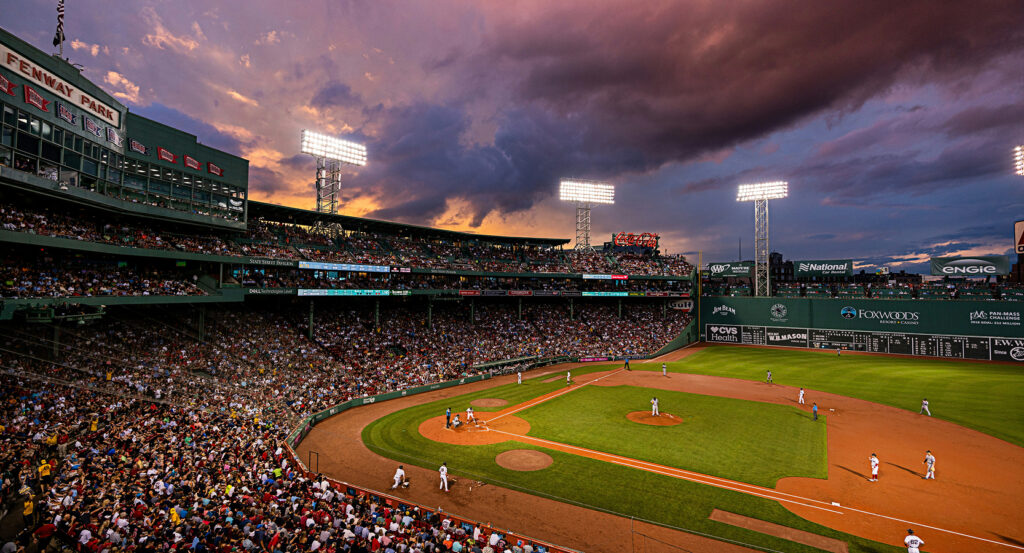
Why you should experience Center Field Triangle in Boston, Massachusetts.
Center Field Triangle is a celebrated Fenway-Kenmore ballpark destination where baseball tradition, architectural ingenuity, championship history, and panoramic stadium views create one of Fenway Park's most distinctive gathering places.
Set beyond center field near Jersey Street and just steps from the Green Monster, this expansive open-air viewing area combines elevated standing terraces, social gathering spaces, contemporary hospitality, and sweeping perspectives across America's oldest Major League Baseball stadium. Uninterrupted sightlines toward home plate, center field, and the surrounding Boston skyline immerse visitors in the rhythm of the game while revealing the ballpark's extraordinary architectural character from an entirely different vantage point. Carefully integrated into the historic stadium, the space demonstrates how thoughtful modernization can enrich the fan experience while preserving Fenway Park's enduring identity. The result is a baseball destination defined by panoramic immersion, architectural continuity, and one of Major League Baseball's most memorable viewing environments.
What you should know about Center Field Triangle.
Center Field Triangle is best known for emerging from Fenway Park's comprehensive preservation and modernization program completed before the 2011 season, transforming previously inaccessible center-field space into a dynamic public gathering area while respecting the architectural legacy of the ballpark that opened on April 20, 1912. Developed under the stewardship of Fenway Sports Group, led by John Henry, Tom Werner, and Larry Lucchino, the project formed part of a long-term preservation strategy that introduced new fan amenities through carefully engineered additions instead of replacing one of baseball's most historic venues. Positioned adjacent to the iconic 420-foot center-field marker, the Triangle offers panoramic views of the playing field while revealing design features rarely appreciated from traditional seating, including the Green Monster, manually operated scoreboard, center-field batter's eye, and the asymmetrical outfield dimensions that have shaped countless memorable moments in Red Sox history. Fenway Park itself was designed by architect James McLaughlin and constructed by the Charles Logue Building Company, becoming the oldest active Major League Baseball stadium while hosting eleven World Series championship teams and generations of Hall of Fame players including Ted Williams, Carl Yastrzemski, Carlton Fisk, David Ortiz, Pedro Martínez, and many others. Structural reinforcements, preservation-sensitive engineering, upgraded circulation, and expanded public spaces introduced during successive renovation campaigns ensured that new destinations such as the Center Field Triangle could coexist seamlessly with the stadium's National Historic Landmark character, reinforcing Fenway Park's international reputation as a benchmark for adaptive preservation within professional sports architecture.
The experience extends beyond baseball by encouraging visitors to appreciate the stadium as a living work of architecture whose irregular geometry, evolving additions, and century of careful stewardship distinguish it from every modern ballpark. Open gathering areas, flexible viewing platforms, thoughtfully integrated concessions, and uninterrupted visual connections create an atmosphere where social interaction, historic appreciation, and championship tradition naturally converge. Every game demonstrates how preservation, engineering, and thoughtful design continue allowing one of the world's most celebrated sporting venues to evolve while remaining unmistakably Fenway Park.
How to fold Center Field Triangle into your trip.
Center Field Triangle works as part of an exploration through Fenway-Kenmore's celebrated baseball heritage and neighborhood attractions.
Begin at The Green Monster, where baseball's most recognizable outfield wall immediately establishes Fenway Park's extraordinary architectural character before continuing to Center Field Triangle for sweeping panoramic views across the historic stadium. Continue to Bleacher Bar, whose field-level window into center field provides a distinctive perspective that extends the ballpark experience beyond the seating bowl. Conclude at Fenway Rooftop Seating, where elevated stadium vistas provide a fitting finale celebrating the architectural evolution and enduring legacy of America's oldest Major League Baseball park. The progression moves naturally from one of baseball's defining architectural features to immersive center-field perspectives before concluding with elevated stadium panoramas, revealing why Center Field Triangle remains one of Fenway Park's most rewarding gathering spaces.
Where your story begins.
Foresyte Travel reveals places that feel extraordinary long before you arrive.
Experience premium editorial crafted for luxury travelers.







































































































