
Why Union Station matters.
Union Station D.C. is a triumph of neoclassical architecture, civic pride, and enduring grandeur at the heart of the nation's capital.
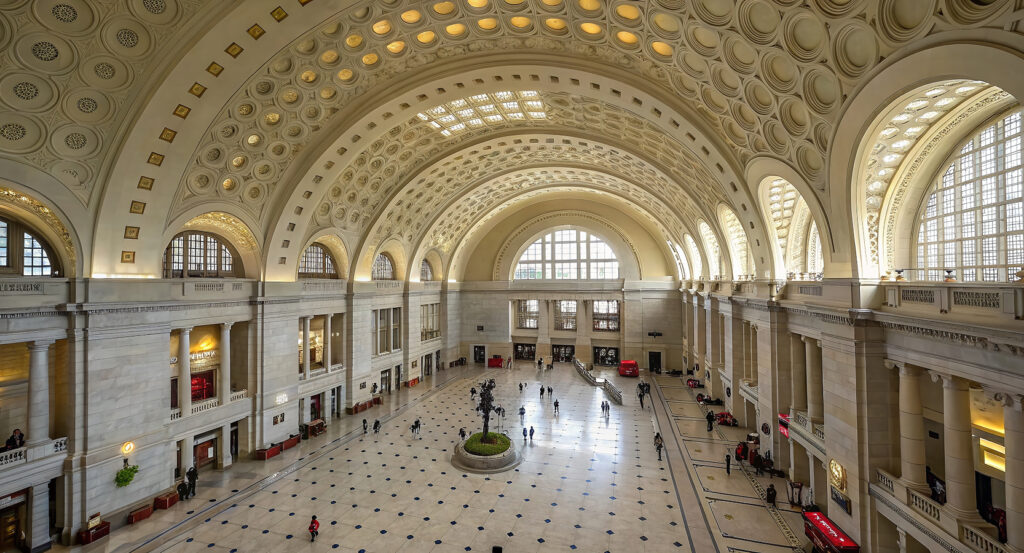
Opened in 1907 and designed by Daniel Burnham, among America's most influential architects, Union Station was conceived as both a gateway to Washington and a declaration of American progress. Its colossal façade of white granite, lined with towering Corinthian columns and heroic statues, draws inspiration from ancient Rome, particularly the Arch of Constantine, embodying the ideal that beauty and function can coexist in public space. Step inside, and the effect is breathtaking: a vast, coffered barrel-vaulted ceiling rises over the Main Hall, gilded in 22-karat gold leaf and illuminated by skylights that bathe the space in soft, celestial light. Every detail, from the Tennessee marble floors to the carved eagles perched above the arches, feels intentional, timeless, and deeply symbolic of the city it serves. Burnham's vision was that a train station could also be a temple to movement, modernity, and civic pride. More than a century later, Union Station remains exactly that: a crossroads where travelers, locals, and history itself pass through in an endless rhythm of arrivals and departures. To walk its halls is to feel the pulse of America, determined, elegant, and always in motion.
What defines Union Station.
Behind its grand design lies a story of reinvention, decline, and revival that mirrors the nation's own turbulent journey through the 20th century.
When it first opened, Union Station was the largest train terminal in the world, symbolizing Washington's growing importance as the federal seat. The station welcomed presidents, kings, and soldiers, it was here that troops departed for both World Wars, and where Franklin D. Roosevelt's funeral train arrived in 1945. Yet by the 1960s, the rise of automobiles and air travel plunged Union Station into disrepair, its once-grand concourse reduced to a neglected shell. In 1981, Congress declared it a national transportation hub, and a $160 million restoration began, a project that returned the building to its original magnificence while introducing modern amenities. Craftsmen meticulously cleaned the marble, restored the gilding, and reinforced the massive roof that had begun to crumble. When the station reopened in 1988, it was reborn not just as a rail terminal, but as a symbol of civic renewal. Today, it serves Amtrak, MARC, and MetroRail passengers, moving over 40 million visitors annually, while housing restaurants, boutiques, and public art installations. The restored Main Hall, with its soaring vaults and chandeliers, is as much a cultural venue as a waiting room. Few realize that beneath the main level lies a subterranean network connecting the station to the Senate office buildings and the D.C. Metro, a literal artery of the capital's daily life. The statues that line its exterior, known as “The Progress of Railroading,” were designed by Louis Saint-Gaudens, brother of famed sculptor Augustus Saint-Gaudens, and symbolize human mastery over industry and innovation. Union Station's history of decay and rebirth mirrors Washington's own, a reminder that even the grandest icons must evolve to endure.
How Union Station fits.
To truly experience Union Station, don't just pass through, wander it like a living museum of American architecture and ambition.
Begin at the plaza facing Columbus Circle, where the station's sweeping colonnade and fountain frame the Capitol dome beyond. Walk beneath the triumphal arches and pause at the bronze doors, their detail and scale echoing Europe's great cathedrals. Inside the Main Hall, stand in the center of the coffered ceiling and look upward: each square, hand-gilded and perfectly aligned, reflects light like a constellation suspended in stone. The acoustics are uncanny, footsteps reverberate softly through the expanse, and the sound of trains blends with the murmur of travelers. Take a moment to explore the mezzanine balconies for a panoramic view of the hall's symmetry, or venture into the East Hall, where light from the arched windows spills across marble floors in gold and shadow. Beyond the station's architectural splendor lies a spirited mix of local life, a bookstore tucked beneath the arches, cafés serving D.C.'s signature half-smokes, and a rotation of exhibitions that turn travel into culture. Step outside to the taxi portico to catch the golden hour, when the granite façade glows against the fading light of Constitution Avenue. If you have time, walk the short distance to the U.S. Capitol, the visual alignment between dome and station was part of Burnham's master plan for the National Mall. For an immersive experience, pair your visit with a meal at one of the restaurants inside the station or return after sunset, when the illuminated arches transform the building into a cinematic tableau of history meeting motion. Union Station D.C. isn't just a monument to travel, it's a living reflection of America's capacity for renewal. Beneath its vaulted ceilings and marble halls, generations have departed, arrived, and begun again. To stand here is to feel connected, not only to a city or a journey, but to the idea of progress that defines the nation itself.
Where your story begins.
Foresyte Travel reveals places that feel extraordinary long before you arrive.
Enjoy editorial crafted for luxury travelers.
Foresyte may earn a commission when you book.







































































































