
Why Universal Studios matters.
Universal Studios is a hillside entertainment complex where Universal City's filmmaking character meets large-scale attractions, steeply layered terrain and more than a century of motion-picture production.
Set along Universal Hollywood Drive near Lankershim Boulevard and just steps from the crest of the Cahuenga Pass, the theme park occupies dramatically sloping terrain above the San Fernando Valley with its principal public areas distributed across separate elevations. Dense clusters of soundstage-scale buildings, themed streets, outdoor rides and enclosed attraction structures fill the Upper and Lower Lots, creating a physical composition shaped as much by the hillside as by individual entertainment properties. Moving through the park carries the encounter across broad pedestrian zones before the multilevel Starway descends the escarpment toward another concentration of rides hundreds of feet below. Elevated sections expose long views across the Valley and adjoining production property, adding an immense geographic dimension to spaces otherwise enclosed by cinematic architecture. The result is a theme park whose unusual vertical form binds Hollywood production, engineered entertainment and the natural contours of the Santa Monica Mountains into a single physical environment.
What defines Universal Studios.
Universal Studios is best known for growing from Carl Laemmle's working film property into the original theme park of a worldwide entertainment-resort business. Laemmle created the Universal Film Manufacturing Company in 1912 through the combination of his Independent Moving Pictures Company with five other film businesses, bringing production, distribution and exhibition under one organization. Film production began on the new California property in 1914, with Damon and Pythias becoming the first picture completed on a Universal lot. Universal City formally opened on March 15, 1915 as a purpose-built center of motion-picture production promoted as the only moving-picture city in the world, and its public inauguration drew an immense crowd into a property equipped with stages, offices, workshops and its own municipal-style facilities. Early spectators watched silent films being made from bleachers and toured a studio zoo, creating a public-entertainment component within the production operation years before conventional theme-park development. The arrival of synchronized sound ended that early access during the late 1920s as filmmaking demanded controlled acoustic conditions. MCA's acquisition of Universal during the 1960s created the corporate setting for renewed public access, initially through Gray Line excursions whose passengers toured the property and patronized the studio commissary. Lew Wasserman subsequently authorized investment in dedicated visitor infrastructure, and the modern operation opened on July 15, 1964 around red-and-white Glamor Trams designed by Harper Goff. Roughly 38,200 passengers participated during the first year, and daily ridership reached 8,000 within two years. That success established the commercial foundation for an entertainment property built directly beside active film and television production, a configuration that became the prototype for Universal's later destination business.
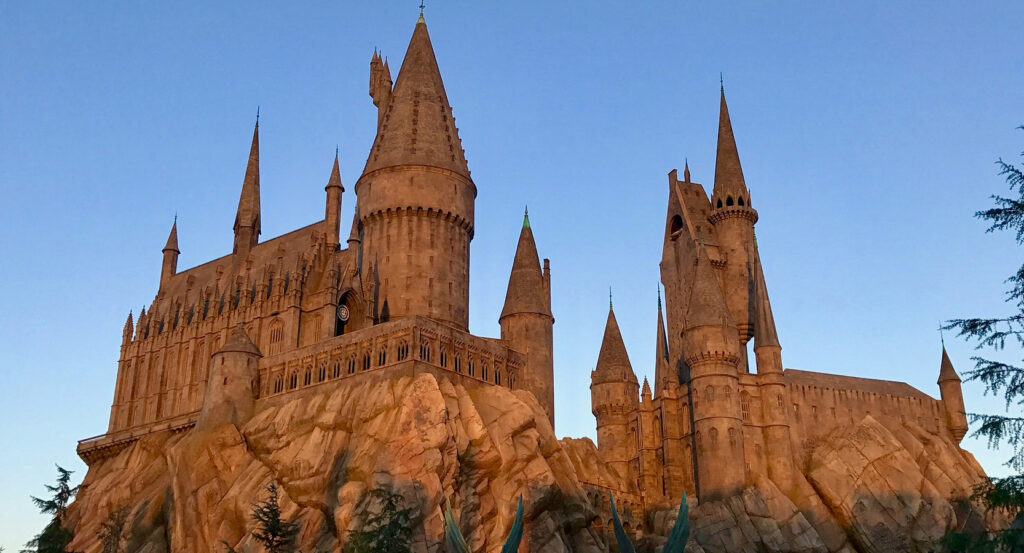
The park underwent a decisive second transformation when management began developing major standalone attractions beyond its original backlot-centered format. E.T. Adventure opened in 1991 after $40 million investment as the first attraction disconnected from the tram operation, signaling a deliberate effort to build a walk-around destination around Universal film properties. Backdraft followed in 1992 through a $10 million effects installation capable of generating fire approaching 2,000 degrees, translating production techniques from Ron Howard's film into a repeatable public show. Jurassic Park-The Ride pushed the strategy to a new scale in 1996: Steven Spielberg consulted on the reported $110 million project, computerized dinosaurs populated its 5½-minute course and an 84-foot descent became the tallest drop then constructed for a water ride. Attendance rose 35 percent during the summer of its debut, reaching 2.5 million by September. The Wizarding World of Harry Potter opened in 2016 around Hogsmeade and Hogwarts Castle, extending the property into fully developed franchise environments, and Jurassic World-The Ride replaced its predecessor in 2019 with new mechanical creatures and effects derived from the later films. Super Nintendo World opened on February 17, 2023 through Universal's partnership with Nintendo, placing Mario Kart: Bowser's Challenge and interactive Power-Up Band technology inside an expanded portion of the Lower Lot. Fast & Furious: Hollywood Drift opened on September 16, 2026 as Universal Destinations & Experiences' fastest roller coaster, sending independently rotating vehicles through four launches at speeds reaching 72 mph across 4,100 feet of aerial track engineered around the hillside and Starway. Six decades of expansion have turned the property from an appendage of a film studio into a technologically ambitious theme park whose major construction eras track Universal's increasing investment in entertainment franchises and attraction engineering.
How Universal Studios fits.
Universal Studios works as the anchor for a Mulholland Drive sequence tracing scenic-road planning, Olympic-era visitor infrastructure and grassroots preservation across the Santa Monica Mountains immediately above the studio property.
Begin at Universal City Overlook, constructed on the north side of Mulholland Drive in 1984 through funding donated by Universal Studios as Los Angeles prepared for the Summer Olympic Games. The viewpoint belongs to the Mulholland Scenic Parkway, whose city section was constructed in 1924 from a concept advanced by Water Bureau chief and city engineer William Mulholland for a mountain road carrying Angelenos toward recreational landscapes beyond the urban basin. Its position above the San Fernando Valley places Universal City and the Verdugo Hills within the broad mountain-and-metropolis geography Mulholland intended the road to reveal. Continue to Jerome C. Daniel Overlook Above the Hollywood Bowl, developed concurrently farther east as another 1984 Olympic-era viewpoint. Its ridge position crosses the Santa Monica Mountains' principal visual divide, opening toward the Hollywood Bowl and Downtown on the southern side and the San Fernando Valley to the north, with the Hollywood Sign and Griffith Observatory extending the panorama eastward. A later $250,000 restoration initiative addressed hillside erosion, damaged fencing and visitor infrastructure after heavy use placed substantial pressure on the small site. Conclude at Nancy Hoover Pohl Overlook, named for the Fryman Canyon resident whose conservation work spanned more than six decades. Pohl fought development across the eastern Santa Monica Mountains and helped secure Fryman Canyon Park, Coldwater Canyon Park and Wilacre Park as protected land. Her work also advanced the five-mile Betty B. Dearing Mountain Trail, which connects preserved mountain properties across terrain repeatedly contested by development pressure. The progression moves from a viewpoint financed by Universal for the 1984 Olympics through a companion overlook spanning both sides of the mountain divide into a conservation site honoring Nancy Hoover Pohl, tracing how scenic infrastructure and citizen action preserved public access to the ridges surrounding Universal City.
Where your story begins.
Foresyte Travel reveals places that feel extraordinary long before you arrive.
Enjoy editorial crafted for luxury travelers.
Foresyte may earn a commission when you book.





































































































