
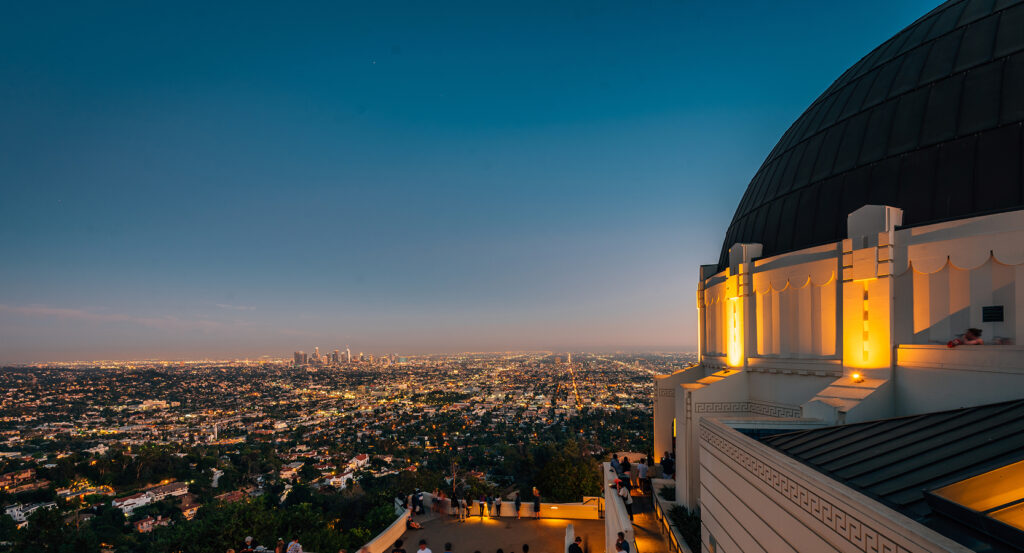
Why Universal City matters.
Universal City is a cinematic enclave where the eastern San Fernando Valley's studio landscape meets a century-old production campus, steep Cahuenga Pass terrain and an entertainment district built directly around the infrastructure of filmmaking.
Positioned between Studio City, Toluca Lake, and the Hollywood Hills, the neighborhood occupies a broad shelf at the northern entrance to Cahuenga Pass, where production buildings and public entertainment complexes rise against slopes separating the San Fernando Valley from Hollywood. Soundstages, backlot streets, office buildings, large-span production structures and densely engineered hillside construction create a physical environment whose scale shifts sharply between enclosed studio compounds and elevated public precincts. Universal Studios supplies the primary encounter through a terraced complex overlooking the working production lot, placing large entertainment structures directly above streets and stages devoted to film and television. Universal CityWalk creates a secondary passage across the upper property through an intensely built pedestrian corridor positioned between the theme park, cinemas and the descending studio campus. The result is a neighborhood whose physical form collapses production, corporate entertainment and public performance into a single hillside district created around one of the oldest continuously important studio sites in American cinema.
What defines Universal City.
Universal City is best known for Carl Laemmle's creation of a purpose-built filmmaking center that joined production with public access during the formative years of the American motion-picture industry. Laemmle had entered exhibition in Chicago before challenging the Edison-controlled film establishment through the Independent Moving Pictures Company, then combined IMP with five other companies in 1912 to create the Universal Film Manufacturing Company. The new enterprise united production, distribution and exhibition under Laemmle's leadership at a moment when the American film business was still defining its industrial structure. Universal began production on its California property in 1914, with Damon and Pythias becoming the first film completed on a Universal lot. Laemmle formally opened Universal City in 1915 as a studio community devoted to motion pictures, promoting the property as the world's only moving-picture city. Paying spectators entered the grounds during the silent era and watched filmmaking, creating an unusually direct relationship between industrial production and public entertainment from the studio's earliest years. The arrival of synchronized sound eventually ended that original arrangement as uncontrolled spectator noise became incompatible with recording on set. Noble Johnson joined Universal in 1917 as the first Black actor signed to a major studio contract, adding another consequential chapter to the company during its first decade on the property. The studio subsequently grew across the hillside into a dense production complex whose current footprint contains dozens of soundstages alongside permanent backlot environments representing New York, European streets, western settings, Colonial Street and other constructed geographies.
Red-and-white Glamor Trams returned public access to the production campus in 1964, beginning with five weekday departures whose routes lasted more than two hours and carried spectators past active movie and television work. Alfred Hitchcock's Psycho set became one of the earliest film environments placed directly before tram riders, giving the revived tour a tangible connection to a major Universal production. Flash Flood joined the route in 1971 as a demonstration of artificial movie weather, followed by the Parting of the Red Sea in 1973 and the spinning Ice Tunnel in 1975 as staged effects increasingly supplemented observation of production. That evolution converted the studio visit into the foundation of Universal Studios, joining a functioning backlot with increasingly elaborate entertainment engineered specifically for the public. More than 200 million people had taken the Studio Tour by its sixtieth anniversary in 2024, and the contemporary route retained production streets and film sets alongside purpose-built attractions. Another major expansion arrived in 1993 when Universal collaborated with architect Jon Jerde on Universal CityWalk, conceived as a three-block pedestrian entertainment corridor drawing its architectural language from Los Angeles streets and commercial imagery. CityWalk placed cinemas, restaurants and retail between the studio attraction and surrounding transportation approaches, extending the original Laemmle-era idea of a filmmaking center open to outsiders into a separate entertainment district. Universal City evolved through two distinct public-facing eras, first allowing spectators into silent-film production and later converting behind-the-scenes access into an entertainment model exported across Universal's international theme-park business.
How Universal City fits.
Universal City works as the anchor for an outing connecting the adobe site of California's 1847 military capitulation, an outdoor performance ground shaped through successive architectural experiments and Hollywood's oldest surviving motion-picture production building.
Begin at Campo de Cahuenga, where Andrés Pico and John C. Frémont concluded the Capitulation of Cahuenga on January 13, 1847, ending armed conflict in California during the Mexican-American War. The agreement required Californio forces to surrender and return home, protected lives and property, deferred any allegiance oath until the wider war ended and preceded the Treaty of Guadalupe Hidalgo of 1848. Los Angeles purchased the property in 1923, and the historical museum dedicated there in 1951 later became one of the city's earliest Historic-Cultural Monuments, preserving a site where the political control of California changed course at the mouth of the pass. Continue to Hollywood Bowl, whose natural Daisy Dell setting became an organized performance ground during the early 1920s before architects repeatedly reworked the relationship between stage, acoustics and surrounding canyon. Myron Hunt shaped the balloon-like seating configuration installed in 1926; Allied Architects supplied the first shell that year, Lloyd Wright answered with a pyramidal design in 1927 and then nine adjustable wooden panels in 1928, and Allied Architects returned in 1929 with a $50,000 semicircular structure that endured for 74 years. Frank Gehry added acoustic elements in 1970, and the present shell arrived in 2004, leaving the Bowl as an unusual century-long sequence of architectural attempts to control sound within a natural amphitheater. Conclude at Hollywood Heritage Museum inside the Lasky-DeMille Barn, a 1901 structure rented by Jesse L. Lasky and Cecil B. DeMille as a production facility after their arrival in Hollywood in 1913. The Squaw Man emerged from the operation as the first full-length feature made in Hollywood, and Lasky's company joined Adolph Zukor's Famous Players in 1916 before the corporate lineage developed into Paramount Pictures. Hollywood Heritage, founded in 1980, rescued the threatened building and opened its museum there in 1985; the barn later entered the National Register of Historic Places in 2014 and survives as Hollywood's oldest motion-picture production building. The progression moves from the agreement that closed armed conflict in Mexican-era California through a century of architectural experimentation around live performance and culminates inside the surviving production building associated with Hollywood's transition into feature filmmaking, tracing three radically different chapters concentrated around Cahuenga Pass.
Where your story begins.
Foresyte Travel reveals places that feel extraordinary long before you arrive.
Enjoy editorial crafted for luxury travelers.
Foresyte may earn a commission when you book.





































































































