
Why Beverlywood matters.
Beverlywood is a secluded enclave where West Los Angeles's residential character meets curving garden-suburb streets, gently rising terrain and a midcentury community organized around landscaped allées and a central teardrop-shaped park.
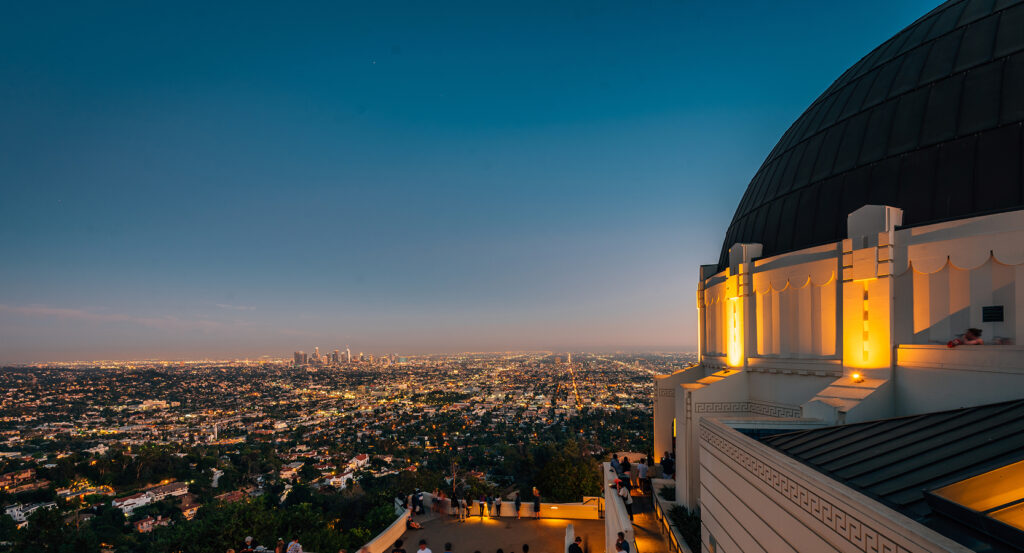
Positioned between Cheviot Hills, Pico-Robertson, and Palms, the neighborhood occupies rolling ground south of Beverly Hills where the flatter northern blocks rise gradually toward higher residential streets overlooking the Westside. Curvilinear roads, irregular parcels, deep setbacks and mature tree cover replace the rectilinear street pattern surrounding much of the district, with American Colonial Revival, Georgian Revival and Ranch houses lining a sequence of deliberately landscaped approaches. Beverly Drive supplies the primary encounter through a broad planted median that draws streets inward before reaching Circle Park near the center of the tract. Smaller roads radiate outward across changing elevations, creating angled intersections, long planted verges and distant views between houses positioned to capture light across the rolling site. The result is a neighborhood whose street geometry, topography and domestic scale preserve the residential-park conception that distinguished Beverlywood from the denser commercial corridors surrounding it.
What defines Beverlywood.
Beverlywood is best known for transforming the former Arnaz Ranch into a 330-acre residential park conceived by Walter H. Leimert during the final years before World War II. A syndicate of Los Angeles investors acquired the property from Marbhead Land Company in 1939, ending an ownership period that had begun in 1901 and placing the rolling ranch acreage under Leimert's development company. Leimert recruited George Gibbs, whose 35-year professional background included work with Olmsted Brothers and whose earlier projects included Forest Hills in New York and St. Francis Wood in San Francisco, to shape the new community. Gibbs organized the tract around curving streets, landscaped thoroughfares and a central park, using irregular parcels and the site's rising southern terrain to maximize light and distant views. Beverly Drive became the principal allée, conceived without houses directly fronting its central section and bordered by planting strips that screened adjoining homesites from automobile traffic. The first 54-acre unit had graded streets, curbs and underground infrastructure underway by June 1940 as Leimert prepared the property for its public opening. Early construction included the Hospitality House, a model residence organized around an entrance garden, rear living porch and rooms opening directly toward outdoor areas, anticipating Leimert's postwar interest in larger rooms and stronger connections between houses and gardens. World War II interrupted the initial building campaign soon after houses began appearing, leaving substantial portions of the tract undeveloped during the conflict. Construction resumed in earnest in 1947, and the neighborhood eventually reached 1,354 houses, completing a community whose curving plan and planted interior remained unusually cohesive within the increasingly urbanized Westside.
Postwar Jewish migration supplied a separate social chapter as professional families moved westward across Los Angeles and increasingly settled in Beverlywood and the adjoining Pico-Robertson corridor. A 1951 study of Jewish residential movement already placed Beverlywood-Mar Vista within a westward sequence connecting older Jewish districts with Beverly Hills and Westwood, marking the neighborhood as part of a major demographic redistribution after World War II. Pico Boulevard developed a corresponding commercial culture, and Beverlywood Bakery opened there in 1946 before becoming one of the Westside's enduring Jewish food businesses. Abe and Esther Factor established Factor's Famous Deli nearby in 1948, followed by Herman Markowitz's acquisition of the business in 1969 and its continuation under his daughters Suzee and Susan. The surrounding district gained further Jewish religious, educational and culinary institutions as families arriving from other Los Angeles neighborhoods and from outside California concentrated around Pico and Robertson. By the 1980s, a growing Modern Orthodox population was reshaping the corridor, followed by a larger Orthodox presence that supported synagogues, day schools, markets and restaurants across the adjoining commercial streets. Beverlywood's postwar houses became part of a much broader westward movement in Los Angeles Jewish life, linking Leimert's residential tract with one of the city's most concentrated Jewish cultural districts.
How Beverlywood fits.
Beverlywood works as the anchor for an outing connecting an early resort golf course, a purpose-built sound-film studio and a museum that placed Holocaust history and prejudice within an interactive educational institution on Pico Boulevard.
Begin at Rancho Park Golf Course, whose first incarnation opened on July 26, 1921 as the Ambassador Golf Club, an excursion property associated with the Ambassador Hotel. English golf architect William Herbert Fowler laid out the original 18-hole, par-72 course across 6,250 yards of hills, ditches and arroyos, and Ambassador Hotel architect Myron Hunt designed its clubhouse. The property became Rancho Golf Club in 1922 before financial trouble ended that phase during the Depression. Los Angeles reopened the acreage for public recreation in 1934, and William Johnson and William P. Bell later designed the present 18-hole course. Rancho Park inaugurated that configuration with the 1949 U.S.G.A. Public Links Championship and subsequently hosted eighteen Los Angeles Opens alongside LPGA and senior professional events, carrying an early hotel excursion ground into the competitive history of public golf in Los Angeles. Continue to Fox Studio Lot, where William Fox opened Movietone City on October 28, 1928 as the first motion-picture studio constructed exclusively for sound production. The 100-acre West Los Angeles complex initially contained several sound stages and 27 buildings, separating it technically from older silent-era studios retrofitted after synchronized sound altered filmmaking. Fox surrendered control of Fox Film Corporation in 1930, and the company merged with Twentieth Century Pictures in 1935 to create Twentieth Century-Fox. The studio remained in continuous production as one of Hollywood's major facilities, and undeveloped northern backlot acreage later supplied the land from which Century City emerged during the 1960s. Its presence also influenced surrounding residential growth, placing a major employment center beside communities including Beverlywood as the Westside developed around the motion-picture industry. Conclude at Museum of Tolerance, founded by the Simon Wiesenthal Center and dedicated on February 8, 1993 after more than five years of preparation. The $50 million, eight-level complex departed from conventional object-centered museum practice by using interactive media and constructed environments to connect Holocaust history with prejudice and antisemitism in contemporary society. Simon Wiesenthal attended the opening weekend, joining Holocaust survivors, diplomats, religious leaders and civic figures as the institution began operating on Pico Boulevard. Its original displays incorporated 75 installations, extensive video technology and a chronological passage through Holocaust history, making electronic participation central to the institution from its opening. Subsequent expansion produced programs and exhibitions that have brought more than eight million people through the museum since 1993. The progression moves from Fowler's 1920s recreational landscape through Fox's purpose-built sound studio and culminates in the Simon Wiesenthal Center's interactive museum, tracing the successive recreational, entertainment and cultural institutions that gave the Westside surrounding Beverlywood significance far beyond its residential streets.
Where your story begins.
Foresyte Travel reveals places that feel extraordinary long before you arrive.
Enjoy editorial crafted for luxury travelers.
Foresyte may earn a commission when you book.





































































































