
Why Christopher Park matters.
Christopher Park is an intimate civic park where Greenwich Village's historic street pattern meets nineteenth-century public space, commemorative sculpture and a nationally significant landscape of LGBTQ+ civil rights.
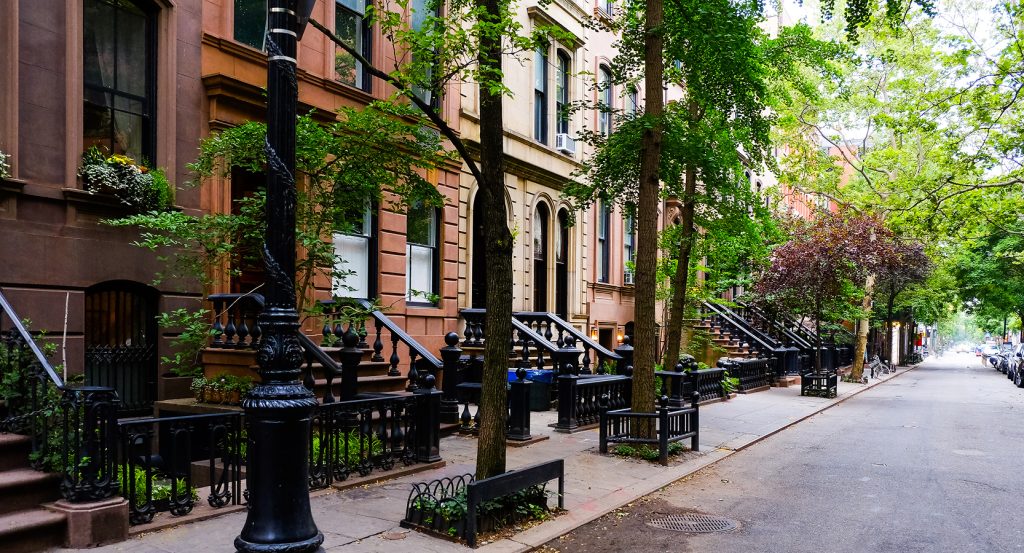
Set along Christopher Street near Grove Street and just steps from the narrow bend of Gay Street, the park occupies a 0.12-acre triangular parcel created where Greenwich Village's pre-grid streets converge west of 6th Avenue. A nineteenth-century wrought-iron fence encloses the small green, with an arched entrance opening toward brick paths, mature trees, planted beds and a western plaza furnished with benches. The triangular geometry divides the grounds into contrasting halves, placing the accessible paved plaza toward the west and denser plantings toward the east. Philip Winslow reshaped portions of the landscape during the late twentieth century through new brick paths and seating, retaining the compact scale and street relationships inherited from the park's earlier configuration. The result is a tightly bounded public garden whose iron perimeter, irregular footprint, brick circulation and contrasting planted areas preserve an unusually intimate piece of Greenwich Village within the surrounding network of angled streets.
What defines Christopher Park.
Christopher Park is best known for occupying a central place within the events surrounding the Stonewall uprising of June 1969 and the civil-rights movement that accelerated afterward. The park itself originated after an 1835 fire destroyed an overcrowded tenement on the parcel, leading New York City to establish the public space in 1837. By the 1960s, Christopher Park had become a gathering place for gay youth, including young people who had left or been expelled from their homes and spent substantial periods on the surrounding streets. Gay-rights activist Bob Kohler became acquainted with many of them through regular walks with his schnauzer Magoo, and artist Thomas Lanigan-Schmidt later recalled the severe hardships faced by members of that community. In the early hours of June 28, 1969, a police raid on the Stonewall Inn across Christopher Street produced demonstrations that spread through the neighboring blocks and continued across several nights. Street youth used Christopher Park as a refuge during the first night, and the surrounding maze of narrow streets aided demonstrators familiar with Greenwich Village as riot-control officers pursued crowds through the district. The uprising became a major catalyst for organized gay and lesbian civil-rights activism nationwide, and the first-anniversary commemoration in 1970 helped expand public protest into what developed as annual Pride observances.
Public art and federal designation added a separate commemorative chapter to the park during the following decades. Two Civil War memorials entered the eastern portion in 1936: a bronze statue honoring Union cavalry commander Philip H. Sheridan and a flagstaff with a plaque dedicated to Colonel Ephraim Elmer Ellsworth of the New York Fire Zouaves, the first Union officer killed during the Civil War. George Segal received a 1979 commission marking the tenth anniversary of Stonewall and produced Gay Liberation, four life-size figures arranged as two male and female couples. The figures were cast in bronze and painted white, continuing Segal's artistic practice of deriving human forms from casts made directly from living models. Opposition delayed the New York installation for years, and Gay Liberation reached Christopher Park in 1992, becoming one of the earliest permanent public artworks devoted to LGBTQ+ equality. President Barack Obama proclaimed Stonewall National Monument on June 24, 2016, creating the first unit of the National Park System dedicated to LGBTQ+ history. The 7.7-acre monument encompasses Christopher Park, the privately owned Stonewall Inn and portions of Christopher Street, Grove Street, Waverly Place, Gay Street, Greenwich Avenue and other surrounding streets and sidewalks associated with the 1969 uprising. New York City donated Christopher Park to the federal government, placing the historic public ground under National Park Service administration within a larger commemorative landscape extending across the streets where the uprising unfolded.
How Christopher Park fits.
Christopher Park works as the anchor for a Greenwich Village outing connecting Victorian civic architecture, nineteenth-century domestic preservation and the transformation of Washington Square into a major public gathering ground.
Begin at Jefferson Market Library, erected between 1875 and 1877 as a courthouse designed by Frederick Clark Withers and Calvert Vaux in Victorian Gothic form. Civil proceedings occupied the second floor, police cases filled the first and prisoners waited in the brick-arched basement before transfer to jail, with a firewatcher's balcony rising 100 feet above Greenwich Village. Court use ended in 1945, and demolition threatened the vacant building during the 1950s before Margot Gayle, Philip Wittenberg, Lewis Mumford, E. E. Cummings and other preservation advocates organized to save it. Mayor Robert F. Wagner announced its conversion into a library in 1961, Giorgio Cavaglieri directed the adaptation and the branch opened in 1967. Continue to Merchant's House Museum, the 1832 late-Federal and Greek Revival row house built by hatter and real-estate investor Joseph Brewster. Merchant Seabury Tredwell purchased the property in 1835 and moved there with his wife Eliza, their eight children and four Irish servants; the family remained for almost a century. Gertrude Tredwell died in the house in 1933, after which relative George Chapman acquired the property and established the organization that opened it as a museum in 1936. More than 3,000 Tredwell possessions survive in its collection, including furniture, clothing, photographs, books and a suite of 12 mahogany side chairs attributed to Duncan Phyfe. Conclude at Washington Square Arch, whose origins lie in New York's 1889 centennial celebration of George Washington's presidential inauguration. Stanford White designed a temporary wood-and-plaster arch north of Washington Square, and its popularity prompted a committee that included former President Grover Cleveland and architect Richard Morris Hunt to support a permanent version. White again supplied the design, with the marble structure substantially complete by 1892 and formally dedicated in 1895. Sculptor Herman Atkins MacNeil added Washington at War in 1916, followed by A. Stirling Calder's Washington at Peace in 1918, giving the 5th Avenue entrance two expansive treatments of Washington separated by military and presidential roles. The progression moves from the rescue and conversion of Withers and Vaux's courthouse through the extraordinary survival of the Tredwell family home and culminates at White's civic arch, joining preservation, domestic history and public commemoration across Greenwich Village.
Where your story begins.
Foresyte Travel reveals places that feel extraordinary long before you arrive.
Enjoy editorial crafted for luxury travelers.
Foresyte may earn a commission when you book.







































































































