
Why The Stonewall Inn matters.
The Stonewall Inn is a storied neighborhood bar where Greenwich Village's LGBTQ+ culture meets the site of the June 1969 uprising that reshaped gay and lesbian civil-rights organizing across the United States.
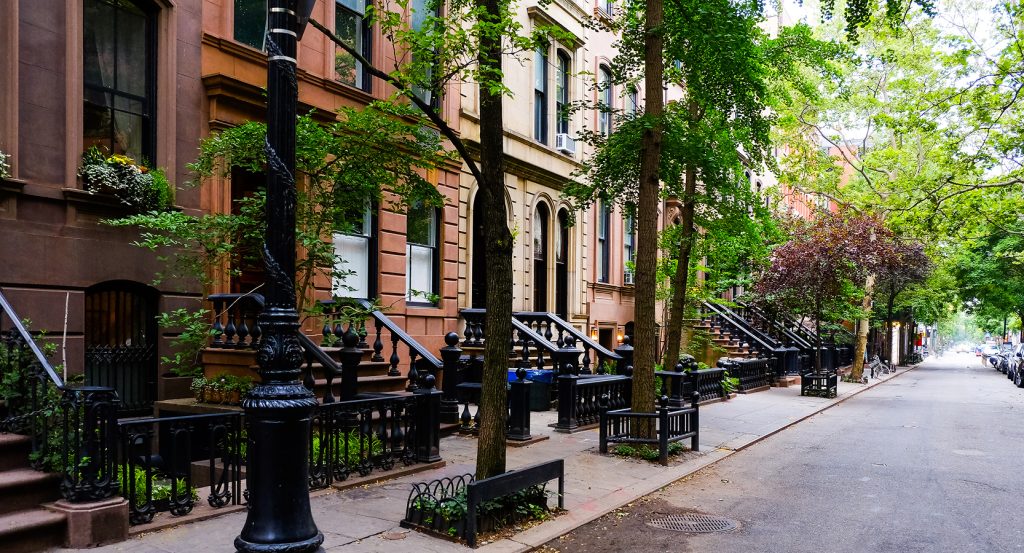
Set along Christopher Street near Seventh Avenue South and just steps from Sheridan Square, the bar occupies two joined nineteenth-century structures within Greenwich Village's irregular street grid, placing a modest brick frontage amid narrow streets inherited from the neighborhood's earlier urban form. The pair originated as separate horse stables built in 1843 and 1846 before a 1930 alteration joined them behind a single exterior façade, giving the property the low horizontal form still legible on Christopher Street. Bonnie's Stonewall Inn subsequently operated there as a restaurant, retaining red brick at street level and stucco above through alterations that preceded the building's later nightclub chapter. The surrounding angled streets carry Christopher Street toward Greenwich Avenue, Gay Street and Waverly Place through a compact network whose physical irregularity sharply distinguishes this section of Greenwich Village from Manhattan's rectilinear avenues farther north. The result is an unusually modest building whose joined structures, surviving façade and tight street setting place nationally consequential history inside the architectural scale of a neighborhood bar.
What defines The Stonewall Inn.
The Stonewall Inn is best known for the uprising that followed an NYPD raid in the early hours of June 28, 1969, when patrons and a gathering crowd resisted a policing pattern long directed at gay bars and their clientele. Police officers began making arrests during the raid, yet people outside remained on Christopher Street, where anger escalated as detainees were moved toward police vehicles. Officers retreated into the bar after the confrontation intensified, and later police reinforcements included members of the Tactical Patrol Force. Demonstrators regrouped through neighboring streets after police charges, returning toward Christopher Street during confrontations that continued across several nights through July 3. Chants of “Gay Power!” and “Liberate Christopher Street!” accompanied a confrontation whose significance extended far beyond the bar as new organizations expanded rapidly during the years that followed. Activist Frank Kameny recalled fifty to sixty gay organizations nationwide before Stonewall and 1,500 a year later, a scale of expansion that places the uprising within a broader surge of organized gay and lesbian activism.
Commemoration of the uprising developed through a separate chain of events that progressively changed the site's national status. Activists marked its first anniversary in June 1970 through Christopher Street Liberation Day in New York, accompanied by commemorative demonstrations in other American cities, helping establish the annual tradition from which Pride observances expanded internationally. The Stonewall site entered the National Register of Historic Places in June 1999 and received federal historic recognition the following year, becoming the first LGBTQ+ site granted that level of national distinction. President Barack Obama created Stonewall National Monument on June 24, 2016, forming a 7.7-acre National Park Service unit encompassing the privately owned inn, portions of the surrounding street network and federally owned parkland. New York City transferred the 0.12-acre park parcel to the federal government before the presidential proclamation, creating the federal property at the center of the new unit. The designation placed the streets associated with the 1969 uprising inside the National Park System and made Stonewall the first national monument devoted to LGBTQ+ history.
How The Stonewall Inn fits.
The Stonewall Inn works as the anchor for an afternoon tracing Greenwich Village through three institutions shaped by architectural preservation, independent cinema and the neighborhood's enduring jazz culture.
Begin at Jefferson Market Library, the Victorian Gothic former courthouse designed by Frederick Clark Withers and Calvert Vaux and constructed between 1875 and 1877 for $360,000. A civil court occupied the second floor, a police court filled the first and prisoners waited in the brick-arched basement beneath a tower whose bell summoned volunteer firefighters. Court operations ended in 1945, and abandonment followed after later municipal occupants departed in 1958, leaving the structure threatened with demolition. Margot Gayle and Philip Wittenberg led a preservation campaign joined by Lewis Mumford, E. E. Cummings and Maurice Evans; Mayor Robert F. Wagner announced its survival in 1961, Giorgio Cavaglieri converted the courthouse for library use and the branch opened in 1967. Continue to IFC Center, which opened on June 17, 2005 after an extensive renovation of the historic Waverly Theater and built a five-screen home for independent, foreign and documentary cinema. Its inaugural program paired Miranda July's Me and You and Everyone We Know, William Lustig's Maniac, D. A. Pennebaker's Bob Dylan film Don't Look Back and Yasujirō Ozu's 1932 silent I Was Born, But…, immediately spanning new independent filmmaking, cult cinema, documentary and repertory programming. DOC NYC later made the complex a principal home for documentary film, and recurring queer-film programming extended the theater's connection to Greenwich Village's LGBTQ+ cultural history through curated cinema. Conclude at Village Vanguard, the triangular basement club at 178 Seventh Avenue South founded by Max Gordon in 1935 and eventually devoted to jazz after earlier decades encompassing poetry, folk music, comedy and cabaret. Musicians including John Coltrane, Bill Evans and Sonny Rollins made celebrated live albums in the room, turning its compact basement acoustics into part of recorded jazz history. The Thad Jones/Mel Lewis Orchestra began its Monday-night residency there in 1966, and the ensemble, later renamed the Vanguard Jazz Orchestra, carried that weekly tradition through thousands of performances across more than half a century. The club's fifteen-step descent and triangular room preserve a physical intimacy inseparable from the performances made on its stage. The progression moves from Withers and Vaux's rescued courthouse through the Waverly's reinvention as an independent-film center into Max Gordon's basement jazz room, tracing how Greenwich Village repeatedly preserved small cultural spaces through new artistic purposes.
Where your story begins.
Foresyte Travel reveals places that feel extraordinary long before you arrive.
Enjoy editorial crafted for luxury travelers.
Foresyte may earn a commission when you book.







































































































