
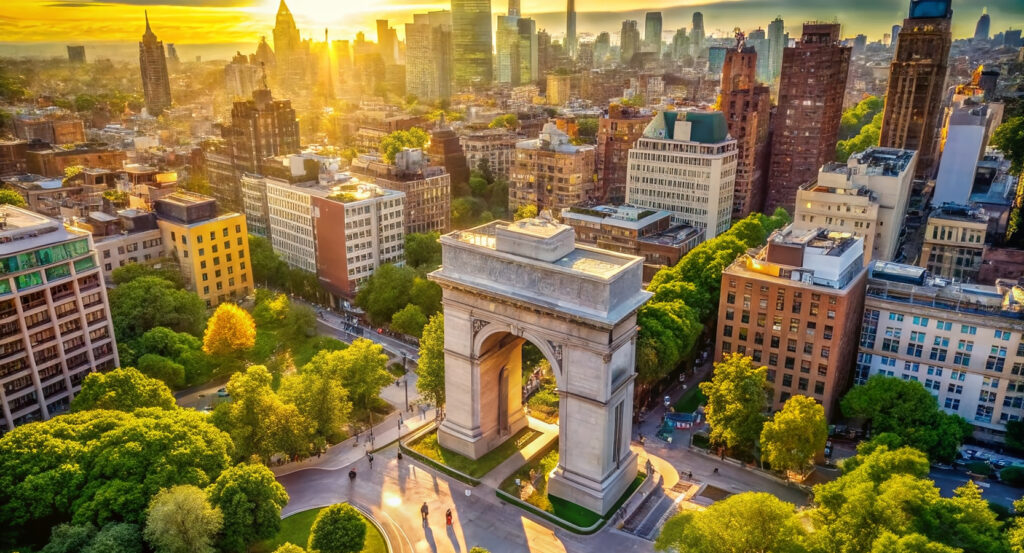
Why Washington Square Park matters.
Washington Square Park is a defining civic space where Greenwich Village's creative character meets nineteenth-century landscape design, Stanford White's marble arch and a long tradition of music, protest and public gathering.
Set along Washington Square North near 5th Avenue and just steps from Washington Square East, the park occupies nearly ten acres at the center of Greenwich Village, with historic row houses, university buildings and dense neighborhood streets framing an open landscape organized around its expansive northern entrance. Mature trees, lawns, curving paths and smaller activity zones surround a broad central plaza where the fountain and arch establish a powerful north-south axis through the otherwise informal plan. The principal encounter unfolds around that plaza as musicians, chess players, performers and informal gatherings continually transform a formally designed civic space through unscripted occupation. Peripheral lawns, playgrounds, dog runs and shaded paths introduce a distinct secondary mechanism by breaking the park into smaller environments whose uses operate independently from the concentrated activity around the fountain. The result is a park where expansive architecture, intimate landscape and unusually persistent traditions of public expression give Greenwich Village a civic center shaped as strongly by collective use as by physical design.
What defines Washington Square Park.
Washington Square Park is best known for evolving from burial ground to military parade ground and public park before becoming one of Greenwich Village's central civic spaces. New York's Common Council acquired land west of Minetta Creek in 1797 for a potter's field used for the burial of poor residents and victims of epidemic disease, placing a municipal cemetery beyond the densely settled city. The burial ground remained active into the early nineteenth century as Manhattan expanded northward and yellow fever outbreaks accelerated settlement around Greenwich Village. Alderman Abraham Valentine advanced the conversion of the former cemetery into a military parade ground in 1826, the same year the space received the Washington name during the fiftieth anniversary of the Declaration of Independence. Public park use followed in 1827, and fashionable residential development rapidly gathered around the open space as Greek Revival houses appeared along its edges. A fountain entered the square in 1852, adding a formal civic feature to ground whose military function had already receded. Ignaz Pilat and Montgomery Kellogg redesigned the park during the early 1870s, replacing the parade-ground character with curving paths and landscaped areas associated with nineteenth-century urban park planning. The transformation established the underlying relationship between central gathering space and planted perimeter that successive reconstructions would repeatedly reinterpret.
George Washington's presidential centennial produced the architectural element that permanently altered the park's relationship with 5th Avenue. William Rhinelander Stewart promoted a temporary Stanford White arch erected north of the square in 1889 from wood and plaster to commemorate the hundredth anniversary of Washington's inauguration. Its popularity led Grover Cleveland, Richard Morris Hunt and other supporters to advance a permanent version, and construction of White's marble triumphal arch began in 1890 within the park. Excavation for its foundations encountered human remains left from the former burial ground, physically connecting the new commemorative structure with an earlier layer of the site. The permanent arch was substantially complete by 1892, with sculptural development continuing through the dedication period and into the twentieth century. Hermon A. MacNeil's Washington at War was installed in 1916, followed by Alexander Stirling Calder's Washington at Peace in 1918, creating the paired presidential figures on the northern face. 5th Avenue traffic continued beneath the arch and through the park into the twentieth century before vehicular use ended, allowing the former roadway to become part of the pedestrian landscape. A $30.6 million multiphase restoration completed in 2014 later renewed the fountain, plaza, lawns, planting, playgrounds, chess area, paths and other public spaces, carrying the park's long cycle of physical reinvention into the twenty-first century.
How Washington Square Park fits.
Washington Square Park works as the anchor for an afternoon tracing nineteenth-century domestic life, Victorian civic architecture and downtown experimental theater through institutions across Greenwich Village and NoHo.
Begin at Merchant's House Museum, where hatter and property developer Joseph Brewster completed a late Federal and Greek Revival row house in 1832 before merchant Seabury Tredwell purchased it three years later and established the family household that remained there until 1933. George Chapman acquired the property after Gertrude Tredwell's death and opened it as a museum in 1936, preserving more than 3,000 family possessions including furniture, clothing, photographs and decorative arts; the house became Manhattan's first building designated under New York City's new landmarks system in 1965 and a National Historic Landmark the following year. Continue to Jefferson Market Library, designed by Frederick Clark Withers and Calvert Vaux as a Victorian Gothic courthouse complex constructed from 1875 to 1877 for $360,000. Civil and police courts occupied the building before judicial use ended in 1945, and demolition threatened the vacant structure during the late 1950s until Margot Gayle, Philip Wittenberg, Lewis Mumford and other preservationists secured its survival; Mayor Robert F. Wagner announced conversion into a library in 1961, Giorgio Cavaglieri adapted the courthouse and the branch opened in 1967. Conclude at The Public Theater, where Joseph Papp's New York Shakespeare Festival established a permanent downtown base after beginning as the Shakespeare Workshop in 1954 and launching mobile performances from a 35-foot trailer in 1956. The company opened its Astor Place era in 1967 with Hair, initiating a production history that later included major American works and eventually Hamilton, extending Papp's commitment to accessible theater from free Shakespeare into one of New York's most consequential nonprofit theatrical institutions. The progression moves from the preserved household of a nineteenth-century merchant family through the community rescue of a Victorian courthouse into Joseph Papp's institutional model for accessible theater, revealing distinct traditions of domestic preservation, civic activism and cultural experimentation surrounding Washington Square Park.
Where your story begins.
Foresyte Travel reveals places that feel extraordinary long before you arrive.
Enjoy editorial crafted for luxury travelers.
Foresyte may earn a commission when you book.







































































































