
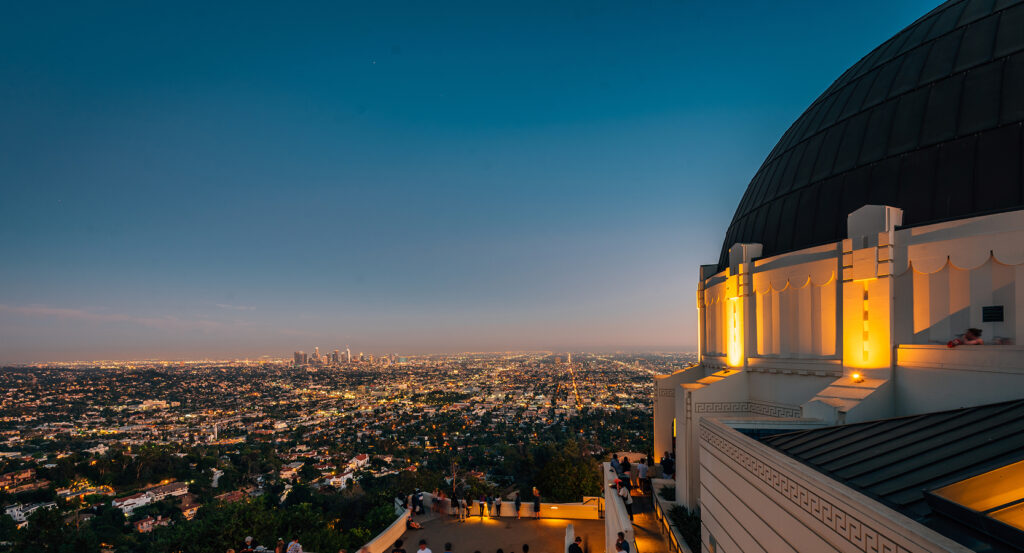
Why Eastside matters.
Eastside is a storied enclave where eastern Los Angeles's river-edge geography meets nineteenth-century suburbs, streetcar corridors, hillside communities and generations of immigrant settlement that made the territory east of Downtown one of the city's deepest concentrations of cultural history.
Positioned between Downtown, Northeast Los Angeles, and East Los Angeles, the neighborhood occupies the metropolitan territory beyond the Los Angeles River, where flat residential grids around Boyle Heights and Lincoln Heights rise eastward into the irregular slopes of City Terrace and El Sereno. Victorian houses, Craftsman bungalows, compact courtyard housing, hillside residences and continuous commercial strips create sharp physical changes across districts developed during successive periods of metropolitan expansion. Cesar E. Chavez Avenue supplies the primary encounter through the Lower Eastside, extending from the river toward the county boundary across a commercial axis whose narrow parcels and dense storefronts preserve the scale of prewar neighborhood commerce. Huntington Drive creates a secondary passage through the elevated eastern territory, following the San Rafael Hills through El Sereno amid early suburban tracts whose detached houses occupy terrain fundamentally different from the flatter districts nearer Downtown. The result is a neighborhood whose river crossings, valley-floor streets and rising eastern hills contain unusually legible layers of Los Angeles expansion from nineteenth-century subdivision through the streetcar metropolis and twentieth-century immigrant city.
What defines Eastside.
Eastside is best known for containing some of Los Angeles's earliest suburban development, beginning with subdivisions established beyond the river during the 1870s. Hancock M. Johnston, Dr. John Strother Griffin and former California governor John G. Downey subdivided land northeast of Downtown in 1873 as East Los Angeles, the community later renamed Lincoln Heights. Griffin, William H. Workman and Downey financed water infrastructure for the tract, overcoming one of the principal obstacles facing residential development beyond the established city. Griffin and Downey connected the subdivision with Downtown through a streetcar line in 1876, giving the emerging district one of Los Angeles's earliest suburban transportation links. South of that tract, William Henry Workman inherited Andrew Boyle's acreage after Boyle died in 1871 and joined Isaias Hellman and John Lazzarevitch in subdividing Boyle Heights in 1875. Workman constructed a water main and horse-drawn streetcar connection across the river, tying another peripheral subdivision directly to Central Los Angeles. A.H. Judson and investors formed the Brooklyn Land and Building Company the following year and divided 105 acres beside Workman's transportation route into Brooklyn Heights, organized around the avenue later renamed Cesar E. Chavez Avenue. Four acres at the center of that tract passed to the city in 1877 and became Prospect Park, embedding public open ground within the expanding residential district. The Eastside grew through several adjoining nineteenth-century subdivisions whose developers used river crossings, water infrastructure and street transportation to convert agricultural acreage beyond Downtown into some of Los Angeles's earliest residential suburbs.
Immigration transformed those early suburbs into a profoundly multicultural district during the opening decades of the twentieth century. Japanese families expanded eastward from Little Tokyo along 1st Street during the 1910s and 1920s, and Boyle Heights contained 1,400 Japanese residents by 1927, then the third-largest Japanese concentration in the city after Little Tokyo and Terminal Island. Eastern European Jewish settlement expanded during the same period, with Jewish households forming about forty percent of Boyle Heights during the 1920s and 1930s and Brooklyn Avenue developing into a major concentration of bakeries, restaurants, shops, union offices and religious institutions. Mexican migration accelerated after the Mexican Revolution began in 1910, then expanded again as industrial employment and inexpensive housing drew households toward communities east of the river. Housing discrimination elsewhere in Los Angeles concentrated Jewish, Japanese, Mexican, Chinese, African American, Armenian and Russian Molokan residents within many of the same Eastside districts, creating unusual proximity among communities separated across much of the wider city. Executive Order 9066 devastated the Japanese American population in 1942 through forced removal and incarceration, emptying homes and businesses across the area. Postwar suburban migration simultaneously reduced the Jewish population, and Mexican American households became increasingly predominant across Boyle Heights and adjoining districts during the 1950s. The Eastside's twentieth-century significance grew from these overlapping migrations and displacements, which turned early suburban territory into a major center of Mexican American life without erasing the architecture and institutions created by the communities that preceded it.
How Eastside fits.
Eastside works as the anchor for an outing connecting rescued Victorian architecture, Charles Fletcher Lummis's hand-built Arroyo Seco residence and a hill landscape whose modern public life emerged from decades of community stewardship.
Begin at Heritage Square Museum, where a preservation campaign begun in 1969 assembled eight nineteenth- and early twentieth-century structures threatened with demolition across Los Angeles. The collection ranges from the Longfellow-Hastings Octagon House to the far larger William Hayes Perry residence, with houses, a church, a railway depot and other structures physically relocated into a concentrated architectural ensemble. The Perry residence originated in Boyle Heights in 1876, where businessman William Hayes Perry commissioned architect E.F. Kysor to design the elaborate Italianate house; the 1887 Hale House contributes a contrasting Queen Anne-Eastlake composition. More than half a century of relocation and restoration turned buildings once scattered across the metropolitan area into an architectural chronology of Southern California between 1850 and 1950. Continue to Lummis House, where Charles Fletcher Lummis began constructing El Alisal beside the Arroyo Seco in 1897 on a three-acre property selected near a massive sycamore. Lummis built the rambling two-story residence over fifteen years from river boulders set into masonry walls measuring two to four feet thick, consulting architects Sumner Hunt and Arthur Benton on structural problems. Fourteen rooms developed behind those walls as Lummis combined his work as author, editor and Los Angeles City Librarian with a house conceived through direct labor and sustained architectural experimentation. El Alisal later received national, state and local historic recognition, preserving one of the most personal architectural works associated with the Arroyo Seco cultural circle. Conclude at Ascot Hills Park, a 93-acre hill landscape in El Sereno whose terrain survived successive development pressures before opening to public use. The hills once formed part of Rancho Rosa de Castilla and remained substantially undeveloped as surrounding tracts expanded; Legion Ascot Speedway occupied nearby territory between 1924 and 1936, drawing automobile racing into the area during Southern California's early motorsport era. Proposals for a park reached back to 1930, yet the property spent decades associated with water storage before residents opposed a 2000 proposal to flatten sections for athletic fields. Initial public access arrived in 2006, and later work added restored habitat, trails, a stream and an amphitheater across terrain whose ridges retain expansive views over eastern Los Angeles. The progression moves from Victorian buildings physically rescued from destruction through Lummis's intensely individual Arroyo Seco architecture and culminates across a hill landscape protected through sustained local stewardship, connecting three distinct approaches to preserving the built and natural inheritance of eastern Los Angeles.
Where your story begins.
Foresyte Travel reveals places that feel extraordinary long before you arrive.
Enjoy editorial crafted for luxury travelers.
Foresyte may earn a commission when you book.





































































































