
Why Forecourt of the Stars matters.
Forecourt of the Stars is a storied cinema courtyard where Hollywood's movie-premiere culture meets nearly a century of handprints, footprints, signatures and highly personal impressions preserved in concrete.
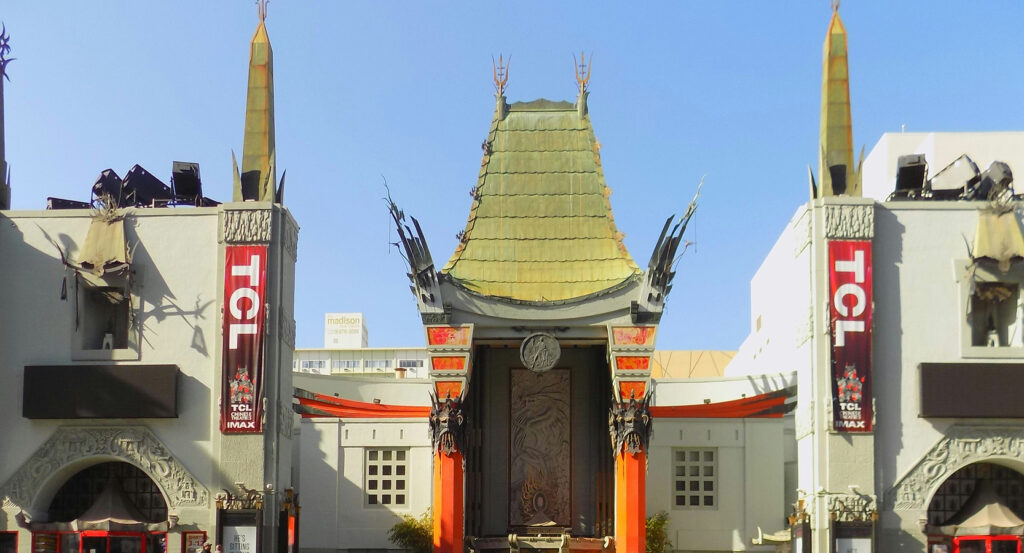
Set along Hollywood Boulevard near Highland Avenue and just steps from the Hollywood Museum, the forecourt occupies the deep open approach between the boulevard and TCL Chinese Theatre's principal entrance. Red columns, flanking fountains and the theatre's towering pagoda composition enclose a paved courtyard whose concrete slabs spread outward beneath the architecture rather than occupying an ordinary sidewalk strip. Celebrity impressions turn the ground plane into the principal point of encounter, with names, dates, handwritten dedications and physical imprints requiring close inspection across individual slabs. Unconventional additions include Betty Grable's legs, Jimmy Durante's nose and the wands used by Daniel Radcliffe, Emma Watson and Rupert Grint, expanding Sid Grauman's original hand-and-foot format through objects and body impressions tied directly to individual performers. The result is a physically intimate archive of Hollywood performance history whose concrete surface carries personal marks across successive generations directly before one of the city's great surviving movie palaces.
What defines Forecourt of the Stars.
Forecourt of the Stars is best known for a tradition born during construction of Grauman's Chinese Theatre in 1927, when actress Norma Talmadge stepped into wet concrete and gave impresario Sid Grauman the idea of preserving movie stars' impressions before his new theatre. Mary Pickford and Douglas Fairbanks made the earliest formal hand-and-foot impressions in April 1927, followed by Talmadge in connection with the theatre's opening the following month. Grauman had conceived the Chinese Theatre after his earlier Million Dollar and Egyptian theatres, working with developer Charles E. Toberman and architect Raymond M. Kennedy of Meyer & Holler on a $2 million Exotic Revival movie palace. Pickford, Fairbanks and Howard Schenck joined Grauman financially, embedding major figures from silent-era Hollywood within the project before its doors opened. Jean Klossner developed the specialized concrete used for the forecourt and subsequently supervised impression ceremonies for three decades, earning the sobriquet “Mr. Footprint.”  Cecil B. DeMille's The King of Kings inaugurated the theatre on May 18, 1927, drawing thousands to Hollywood Boulevard and placing the new courtyard directly within the performance surrounding a major motion-picture premiere. The impression tradition continued alongside that premiere culture as the Chinese Theatre became one of Hollywood's central sites for film openings, Academy Awards ceremonies and public appearances. Los Angeles designated the theatre Historic-Cultural Monument No. 55 in 1968, protecting a complex in which the forecourt had become inseparable from the architecture and public history of the building.
Individual slabs developed into miniature portraits as performers modified Grauman's original formula with personal inscriptions and objects associated with their screen personas. Gloria Swanson drew a heart pierced by an arrow beside a dedication to Grauman in 1927, and later inscriptions by Mickey Rooney, Gary Cooper and Humphrey Bogart addressed “Sid” directly, preserving the personal relationship between honoree and impresario within the concrete. Sonja Henie pressed skate blades into her slab, director Raoul Walsh made a fist, and Marilyn Monroe placed an earring into the concrete during her 1953 ceremony with Jane Russell for Gentlemen Prefer Blondes. Harold Lloyd contributed his eyeglasses, Groucho Marx his cigar and John Barrymore the profile of his face, allowing objects and physical characteristics to stand beside conventional impressions. The Star Wars tradition extended the practice into screen characters through marks associated with R2-D2, C-3PO and Darth Vader, demonstrating how the forecourt gradually admitted cinematic personae alongside actors and filmmakers. Space limitations eventually required some stones to rotate into storage or leave temporarily for repair, turning the visible courtyard into a changing selection from a collection larger than the available ground surface. Ceremonies remain active in the twenty-first century, preserving Grauman's simple 1927 idea as a continuing form of film-industry recognition rather than a closed collection from Hollywood's studio era.
How Forecourt of the Stars fits.
Forecourt of the Stars works as the anchor for a Hollywood outing connecting the birth of premiere performance, the social infrastructure surrounding the early film industry and the technical craft that shaped faces for the screen.
Begin at Egyptian Theatre, where Sid Grauman and Charles E. Toberman opened an Egyptian Revival movie palace in 1922 and staged the premiere of Douglas Fairbanks's Robin Hood on October 18, an event credited as Hollywood's first major movie premiere. The venue subsequently received Cecil B. DeMille's The Ten Commandments in 1923, Charlie Chaplin's The Gold Rush in 1925 and Don Juan with John Barrymore and Mary Astor in 1926. American Cinematheque acquired the building in 1996 and reopened it in 1998; Netflix acquired it in 2020 and financed a 2021-2023 restoration that returned key architectural elements toward their 1922 appearance before its November 2023 reopening. Continue to The Hollywood Roosevelt, opened in May 1927 through financing associated with Douglas Fairbanks, Mary Pickford, Louis B. Mayer, Sid Grauman and Marcus Loew. The twelve-story Spanish Colonial Revival hotel quickly became a social center for the film business, then entered Academy history on May 16, 1929 when 270 attendees gathered in its Blossom Room for the first Academy Awards, hosted by Fairbanks. Marilyn Monroe later lived there, and David Hockney painted the bottom of its swimming pool, adding later artistic chapters to a property created by figures closely tied to Hollywood's silent-era expansion. Conclude at The Hollywood Museum, housed inside Max Factor's former cosmetics headquarters in the building he purchased in 1928 and opened in 1935. Architect S. Charles Lee designed the Hollywood Regency Art Deco structure for Factor, whose career had carried him from work connected with the court of Czar Nicholas II through immigration to the United States and the creation of a cosmetics enterprise closely linked with motion pictures. Restored makeup rooms preserve Factor's specialized spaces for blondes, brunettes, brownettes and redheads, with the building connecting film history to the technical manipulation of hair, complexion and screen appearance. The Hollywood Museum acquired the property in 1994, spent nine years restoring it and opened there in 2003. The progression moves from Grauman's invention of the Hollywood premiere through the Roosevelt's role in the film community and culminates in Factor's specialized screen-cosmetics headquarters, joining three institutions that shaped how Hollywood presented films, celebrated its industry and constructed the appearance of its stars.
Where your story begins.
Foresyte Travel reveals places that feel extraordinary long before you arrive.
Enjoy editorial crafted for luxury travelers.
Foresyte may earn a commission when you book.





































































































