
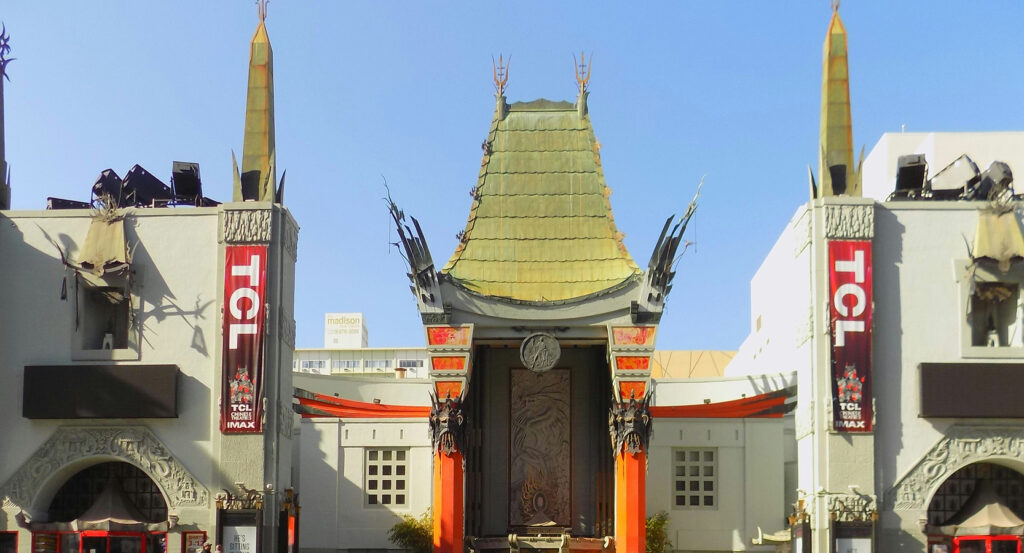
Why TCL Chinese Theatre matters.
TCL Chinese Theatre is an ornate movie palace where Hollywood's cinematic character meets fantasy architecture, premiere culture and a century of film history embedded directly into Hollywood Boulevard.
Set along Hollywood Boulevard near Orange Drive and just steps from the Hollywood Roosevelt, the movie palace occupies a deep setback from the boulevard where a broad forecourt creates a ceremonial transition between the commercial street and the towering entrance beyond. Curving walls, copper-topped turrets, temple-inspired ornament and an immense central roof mass give the exterior a theatrical scale, with retail wings enclosing the approach and drawing attention toward the recessed doors. Crossing the forecourt carries the encounter through a dense field of celebrity impressions before the architecture rises sharply ahead, turning the approach itself into an extended prelude to the auditorium. Interior passages intensify the decorative treatment through carved surfaces, painted ornament, elaborate lighting and richly modeled architectural details before the enormous screening room replaces the compressed entrance sequence with a single sweeping volume. The result is a movie palace whose ceremonial approach, architectural fantasy and direct physical connection with generations of performers turn film exhibition into a distinctly Hollywood form of public performance.
What defines TCL Chinese Theatre.
TCL Chinese Theatre is best known for Sid Grauman's 1927 movie palace and its Forecourt of the Stars, where impressions made by generations of performers transformed wet concrete into one of Hollywood's enduring rituals. Grauman developed the project with real-estate entrepreneur Charles E. Toberman after their Egyptian Theatre had helped shift premiere culture toward Hollywood Boulevard, and the architectural firm Meyer & Holler designed and constructed the new building with Raymond M. Kennedy serving as principal designer. Kennedy conceived an Exotic Revival interpretation of a Chinese temple, and the finished composition incorporated imported architectural elements alongside grand guardian figures, stone Heaven Dogs and a roofline dominated by a pagoda-like mass. Construction cost $2 million, an immense investment for the period, and Grauman reinforced the building's theatricality through a 2,200-seat auditorium equipped for elaborate live prologues as well as motion pictures. Mary Pickford and Douglas Fairbanks became investors, binding two of silent cinema's most powerful stars financially to a theater conceived as a showcase for the industry surrounding them. Grauman inaugurated the building on May 18, 1927 with Cecil B. DeMille's The King of Kings, preceded by his live production Glories of the Scriptures with a 65-piece orchestra and Wurlitzer organ. Thousands crowded Hollywood Boulevard for the opening before regular public screenings began the following day. Los Angeles designated the building Historic-Cultural Monument 55 in 1968, and the Hollywood Boulevard Commercial and Entertainment District later entered the National Register of Historic Places with the theater recognized as one of its principal examples of 1920s fantasy architecture.
The celebrity-imprint tradition developed alongside the theater itself, turning the entrance court into an archive created through direct participation by film personalities. Norma Talmadge became associated with the custom's origin after stepping into wet concrete during construction, although surviving histories differ over whether that incident directly initiated the formal ceremonies; Grauman soon converted the basic idea into an organized promotional practice. Mary Pickford and Douglas Fairbanks made impressions during 1927, establishing a format in which signatures, hands and shoes became physical counterparts to the performers seen on screen. Later participants expanded the practice beyond conventional prints: John Wayne left a fist, Groucho Marx impressed his cigar, Jimmy Stewart included hoofprints from the horse Pie and Whoopi Goldberg pressed a dreadlock into the cement. Ownership and branding changed around this enduring ritual, with the building becoming Mann's Chinese Theatre in 1973 before its historic Grauman's name returned in 2001. Chinese electronics company TCL entered a 10-year naming-rights agreement in January 2013, supplying the current name as another major technical overhaul began. The auditorium reopened that September after conversion for IMAX, with the floor excavated and seating reorganized into a steeper configuration while preservation specialists protected the historic interior. The resulting 932-seat room paired the surviving movie palace with an enormous curved screen and later laser projection, allowing a theater created for silent-era performance to remain a major first-run cinema and premiere venue deep into the digital era.
How TCL Chinese Theatre fits.
TCL Chinese Theatre works as the anchor for a Hollywood Boulevard sequence tracing how live drama, silent-film performance and the institutional culture of the motion-picture industry created an entertainment district whose surviving buildings still carry distinct chapters of Hollywood history.
Begin at El Capitan Theatre, developed by Charles Toberman with Sid Grauman and opened on May 3, 1926 as Hollywood's largest legitimate theater, with Charlot's Revue bringing Jack Buchanan, Gertrude Lawrence and Beatrice Lillie to its inaugural production. Stiles O. Clements designed the cast-concrete Spanish Colonial Revival exterior, and G. Albert Lansburgh created an East Indian-inspired interior for a 1,550-seat house devoted initially to spoken drama. Financial pressures during the Depression pushed the building toward film, and Orson Welles's Citizen Kane received its world premiere there in 1941 after other Hollywood venues declined the engagement. Disney and Pacific Theatres later undertook an extensive restoration before the building reopened in 1991 with The Rocketeer, returning a former dramatic stage to prominence as a specialized movie palace. Continue to Egyptian Theatre, where Grauman and Toberman opened an Egyptian Revival cinema on October 18, 1922 with Douglas Fairbanks in Robin Hood, staging the event as Hollywood's first major red-carpet film premiere. The building's long forecourt placed the auditorium 150 feet behind Hollywood Boulevard, creating a processional approach suited to elaborate publicity and helping establish an architectural model Grauman subsequently developed elsewhere. The American Cinematheque acquired the closed theater from Los Angeles in 1996 and reopened it after rehabilitation in 1998; Netflix joined the institution in 2020, financed another restoration and reopened the building in November 2023 with David Fincher's The Killer. Conclude at Hollywood Roosevelt, the 12-story hotel C.E. Toberman opened in May 1927 with financial backing that included Douglas Fairbanks, Mary Pickford and Louis B. Mayer. Its Blossom Ballroom became the site of the first Academy Awards on May 16, 1929, when 270 attendees paid $5 for a banquet and Douglas Fairbanks presided over a ceremony lasting 15 minutes. The Academy of Motion Picture Arts and Sciences maintained offices on the hotel mezzanine, tightening the relationship between the building and the emerging awards institution, and David Hockney later painted the floor of its Tropicana Pool during the 1980s. The progression moves from a purpose-built dramatic stage through Grauman's early experiment in premiere performance into the hotel where the Academy Awards began, connecting three surviving buildings with the theatrical, promotional and institutional forces that made Hollywood Boulevard an international center of screen culture.
Where your story begins.
Foresyte Travel reveals places that feel extraordinary long before you arrive.
Enjoy editorial crafted for luxury travelers.
Foresyte may earn a commission when you book.





































































































