
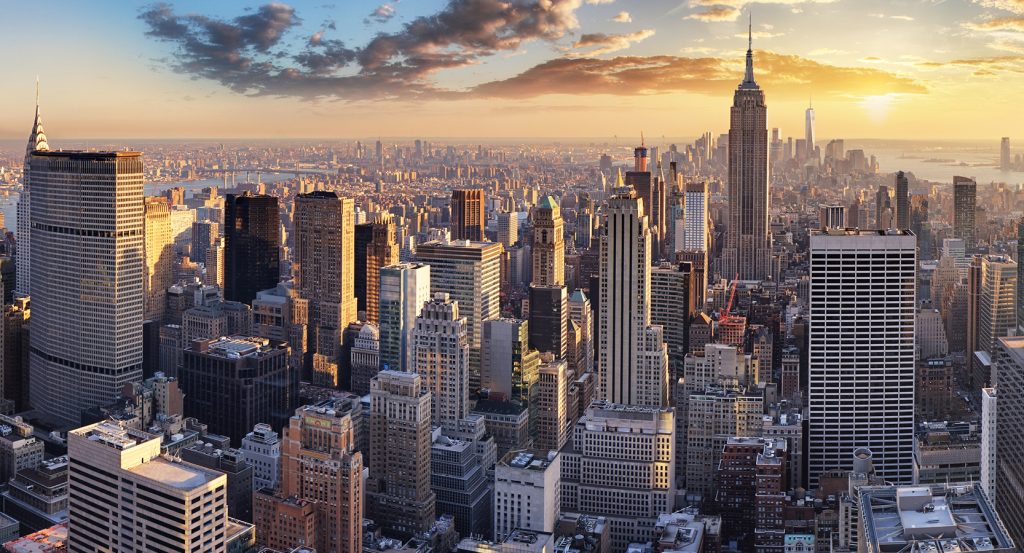
Why Herald Square matters.
Herald Square is a compact urban square where Midtown's retail intensity meets newspaper history, expansive sculpture and one of Manhattan's busiest pedestrian crossroads.
Set where Broadway crosses 6th Avenue between West 34th and West 35th Streets and just steps from the Martinique New York on Broadway, the triangular park occupies the northern half of the bow-tie formed with Greeley Square to the south. Wrought-iron fencing, dense seasonal planting, mature trees and movable furnishings shape a surprisingly defined green enclosure within the surrounding canyon of large commercial buildings. The square opens westward into a Broadway pedestrian plaza created when vehicle traffic was removed from this stretch in 2009, more than doubling the passive public area surrounding the two triangular parks. Planting beds and shade trees tighten the interior around the Bennett Clock, with Broadway's broad paved zone providing a contrasting extension toward the adjoining retail blocks. The result is a small but strongly articulated public space whose triangular geometry, planted interior, pedestrianized Broadway edge and expansive clock organize an exceptionally compressed piece of Midtown.
What defines Herald Square.
Herald Square is best known for taking its name from the New York Herald, the newspaper founded by James Gordon Bennett Sr. in 1835 and later developed by his son James Gordon Bennett Jr. The newspaper moved uptown from Printing House Square during the 1890s, occupying a new headquarters on West 35th Street overlooking the square. McKim, Mead & White designed the two-story Italianate Herald Building, with Stanford White drawing architectural inspiration from the Palazzo del Consiglio in Verona and Bennett's fascination with owls carried throughout its decorative program. French sculptor Antonin Jean Carlès created the bronze Minerva and Bell Ringers ensemble installed above the cornice, where two workers nicknamed Stuff and Guff appeared to strike the great bell beneath Minerva as the clock marked the hours. Bronze owls accompanied the ensemble, with illuminated green eyes extending Bennett's personal emblem across the building. The figures occupied the newspaper headquarters from 1895 until 1921, when the statuary was removed before the Herald Building disappeared. William T. Dewart, publisher of the New York Sun, gave the bronzes to New York University in 1928, and the university subsequently placed them in the care of the city's Parks Department. The surviving group returned to Herald Square within a 40-foot memorial unveiled in November 1940, preserving a physical fragment of the newspaper building after the architecture itself had vanished.
A separate chapter began with the deterioration of the surrounding district during the later twentieth century and the creation of the 34th Street Partnership. Formation of the organization began in 1989 at Mayor Ed Koch's request, and the Partnership formally started operating in 1992 as one of New York's early business improvement districts. Its initial $6 million annual program covered sanitation, security, social services, public events and debt service connected with a $25 million capital-improvement bond spanning the wider district. Herald and Greeley Squares became a central physical undertaking, with the Partnership eventually investing millions of dollars in capital work across the two parks. A reconstruction completed in 1999 replaced their deteriorated late-century condition with landscaped public spaces, and Herald Square reopened after a further $1 million restoration in 2000 that repaired the Bennett Clock and renewed surrounding elements. The monument required another substantial conservation campaign two decades later after pollution, water infiltration, winter freeze-thaw cycles and mechanical deterioration damaged the granite, bronze and bell apparatus. Herald Square carries two distinct eras of Midtown development in the same compact site: the physical remnants of Bennett's newspaper empire and the late twentieth-century reconstruction that restored the square as a functioning public park.
How Herald Square fits.
Herald Square works as the anchor for a Midtown outing connecting department-store expansion, skyscraper engineering and one of America's great private collections transformed into a public institution.
Begin at Macy's Herald Square, whose predecessor R. H. Macy & Co. began in 1858 when Rowland Hussey Macy opened a dry-goods store in New York and generated $11.06 in sales on its first day. The Straus family entered a general partnership with Macy's in 1888, and the company moved to Herald Square in 1902, establishing the retail anchor that would reshape the surrounding district. The first portion of the present Broadway building opened that year, then expanded through three further phases before reaching its mature form in 1931; a 1924 expansion had already carried the store westward from Broadway to 7th Avenue along 34th Street. The resulting complex contains 2.2 million gross square feet, preserving more than a century of department-store growth within a single connected property. Continue to Empire State Building, developed after the former Waldorf Astoria site was sold in 1928 and an investment group led by John Jakob Raskob formed Empire State, Inc. the following year with former New York governor Alfred E. Smith heading the corporation. Shreve, Lamb & Harmon Associates designed the 102-story skyscraper, and Starrett Bros. amp; Eken drove construction from March 17, 1930 to May 1, 1931. Crews advanced at 4.5 stories per week, completing the building in one year and 45 days during one of the most compressed major skyscraper construction campaigns in architectural history. Conclude at The Morgan Library & Museum, where financier Pierpont Morgan began assembling illuminated manuscripts, literary and historical manuscripts, early printed books, drawings and prints during the late nineteenth century. By 1900 the collection had grown sufficiently for Morgan to plan a dedicated library beside his Madison Avenue residence, and he selected Charles Follen McKim of McKim, Mead & White to design it. McKim completed the Italian Renaissance-inspired marble building in 1906; Morgan's son Jack converted the library into a public institution in 1924, Benjamin Wistar Morris added an Annex completed in 1928 and Renzo Piano later united the expanding campus through steel-and-glass pavilions unveiled in 2006. The progression moves from Macy's century of department-store expansion through the extraordinary construction campaign behind Shreve, Lamb & Harmon's skyscraper and culminates in Morgan and McKim's private library becoming a major public collection, tracing three powerful forms of commercial, architectural and cultural institution-building around Midtown.
Where your story begins.
Foresyte Travel reveals places that feel extraordinary long before you arrive.
Enjoy editorial crafted for luxury travelers.
Foresyte may earn a commission when you book.







































































































